
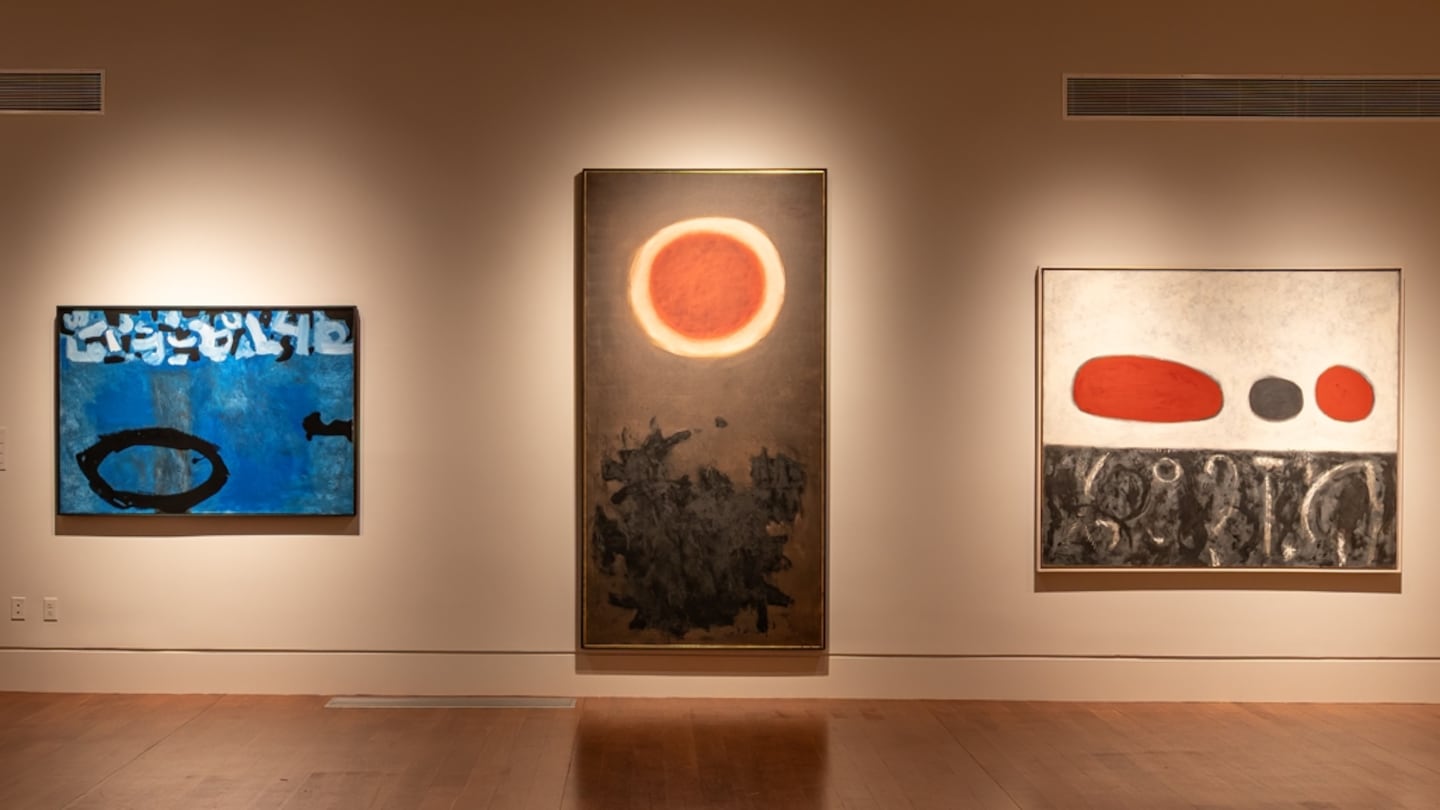
 Late works by Adolph Gottlieb at “Avery, Gottlieb & Rothko: By the Sea,” at the Cape Ann Museum.Steve Rosenthal/Cape Ann Museum
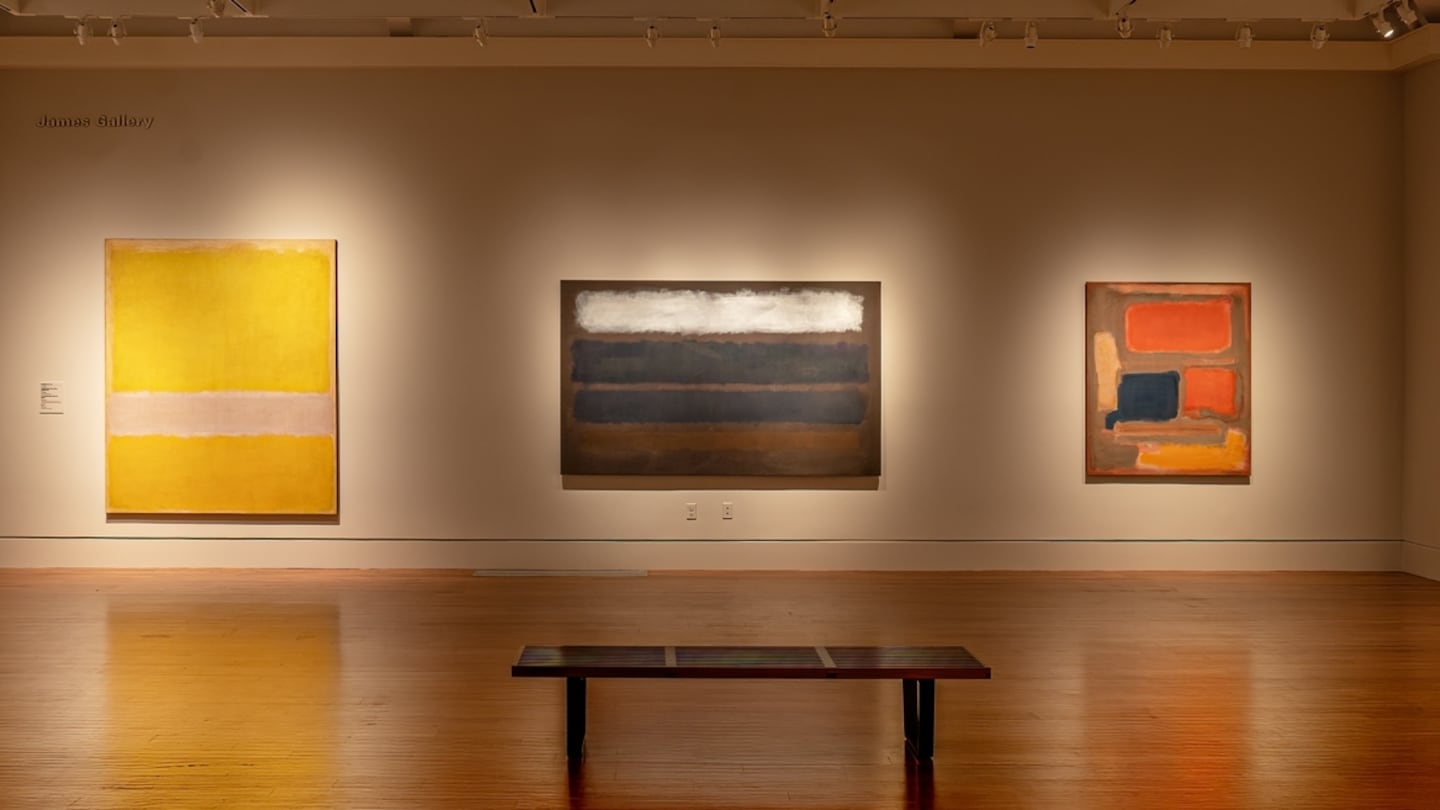
If you want to start with a bang, this is tough to beat. Curator Eliza Rathbone, formerly of the National Gallery of Art and the Phillips Collection and now a full-time Gloucesterite, delivers the necessary fireworks right up front. One expansive gallery here is a smoldering realm of painterly wonder: One wall is given to three mature Rothko paintings, uncanny in their inscrutable splendor; another, to Gottlieb at his peak, with his jagged primal forms swiped urgently on the canvas; and another, to Avery, the elder, brushing aside the abstract urges of his young charges with an impish tease.
I feel confident saying it’s one of the best rooms you’ll see in an American museum this summer, but more on that in a bit. This is the destination, the trio fully formed; the journey, meanwhile, awaits. In the entry hall, Rathbone grounds her subjects in the abiding friendship that underpinned their artistic communion: Avery’s warmhearted portrait of Rothko smoking his pipe, Gottlieb’s sketch of Avery at his easel.
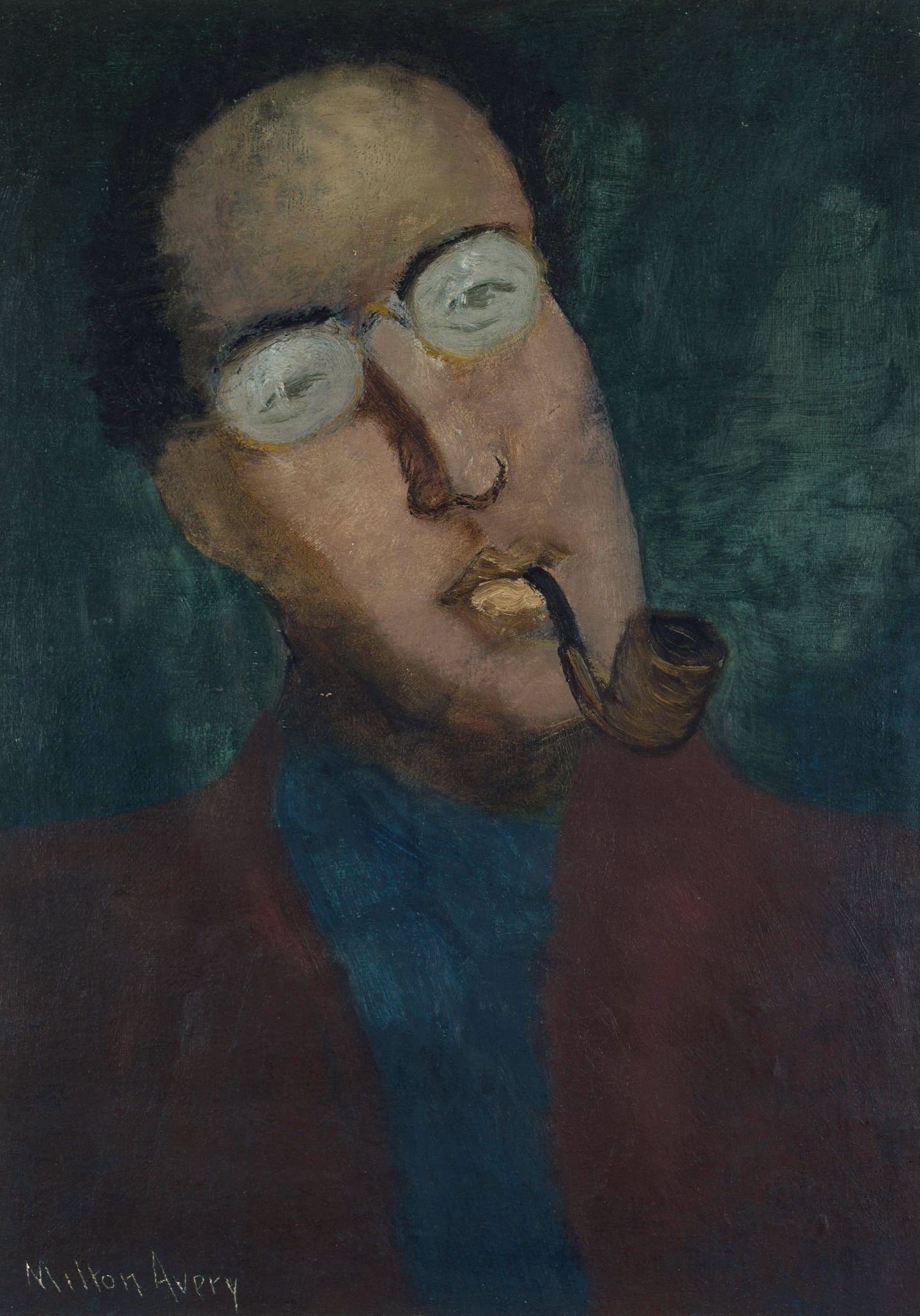 Milton Avery, “Portrait of Mark Rothko,” 1933. Rhode Island School of Design Museum, Providence. Milton Avery Trust/Artists Rights Society
It sets the scene with genuine affection and an appreciation for their precious shared moments. A 1957 Avery painting of stubby gulls keening over the marshy beaches of the North Shore hints at the seaside idyll; Rothko’s loving watercolors of a woman nuzzling the small child folded into her lap tips to familial bliss, and maybe something more: The softness of form, the seepage of paint, signals of the catalytic era yet to come.
To be fair, hindsight is a pretty easy read. These little Rothkos, painted in the early 1930s right here in Gloucester, speak less to clairvoyance and more to the artist’s adoration of Modern masters Henri Matisse and Paul Cezanne, who he aped but couldn’t quite emulate (Rothko, by his own admission, struggled with the fiddlier parts of figure painting, like hands and faces).
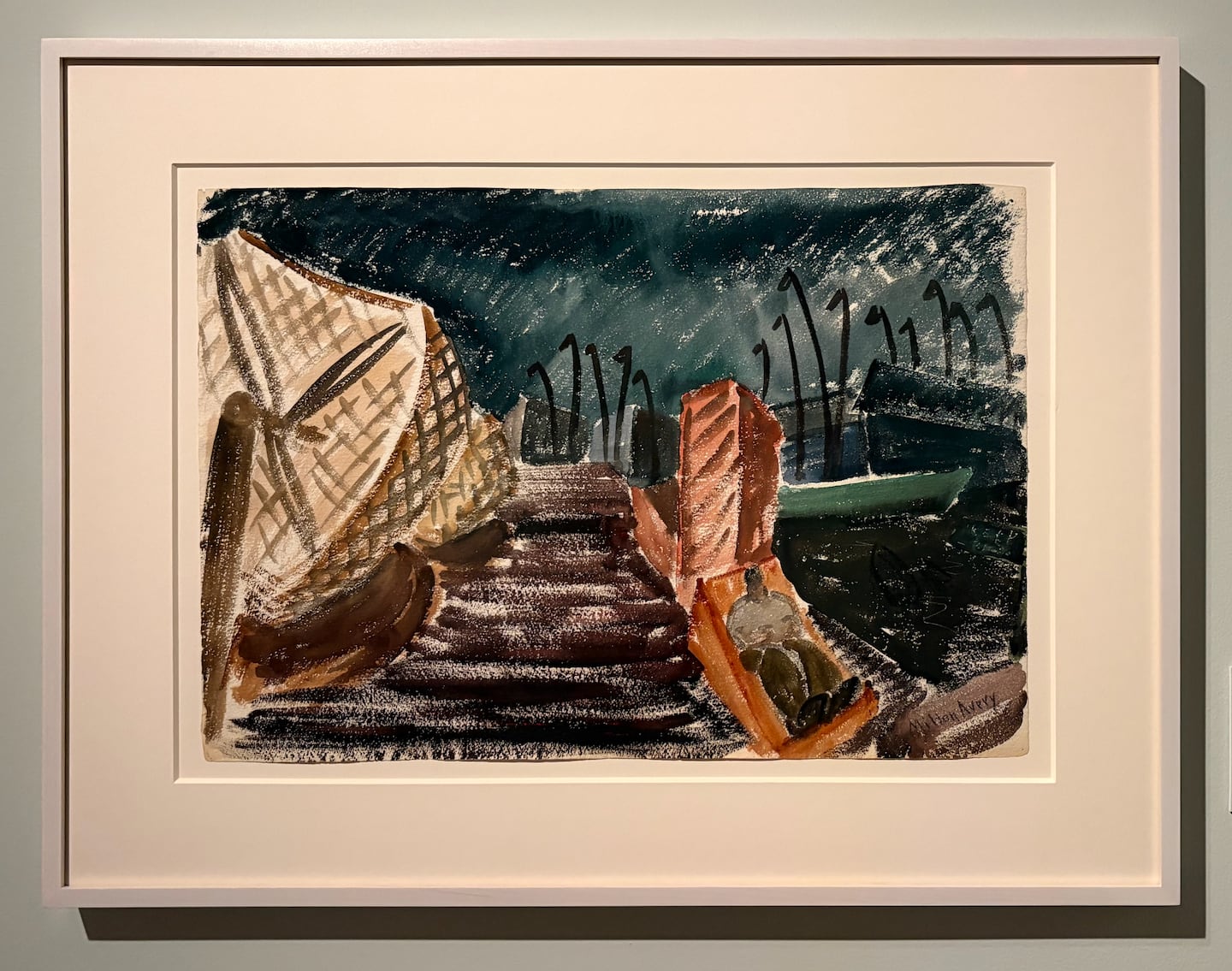 Milton Avery, “Untitled (Man & Nets),” no date. Installation view, “Avery, Gottlieb & Rothko: By the Sea,” at the Cape Ann Museum.Murray Whyte/Globe Staffx
But nothing comes from nothing, and this show is here to make that much plain. Cross the hallway from the cathedral-like setting of the trio at their peak, and you’ll find a stroll through the artists’ formative years. Avery takes the starring role here; he was the Gloucester devotee who lured his young charges north from New York, where they’d met at the Art Students League.
Avery was a misfit in a great many ways, all of them finally adding up in recent years to one of the most important and unique careers in American art. For him, Gloucester had lineage: From Luminist forefather Fitz Henry Lane to Winslow Homer to John Sloane, Stuart Davis, and Marsden Hartley, its rocky shores and unearthly northern light had inspired generations of artists.
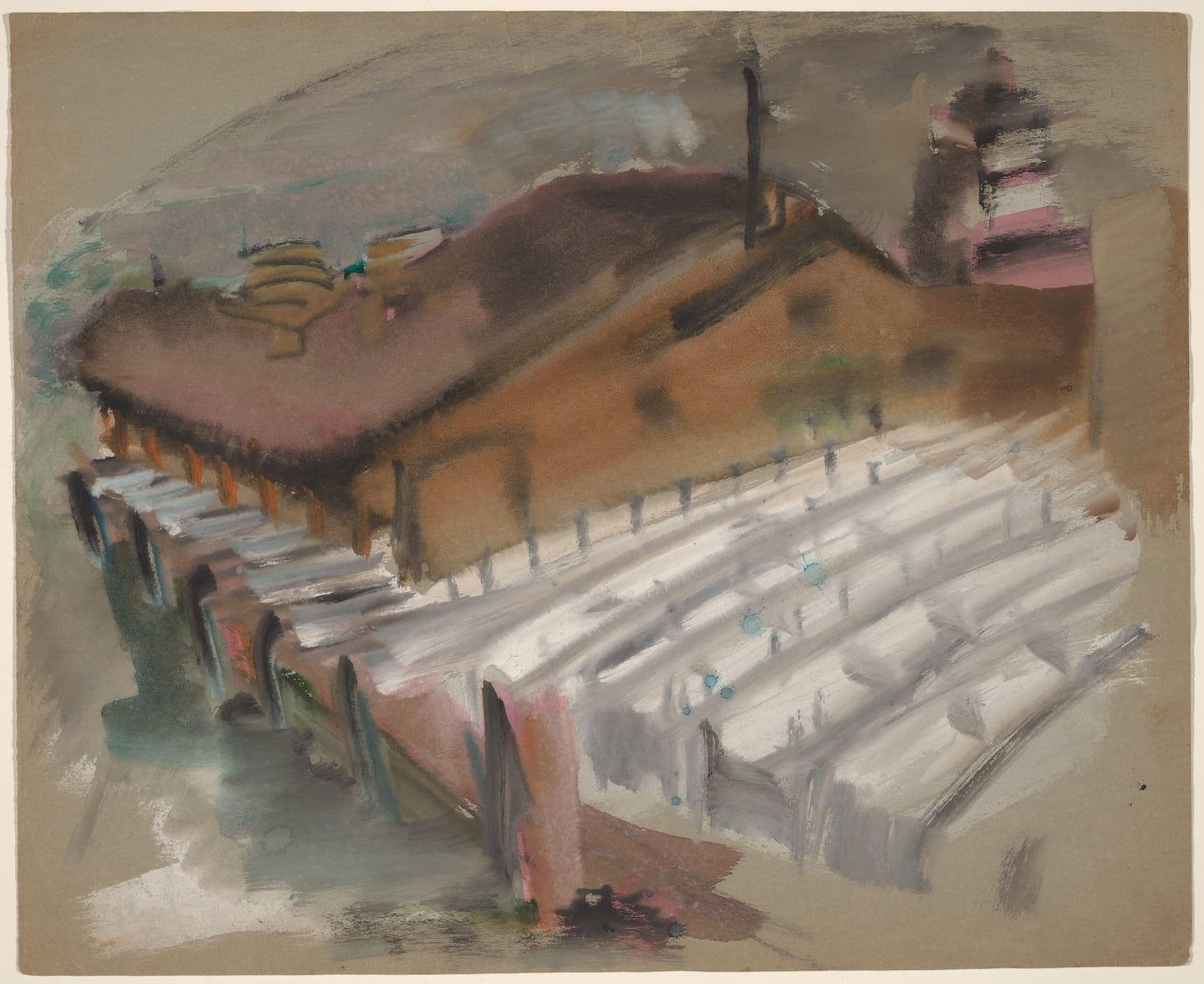 Mark Rothko, “Untitled (wharf, Gloucester, Massachusetts),” 1934. National Gallery of Art, Washington, D.C.Kate Rothko Prizel & Christopher Rothko/Artists Rights Society
His little paintings of boats and harbors are a marvel, a clever fusion of the blooming Modern sensibility of the time and the local maritime heritage: The shadowy ruptures of “Untitled (Man & Nets),” which has no date, brims with an exuberance for color and form, almost disconnected — but not quite — from the dock and black water it so loosely captures. “Gloucester Dawn,” 1921, swims in a haze of yellow morning heat bouncing off a still sea, and casting the boats in a wavering shimmer; “Gorton’s Dock,” 1931-34, piles up the rough shapes of mast and sail, pier, shack, and hull in a mound of hectic form.
When Avery started spending summers there, artists were everywhere, though fewer of the Modern cast than he favored. He decided to bring his own; he extended the invitation to Gottlieb and Rothko — urbane, serious, intellectually driven — to maybe help them lighten up a little bit. It worked — one of the real pleasures of the show is a snapshot of Rothko on the title wall, lounging in the soft sands of Good Harbor Beach, an unexpected dash of casual repose — but it wasn’t a slackening of pace as much as an invigorating refresh.
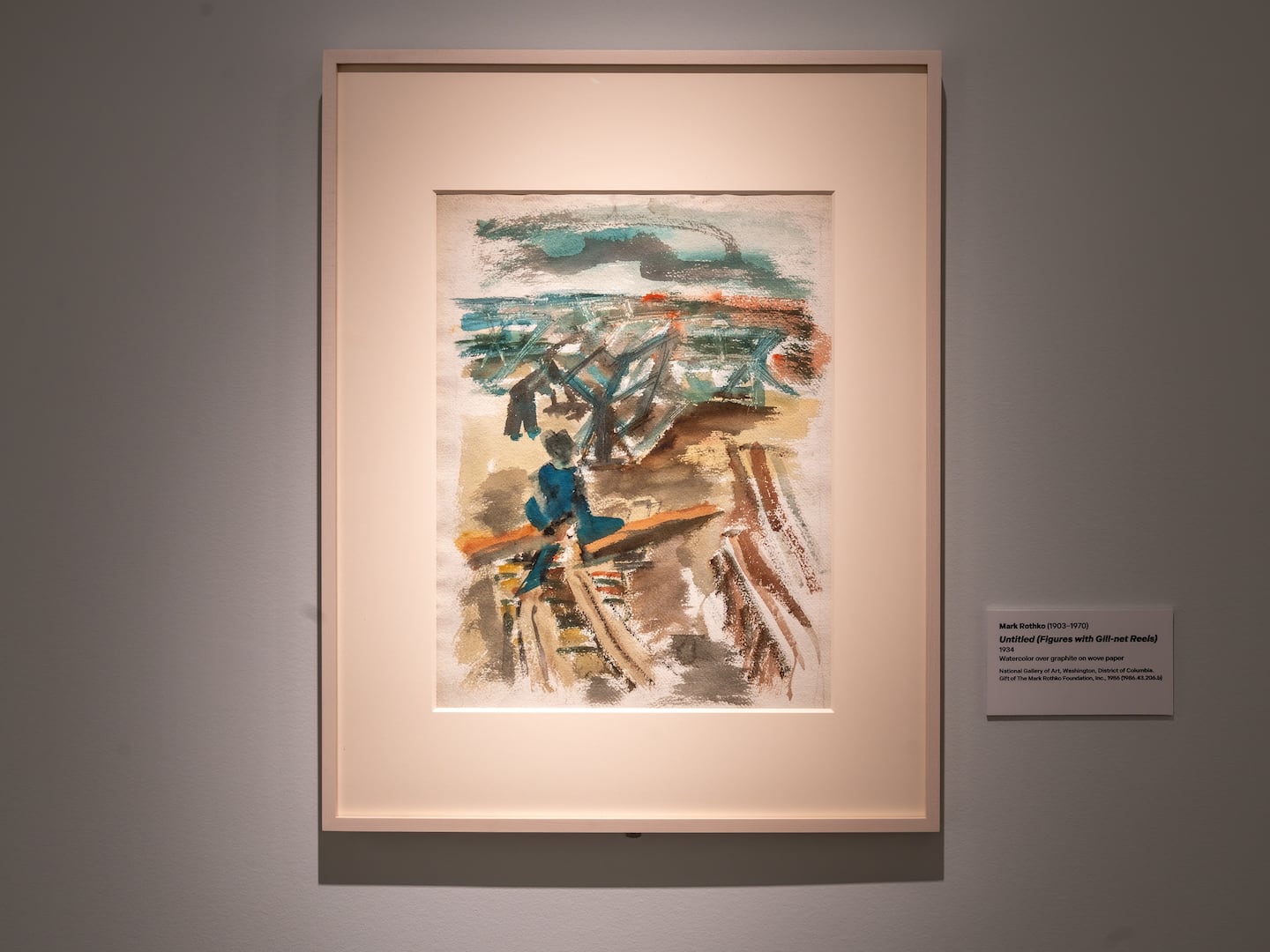 Mark Rothko, “Untitled (Figures with Gill Net Reels),” 1934. Installation view, “Avery, Gottlieb & Rothko: By the Sea,” at the Cape Ann Museum.Steve Rosenthal/Cape Ann Museum
In the harbor, the three come together with diverging interests: Gottlieb’s “Rockport,” 1936, captures his dismay at the Depression and the death of industry it wrought; a denuded landscape in mud-brown, its lonely, vacant shacks are ramshackle and untended. Alongside them both, Rothko was reaching for new ground: An untitled 1934 watercolor of a Gloucester wharf seems to almost dissolve into mist before your eyes — the drying racks for salted fish just a slash of bright white, the wharf house itself being swallowed by fog.
Extract whatever narrative you like from that, but it snaps together with a cannily chosen companion right next to it, another untitled piece from the same year of men tending gill net reels. It pushes that much further: With its angular slashes of color barely assembling into a coherent scene, it teases at an artist on the edge of destiny, looking down and contemplating the plunge.
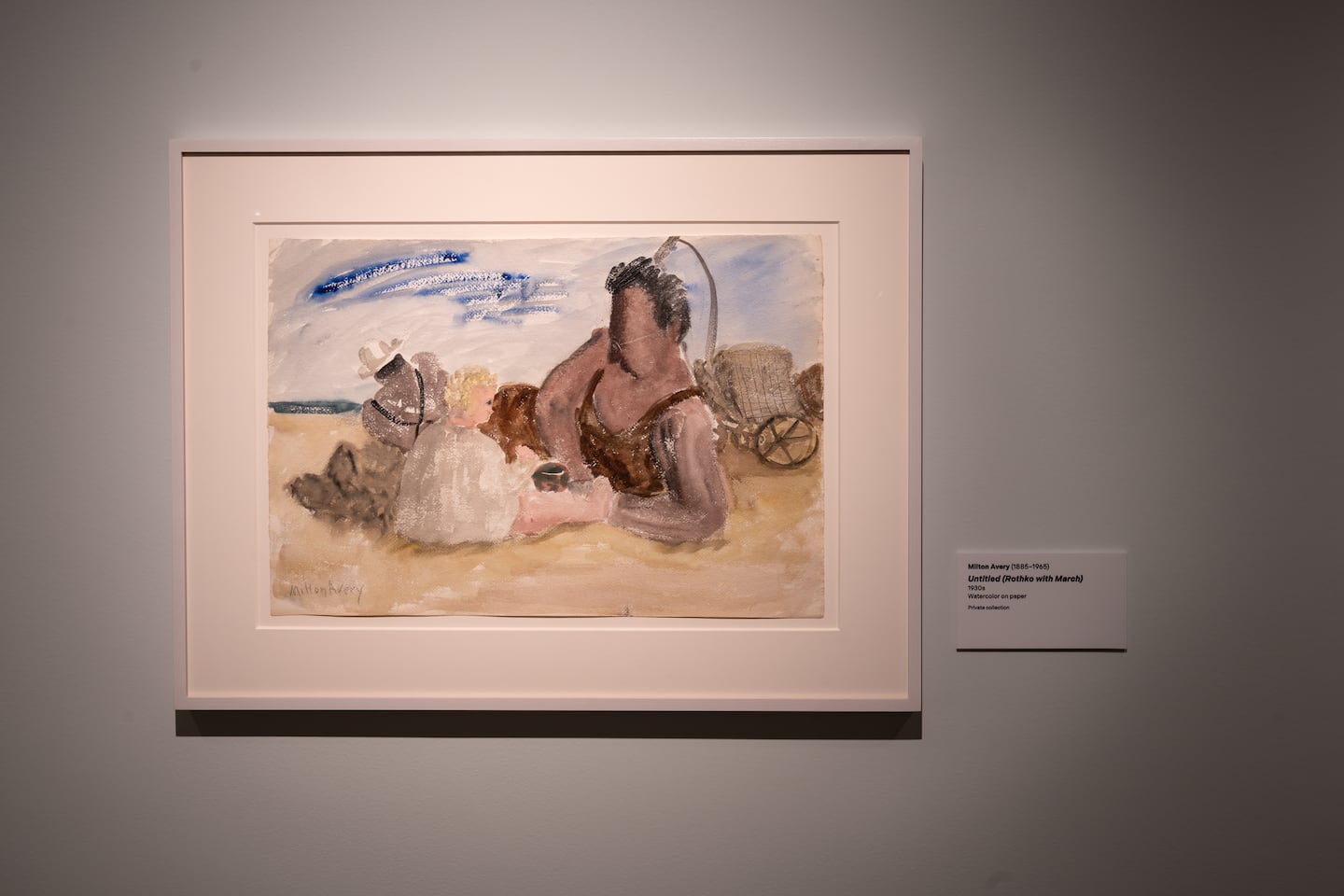 Milton Avery, “Untitled (Rothko with March),” 1930s. Installation view, “Avery, Gottlieb & Rothko: By the Sea,” at the Cape Ann Museum.Steve Rosenthal/Cape Ann Museum
How much did Gloucester inspire the leap? There are hints, and you may draw your own conclusions. What’s clear, though, is how much it provided all three men room to breathe, time to think, and the gift of communion. Away from the steamy cauldron of a New York summer, experiments were looser, freer; leisure was embraced, not scorned. An array of Avery’s beach scenes, loose and immediate, unspool countless carefree hours; one, of a young Rothko resting on a propped elbow in the sand with Avery’s infant daughter March is an absolute treasure. Rothko’s versions of the same surprise and delight: Soft bleeds of figures in repose, hunkered on horizontal bands of sand, sea, and sky that might portend what’s to come.
The show embraces that evolution: It tracks Gottlieb’s interest in Surrealism with a pair of 1930s paintings of found objects — shells, seaweed, molted skin of unknown creatures — arrayed in a box and left on the shore; and then, in the ’40s, his turn to pictograms en route to the pure abstraction to come. Alongside, Rothko abandoned his breathy renderings of beach and wharf for amoeba-like swirls of chaos (remember the gill nets?). Avery, meanwhile, remained moored to the seen and known, as he always would.
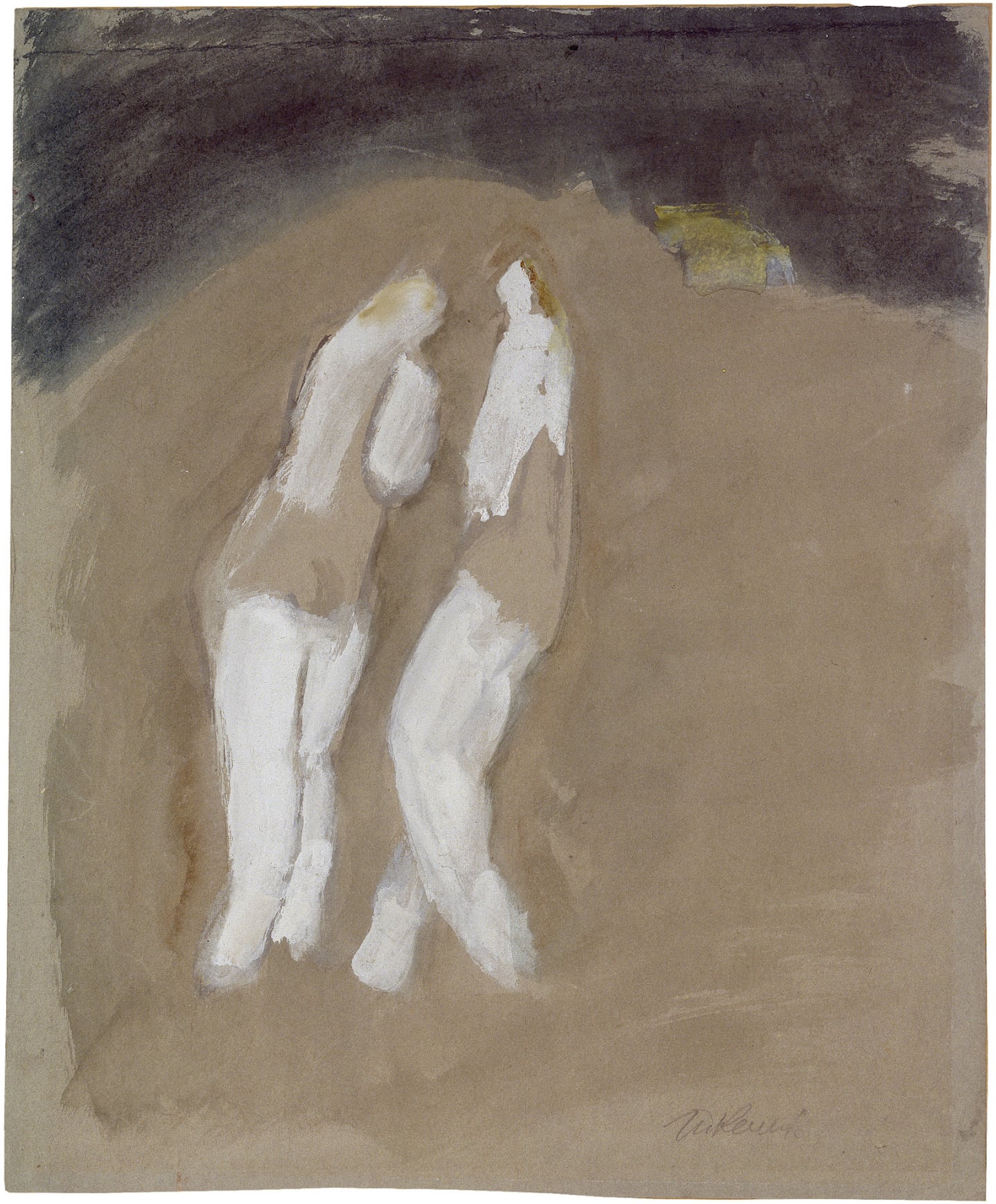 Mark Rothko, “Untitled (bathers on the beach),” 1934. Collection of Christopher Rothko. Kate Rothko Prizel & Christopher Rothko/Artists Rights Society
Which brings us all the way back around, to that near-holy ground of American art at the very beginning. Look again at these great big canvases, purposefully unmoored from the known world as Gottlieb and Rothko, more than anyone else, sought to drive painting into a realm of only color and form, apart from things you could hold and touch.
Avery riding alongside here is not a misfit anomaly. He’s the “but wait:” he watched as his younger friends built an Abstract Expressionist manifesto and pursued it full bore; he scaled up to meet the enormous canvases they began painting, but never followed their path. I see him, in a way, as their conscience: Just because you’ve abandoned the world, he seems to say, doesn’t mean it ceased to exist.
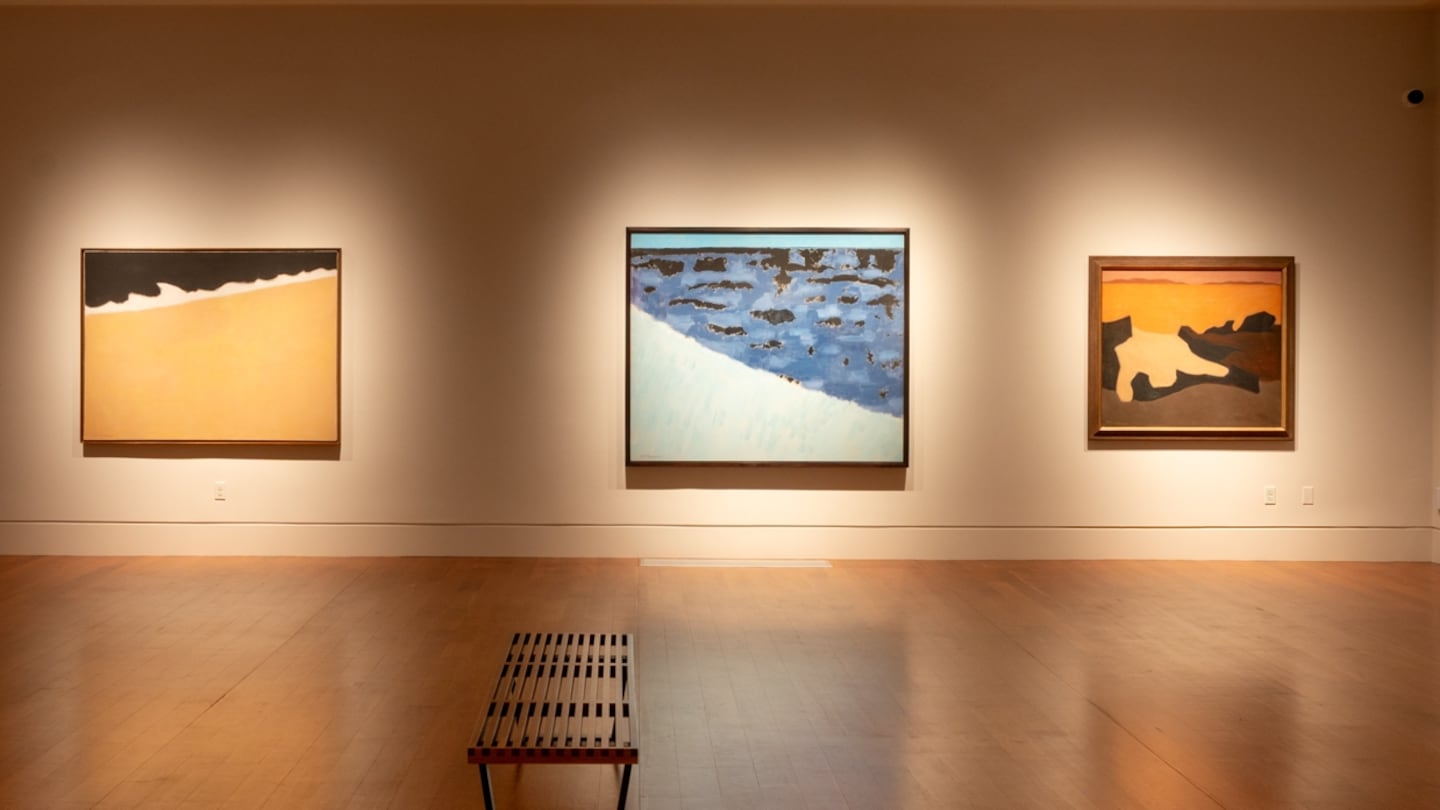 Milton Avery’s late works in the chapel-like room of “Avery, Gottlieb & Rothko: By the Sea,” at the Cape Ann Museum.Steve Rosenthal/Cape Ann Museum
In this glorious room, Avery’s “Black Sea,” 1959, hangs next to a suite of Rothko’s simmering abstractions, but defers to them not at all. A searing swath of sand curves up and to the right of the frame, a froth of white limning the shoreline from the dark water above.
A tease? Maybe. It’s that close. In “Red Sky, Blue Sea,” a little watercolor here, Avery seems to take a poke at Rothko with a composition that is pretty clearly a Rothko take-off; by naming its elements — all just indistinct blocks of color — there’s surely some playful subversion. But Avery was as dead serious in his pursuit as the younger renegades. He stood his ground as the world shifted beneath him — away, by midcentury, from depictions of the real and into the explosive abstraction that would for the first time make America the center of the art world. Avery had given his younger friends all that he could. This much, he would gladly keep forever for himself.
AVERY, GOTTLIEB & ROTHKO: BY THE SEA
At Cape Ann Museum, 27 Pleasant St., Gloucester. Through Sept. 27. 978-283-0455, www.capeannmuseum.org
Murray Whyte can be reached at murray.whyte@globe.com. Follow him @TheMurrayWhyte.