
A startup co-developed by a UCL alumnus has taken part in the sought-after Y Combinator accelerator in San Francisco to develop its AI personal health assistant for people living with chronic illness.
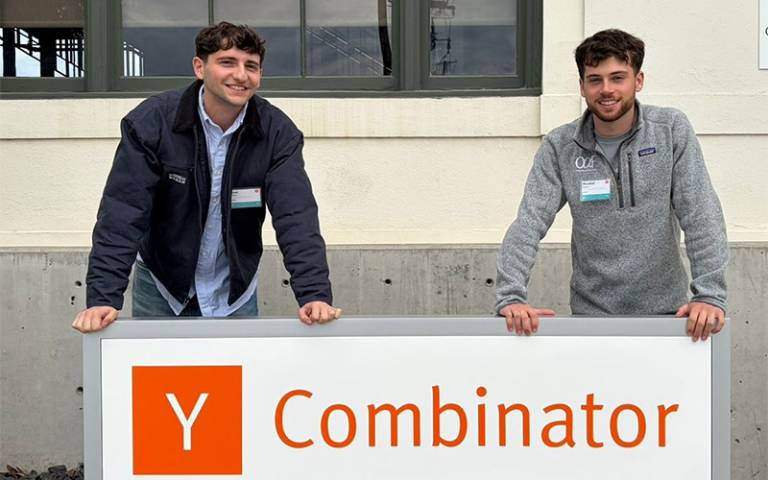
Juno was launched by UCL alumnus Isaac Tolley (MSc Bioscience Innovation and Enterprise) and Marshall Gould (BSc Genetics), after the pair both spent years struggling with chronic health conditions themselves.
A personal AI health assistant for people affected by chronic illnesses such fibromyalgia, long Covid and endometriosis, Juno is designed to help people understand their health better, reduce their symptoms and obtain earlier diagnoses.
Isaac explained: “I grew up with chronic sinusitis, and Marshall lives with chronic fatigue syndrome, and we’d both experienced the pain and struggle of waiting months for appointments, years for answers and having to re-explain your symptoms every time you go to an appointment. So we wanted to build something that would help people both understand their health and have that support while you’re going through it as well.”
The app builds up a detailed understanding of each user’s medical history by uploading their records, daily symptoms and biometrics, and then provides personalised recommendations on how to manage their condition. Juno also tracks information by voice or text, which can then be shared before appointments with doctors, speeding up diagnoses and access to treatment.
Juno has already been downloaded 150,000 times in its first eight months and has received 150,000 five-star reviews on the App Store.
Since being selected to join the Y Combinator (YC) as part of this year’s Spring intake, Isaac and Marshall have been supported to grow their business to the next stage. YC is a world leading business accelerator that has helped to launch the fortunes of companies like Stripe, Airbnb and Reddit. Offering $500,000 for 7% equity to selected companies, the programme included intense mentorship and a demo day in San Francisco to accelerate growth for high potential startups.
Isaac commented: “Joining YC has been an incredible experience. It’s amazing to be part of this place that’s incubated so many successful businesses like AirBnB, Instacart and Coinbase. We’ve had access to this hugely powerful network and direct access to the partners, including many of the people who’ve grown these incredible unicorn businesses themselves. Most of all though, this programme has pushed us to think bigger, to be more ambitious and to move faster than we ever could have on our own.”
Before launching Juno, Isaac and Marshall received entrepreneurial support through UCL’s Venture Builder programme, run by UCL Innovation and Enterprise.
“We took part in Venture Builder during the second term of my master’s to help with growing our previous business, SharedGenes, a social network to connect people with rare and chronic diseases. Although we decided not to move forward with that venture long term, it was still a fantastic experience for us to access support from UCL’s mentors and be surrounded by other inspiring founders. That was the forerunner for us going on to develop Juno, so it was an important stepping stone in propelling us forward in our entrepreneurial journey,” Isaac added.
Isaac also cites his MSc Bioscience, Enterprise and Innovation at UCL as being instrumental in giving him exposure to the world of entrepreneurship.
“Before starting the course, I knew very little about startups, entrepreneurship, venture capital, or anything of that kind. So the master’s at UCL was excellent at providing me with that broad understanding – while also giving us exposure to the latest thinking in areas like digital health and AI,” he said.
Over 93% of UCL Bioscience Innovation and Enterprise MSc alumni are now working in life sciences commercialisation across the science/business interface, building social and economic value from science. 23 students from the course have gone onto found their own companies.
As for Juno and what’s next, Isaac and Marshall are focused on getting their app into the hands of more people who urgently need it.
“We’ve grown about 70% month on month so far, which we’re really proud of, but we want Juno to reach even more people. There are currently one billion people living with chronic health conditions (one in three adults live with one or more chronic conditions*), often with inadequate support.
“What really motivates us is speaking to our users every day and understanding how it’s helped them track their symptoms and patterns, communicate with doctors and advocate for their health far better than they could before. That’s so powerful to hear and amazing to see the impact this is having.
“So that’s our focus now, continuing to grow and share Juno with more people, as well as of course improving it, building partnerships across the space, and ultimately doing all we can to improve health outcomes for people living with chronic conditions.”
Congratulating the team, Professor Geraint Rees, UCL Vice-Provost (Research, Innovation and Global Engagement), said: “Isaac and Marshall have found a simple but powerful way to harness AI technology that’s now benefitting thousands of people struggling with long-term health conditions. They’re a great example of graduates who’ve been able to take the entrepreneurial foundations started at university, and build on that to create a viable and impactful business. We’re thrilled UCL’s entrepreneurial community has played a part in their journey and wish them every success in scaling Juno further.”
*Source: National Library of Medicine: https://pmc.ncbi.nlm.nih.gov/articles/PMC6214883/
Links