
Small, cone-shaped pits occasionally turn up in the fine, dry soil beneath a rock overhang or a roadside shelter. An unsuspecting ant stumbles in, the walls crumble, and something waiting at the bottom drags it down under.
Science has known this type of trap for centuries. But it took nearly fifty years to figure out exactly which creature left those particular pits in the Himalayan foothills of southern Tibet.

Larvae collected there in 1978 had been sitting in entomological collections for 48 years, recognized as something unusual but unnameable. No one had ever caught the adult that made them. A 2025 expedition finally closed that gap.
Not an antlion
The maker turns out to be a type of fly. Its larva, known as a wormlion, scoops a cone-shaped pit and waits at the bottom for an insect to tumble in. Among the world’s flies, only one family builds pitfall traps like this.
These flies of the family Vermileonidae, hit on the same method of entrapment as antlions, despite there being no close kinship. A study shows two branches of life arriving at the same buried trap, independently.
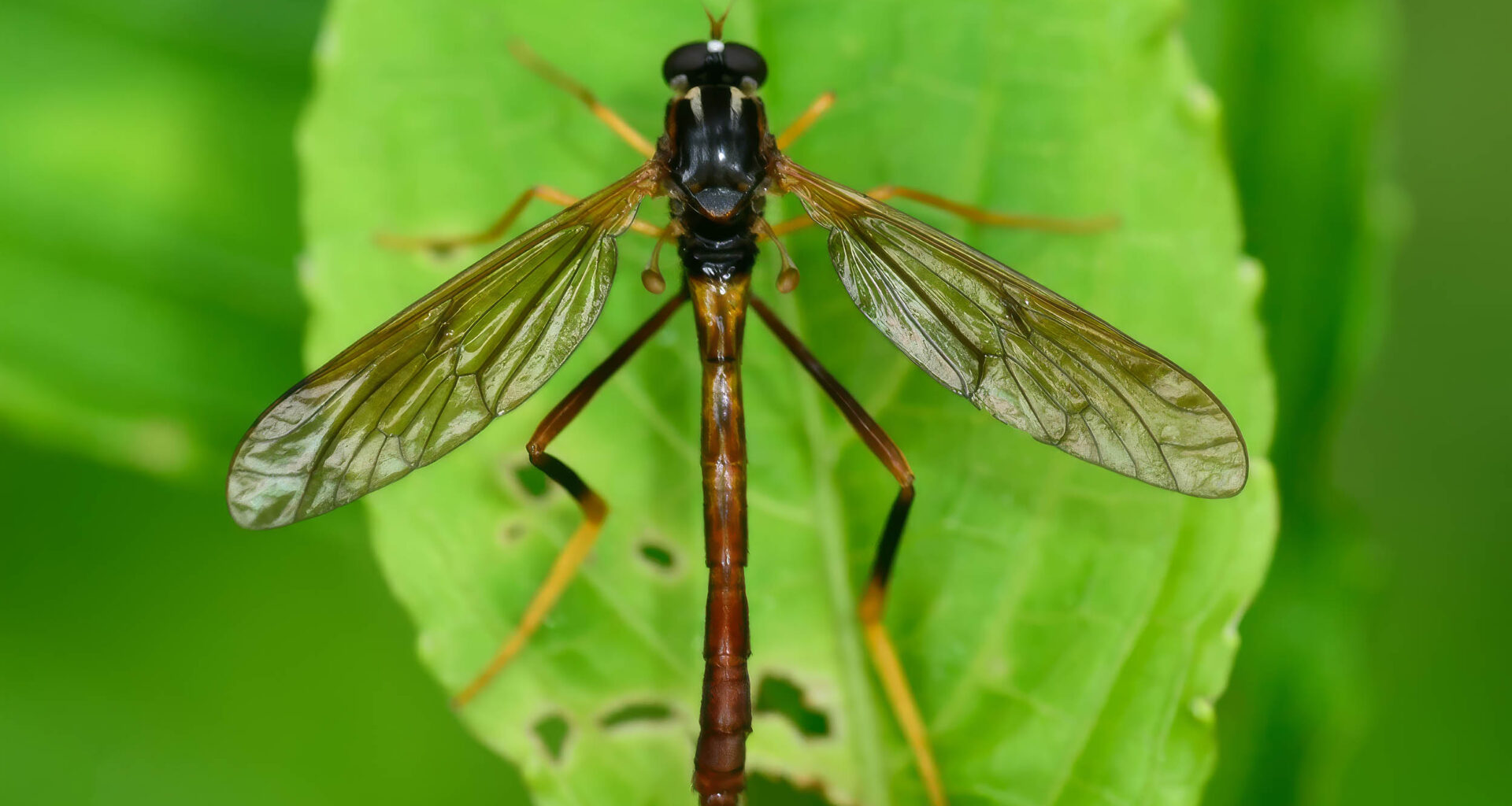
Research on the new species was led at Dali University in southwestern China. Entomologist Ji-Shen Wang and colleague Li-Xia Shan named the species Vermitigris tsangyanggyatso after collecting adults that had slipped past science for decades.
Long wait to identify wormlions
The trail began in 1978, when entomologist Fa-Sheng Li gathered larvae in Yadong, a county in southern Tibet that is pressed against the Himalayan border. The young insects looked distinctive. No adults were collected, though.
Larval features alone were not enough to name a new species. In 1987, two researchers flagged the odd traits but held off, asking for more collections. Then the trail went cold.
Not until a 2025 expedition, guided by those old records, did the team gather every life stage of the flies at once. They matched the long-orphaned wormlion larvae to adults and confirmed what no one had pinned down before.
Big for its kind
Wormlion flies tend to run small. This species does not. Adults reach about three-quarters of an inch (1.9 centimeters), with wings close to two-thirds of an inch (1.7 centimeters) in length. This makes the new species the largest known in its genus.
Larvae grow even bigger than the adults, some past an inch (2.5 centimeters). Each carries a single, fleshy stub ringed with five to seven spines, the trait that tied the Tibetan larvae to this branch.
Color sets it apart too. Its abdomen runs an even yellowish-brown to reddish-brown, without the pale bands or dark stripes that mark its closest relatives. That plain body was a sign that it had gone undescribed.
Wormlion named for a poet
The name Vermitigris tsangyanggyatso honors Tsangyang Gyatso, the sixth Dalai Lama, who lived in the late 1600s. He remains one of Tibet’s most beloved poets, known for verses about love and longing.
Born in 1683, he broke with the strict expectations of his role, writing romantic poetry and living a famously unconventional life before dying young. His name roots the new fly species in its Tibetan home.
The find nudges the tally upward. China now holds two of these species instead of one. The genus climbs from four to five species, and the world’s living wormlion fly count reaches 67 species.
Where the wormlion larvae hide
The larvae need cover to function. Their sand traps wash out in rain, so they tuck into dry, protected pockets. The team found colonies in three kinds of sheltered ground: fine soil under giant boulders, rotting wood beneath a roadside pavilion, and fine river sand piled along a stream. There was a clear preference for the river sand.
Earlier research on related wormlions found the same pull toward shaded, fine-grained sand. Poke one of these larvae and it snaps into a tight curl, a defensive reflex that is shared across the family.
How the larvae build working traps across such different materials – soil, wood debris, loose sand – still escapes the researchers. “We honestly do not know yet,” they said, leaving the puzzle for future behavioral experiments.
No meals as adults
The adults likely never eat. Their mouthparts are stunted, shrunk to little more than a nub, which suggests these flies run entirely on fuel stored during the larval stage, rather than feeding as adults.
Some relatives went the other way, growing long mouthparts to sip nectar from flowers. This species appears to have taken the path of no feeding during adulthood.
Most adults turned up resting on leaves near their old larval grounds. But one male appeared near farm fields with no colony nearby. This hints that these flies travel well beyond where they hatch.
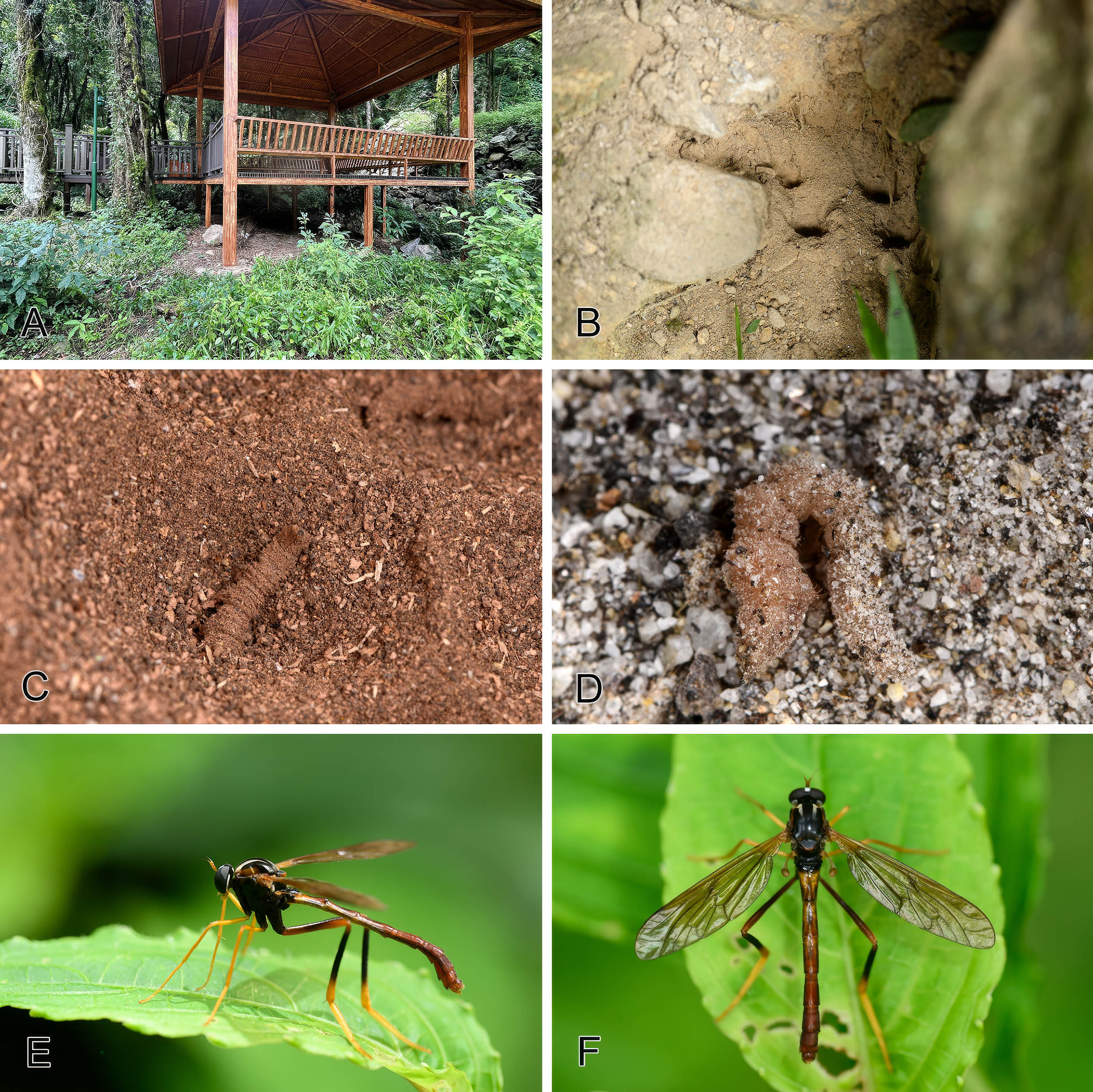 Habitats and habitus of Vermitigris tsangyanggyatso sp. nov. A. A pavilion shades a larval colony; B. Larval colony in fine-grained soil under a giant rock; C. Larva inhabiting wood debris produced by wood-boring insects under a pavilion; D. Larva inhabiting fine-grained river sands accumulated under a giant rock next to a river; E, F. Male resting on a plant leaf. Credit: ZooKeys. Click image to enlarge.Crossing a green barrier
Damp forests usually stop wormlion flies cold. A paper on the family’s history found that wet, wooded habitats tend to block their spread, which is why they’re absent from the Amazon and central Africa.
This genus breaks the pattern. Most of its species live in exactly those rainy forests, sidestepping the problem by sheltering in dry pockets under rocks and roofs where their traps hold.
Finding it high on the Himalayan slopes suggests the range works as a corridor, letting warm-climate insects push into Eurasia. The group was long considered restricted to the tropics, but this discovery hints that it can manage subtropical conditions too.
Still more to find
For nearly half a century, these larvae sat in collections with no adult to match. Now they carry a name, a documented life cycle, and stand as the largest wormlion fly in their genus.
The work also tells biologists where to look next. Collection sites sit just miles from Bhutan, Nepal, and northern India, so the same fly likely waits across those borders, with relatives through southern China and Southeast Asia.
Exactly what adaptations let the larvae engineer reliable traps across such varied ground textures remains an open question – one that the researchers say will need to be answered with future behavioral experiments.
The study is published in ZooKeys.
—–
Like what you read? Subscribe to our newsletter for engaging articles, exclusive content, and the latest updates.
Check us out on EarthSnap, a free app brought to you by Eric Ralls and Earth.com.
—–