

This article first appeared in The Edge Malaysia Weekly on July 6, 2026 – July 12, 2026
THE healthcare sector is entering a new phase of expansion as private hospital operators race to meet rising demand from an ageing population, the growing prevalence of chronic diseases and increasing demand for specialised care.
However, rather than just building new hospitals, KPJ Healthcare Bhd (KL:KPJ), the country’s largest private hospital operator by number of hospitals, is focused on improving its productivity, strengthening its specialist capabilities and maximising the use of its existing assets to generate better returns.
This is the group’s strategy as it embarks on its largest expansion programme to date. It has set aside RM5 billion for capital expenditure (capex) over the next five years (2026-2030), with the investment set to add 2,200 beds to its network of hospitals.
The expansion will increase KPJ’s total bed capacity by more than 50% to about 6,270 beds from 4,070 at the present time. KPJ, which is 44.36% owned by Johor Corp, currently operates 30 hospitals nationwide with a presence in every state except Terengganu and Melaka.
“Before I think about growing from 30 hospitals to 50 or even 100, I want to make sure we have fully optimised what we already own,” president and managing director Chin Keat Chyuan tells The Edge in an interview.
“The RM5 billion [investment] will primarily support brownfield expansion across our existing hospitals, including new clinical towers, additional capacity and specialist facilities. We are also investing in digital health infrastructure, clinical technologies and other strategic initiatives that support the convergence of AI, genomics and value-based care. These investments will strengthen our Centres of Excellence (CoE), improve access to specialised care and support the group’s long-term growth strategy.
“The investment will be deployed in phases, based on project readiness and disciplined capital allocation.”
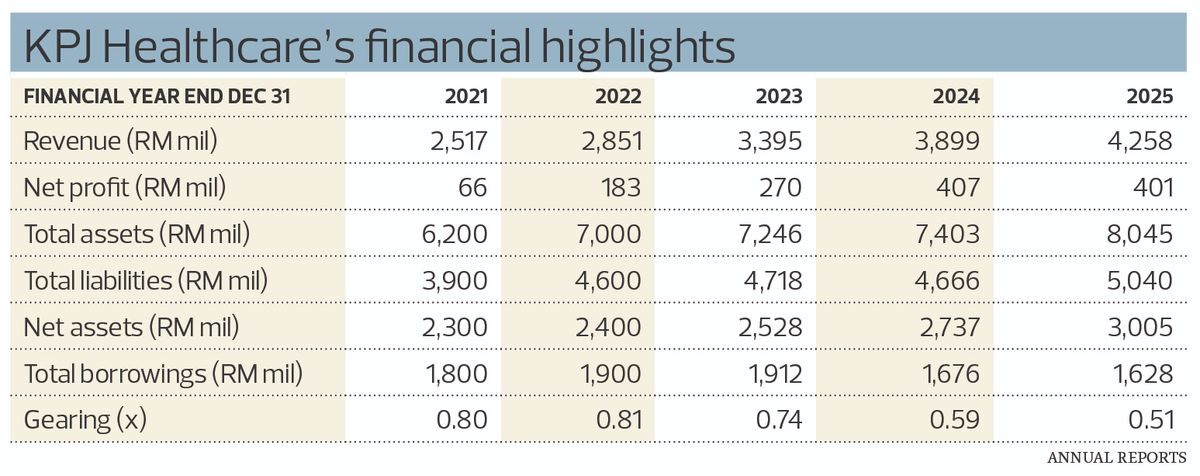
The detailed breakdown of the RM5 billion investment was not disclosed. Nevertheless, it marks a significant step up in spending. According to KPJ’s annual reports, the group invested a cumulative RM1.73 billion in capex between 2021 and 2025, with annual spending more than doubling from RM234.7 million to RM502.4 million over the period. The latest investment commitment is almost three times what KPJ spent over the previous five years.
The RM5 billion is expected to be generated through a combination of bank borrowings and sukuk. As at end-March, KPJ held RM1.1 billion in cash and deposits against RM1.62 billion in total borrowings, leaving it in a net debt position of about RM527 million. Around three-quarters of its borrowings consist of sukuk wakalah issued under a RM3 billion programme established in 2022 to finance expansion and working capital.
Catching up with peers
KPJ’s latest expansion comes less than three years after Chin took the helm in September 2023, after having spent more than two decades with healthcare and pharmaceutical giant Johnson & Johnson. Since then, KPJ has undergone a broad transformation focused on operational efficiency, asset optimisation, cost discipline and brand repositioning.
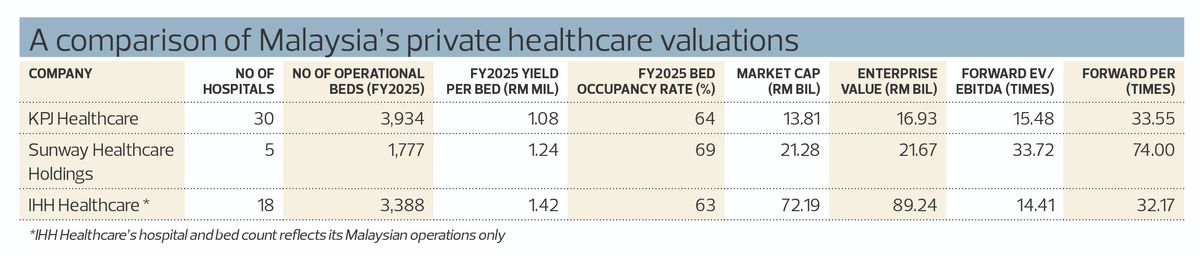
However, more needs to be done, says Chin. According to him, KPJ generated about RM1.08 million in yield per bed in the financial year ended Dec 31, 2025 (FY2025), the lowest sum among its listed peers. He believes the gap can be narrowed. But rather than just matching the competitors, he wants KPJ to raise the bar.
“Memang (yes), in terms of yield, we are lower [compared with peers]. Maybe it’s the complexity of the procedures. Maybe we don’t do that much. Maybe other people are doing all the high-end, fancy procedures. Or maybe I’m more cost-effective. I still treat patients, but my costs are relatively reasonable.
“There’s a lot more that I can do. But I can only do it when I bring in the right group of clinicians and start giving them the right technology. All this will start to build up. Hopefully, with that, I will be able to improve my yield, and that is actually the direction we’re heading in,” he says.
By comparison, Sunway Healthcare Holdings Bhd (KL:SUNMED), which was listed on the Main Market of Bursa Malaysia in March, recorded a higher yield per bed of RM1.24 million. Its bed occupancy rate was also higher at 69%, compared with KPJ’s 64%, despite having a smaller capacity of 1,777 beds.
Several structural factors help explain the gap. One is the hospital locations. Private hospitals in major urban centres typically serve larger populations with higher household income and insurance coverage, while also attracting more complex cases and medical tourists.
Roughly half of KPJ’s 30 hospitals are located in major urban centres, including KPJ Damansara Specialist Hospital 2, one of the group’s flagship hospitals.
All five of Sunway Healthcare’s hospitals are in major urban centres too, led by its flagship Sunway Medical Centre in Sunway City.
Meanwhile, IHH Healthcare Bhd (KL:IHH) recorded a yield per bed of RM1.42 million. Unlike KPJ and Sunway Healthcare, IHH has a more geographically diversified footprint, with operations spanning multiple markets across Asia and beyond.
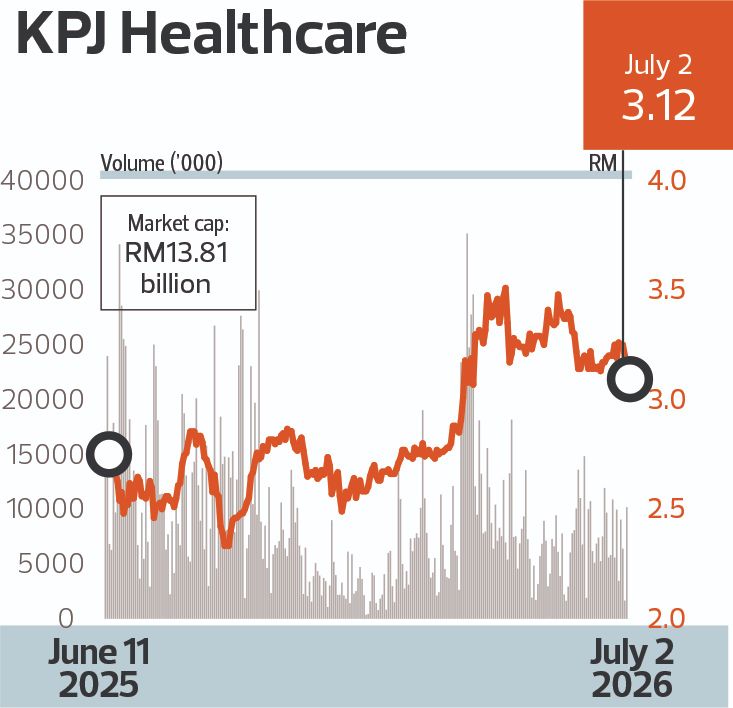
KPJ’s share price has risen from around RM1.18 when Chin joined the company to the RM3 level now, more than doubling the group’s market capitalisation from roughly RM5.3 billion to more than RM13 billion. The counter closed at RM3.12 last Thursday, giving it a market value of RM13.81 billion.
Asked whether KPJ could eventually achieve a market capitalisation of RM20 billion to RM30 billion as it rolls out its expansion plans, Chin answers without hesitation. “My answer is yes. It’s 100% possible.”
Sunway Healthcare, meanwhile, has already surpassed a RM20 billion valuation just months after its listing.
M&As, joint ventures
As at end-March, KPJ’s total assets stood at RM8.14 billion while total liabilities were RM4.97 billion. Its low net gearing of 0.17 times suggests that its balance sheet has the financial flexibility to pursue acquisitions should opportunities arise.
While remaining open to mergers and acquisitions and joint ventures that can create long-term shareholder value, Chin says KPJ is also exploring more efficient care delivery models as healthcare costs continue to rise.
For example, Chin says KPJ could consider establishing ambulatory care centres (ACCs) in markets such as Cambodia, where demand for treatment abroad has increased amid geopolitical tensions with Thailand. ACCs provide consultations, diagnostic services and day procedures for patients who do not require overnight hospitalisation. KPJ currently operates three ACCs in the Klang Valley and Perak.
“Why Cambodia? Because Cambodia is a significant source of health tourism patients for Malaysia. I’m not talking only about KPJ, but Malaysia in general. Due to the geopolitical tensions between Cambodia and Thailand, many affluent Cambodian patients are seeking treatment overseas. That presents another pool of potential patients.
“So, what if I set up an ACC in Cambodia to provide primary and day-care services … With insurers continuing to raise concerns about rising healthcare costs, we need to think differently. One way is by shifting suitable low-risk cases from inpatient to outpatient care.
“That’s where ACCs become important. If a patient’s condition can be managed as an outpatient, I’d rather treat them at an ACC than admit them to hospital. ACCs could therefore become part of our growth strategy, both locally and overseas,” Chin says.
As for KPJ’s overseas footprint, the company’s presence is currently limited to Thailand and Australia after it exited Bangladesh and Indonesia as part of a portfolio rationalisation.
Chin says future overseas investments will be guided by returns rather than expansion for its own sake. “We exited Bangladesh because it wasn’t contributing positively to either the top line or the bottom line. In Australia, we also divested ourselves of our aged care business because policy changes no longer supported that business model and the returns weren’t meaningful for shareholders.
“Today, we only have the retirement village business left in Australia, which has turned around in the past two years, and we’re continuing to monitor its performance. Thailand remains a good business for us because Vejthani Hospital has a strong health tourism business.”
Health tourism remains a growth opportunity
Health tourism remains an under-penetrated growth driver for KPJ, contributing just 6.2% to revenue in FY2025, compared with 15% for IHH Healthcare and 13.8% for Sunway Healthcare.
According to the Malaysia Healthcare Travel Council (MHTC), Malaysia’s health tourism revenue rose 23% to RM3.35 billion in 2025 from RM2.73 billion a year earlier, while patient arrivals increased 13% year on year to 1.79 million.
Chin believes KPJ’s integrated academic healthcare model, known as the KPJ Health System, will underpin the group’s next phase of growth in medical tourism. At the centre of the strategy are its CoEs, which combine specialised clinical expertise with education, research and innovation to attract more international patients.
The group has already established a Heart & Lung Centre of Excellence at KPJ Johor Specialist Hospital and a Neuroscience & Stroke Centre of Excellence at KPJ Damansara Specialist Hospital 2. Under its five-year plan, KPJ aims to expand the network to 15 CoEs.
“KPJ Health System will help us drive highly specialised services and treatments. That’s why establishing CoEs is so important. I can assure you 80% of international patients coming to Malaysia are seeking treatment for heart disease, stroke, cancer and orthopaedic conditions. These are exactly the areas we are focusing on,” Chin says.
“But how ours is going to be different is that we are working with internationally renowned hospitals such as the Mayo Clinic. We are leveraging their expertise because we are part of the Mayo Clinic Care Network. We are using their support to help us set the benchmark for what it means to be a CoE, what kind of preparation is required, what sub-specialists are needed, what technology must be in place and how to deliver a seamless patient experience. Global patients are drawn to centres that have international recognition or accreditation. And that’s what we plan to achieve.”
Currently, international patients make up 55% of KPJ’s health tourism business, with expatriates living in Malaysia accounting for the remaining 45%. Chin says KPJ aims to shift that mix to 65% international patients and 35% expatriates, as medical tourists tend to spend more and help improve bed occupancy.
Indonesia remains KPJ’s largest source market for international patients, followed by China, Bangladesh and India. Chin did not specify the breakdown of the group’s international patients.
Despite the weaker rupiah, Chin says the group has not seen any significant decline in Indonesian patient arrivals.
According to MHTC data, 87% of Indonesian patients who sought treatment in Malaysia in 2025 were health tourists who travelled specifically for medical care. This was followed by China, with Chinese health tourists accounting for 39% of patients, and India (12%).
“I don’t see a significant drop. As I said, there are always seasonal ups and downs, but the fluctuation is usually about 10% to 15%; it is not anything beyond that. In general, Indonesian patients always travel overseas. If they can afford it, they will travel abroad for healthcare. I think the Malaysian healthcare system, in general, has been relatively good and mature. Mature in the sense that whatever technology you are talking about today, I think Malaysia already has 90% to 95% of what Singapore has. But when it comes to cost and innovation, I think Malaysia is definitely much more cost-effective,” Chin says.
Execution holds the key
Analysts generally view KPJ’s RM5 billion expansion plan positively, noting that expanding existing hospitals typically requires less capital, carries lower execution risk and generates better returns than building greenfield hospitals. Brownfield projects also benefit from existing specialists, referral networks and infrastructure.
However, MBSB Research says the key question is not whether KPJ can add more beds, but whether it can improve yield per bed, margins and returns on invested capital.
“Adding beds can increase revenue, but it does not automatically improve yield per bed. Yield per bed improves when hospitals handle more complex procedures, attract better-paying patients and operate with stronger specialist capability. To close the gap, KPJ may need to move further up the value chain by accelerating its CoEs, improving its case mix and making greater use of ambulatory care,” the research house says in an email response to The Edge.
MBSB expects KPJ’s investment plan to support steady earnings growth over the medium term but says a meaningful valuation re-rating will depend on how effectively KPJ executes its plan.
“Our forecasts already imply earnings growth, but not dramatic acceleration. Revenue and core earnings are expected to rise gradually over FY2026-FY2028. While the investment plan supports medium-term growth, further upside will depend on KPJ demonstrating stronger execution in improving productivity and profitability,” it says.
Other analysts believe KPJ’s RM5 billion investment is manageable as it will be deployed over the next five years.
“This may sound large, but spread over five years, it is equivalent to RM800 million to RM1 billion annually. For a company generating around RM4 billion in revenue with healthy operating cash flow, this is quite manageable,” says BIMB Securities analyst Maliana Shaharudin.
In terms of valuation, Sunway Healthcare continues to trade at a much richer valuation than its listed peers. On a 12-month forward basis, it is valued at 74 times price-earnings ratio, compared with 33.55 times for KPJ and 32.17 times for IHH.
On an enterprise value-to-earnings before interest, taxes, depreciation and amortisation basis, Sunway Healthcare trades at 33.72 times, compared with 15.48 times for KPJ and 14.41 times for IHH.
With its growth strategy mapped out, the next test for KPJ is execution. Whether KPJ can command a higher valuation will depend on its ability to translate its plan into stronger earnings growth.
Getting ready for DRG
As medical inflation drives healthcare costs and insurance premiums higher, the government is pinning its hopes on the Diagnosis Related Group (DRG) payment system to make private healthcare more sustainable. Private hospital operators, however, fear the reform could squeeze margins and profitability if reimbursement rates fail to keep pace with treatment costs.
For KPJ Healthcare Bhd (KL:KPJ), the impact could be significant as nearly all of its revenue is generated in Malaysia. The DRG payment system categorises patients based on the classifications of diagnoses and procedures. The patients are charged fixed rates based on those classifications, regardless of the final cost of treatment. The rollout was initially planned for last year but has been delayed until next year.
“It would be a lie for me to say … it (DRG) will not [have an impact]. Will DRG resolve medical inflation? I think DRG is a system pointing towards value-based care. That means they are trying to say ‘let’s focus on patient clinical outcomes and the value that we can maximise for patients instead of an activity-based kind of healthcare system. Because activity-based means every activity I do, I charge. Regardless [of] how the patient outcome is, which is not good also, if you ask me seriously’,” says KPJ president and managing director Chin Keat Chyuan.
“So now KPJ, IHH, Sunway Healthcare … Everyone has been submitting sample hospital bills of different sizes and types. They have been analysing all of these. So if you ask me, ‘Chin, is it moving forward?’ 100% … We are always very grateful, as industry players, that the government and policymakers provide a platform to continuously engage with us. To me, that is very important. If people move ahead with certain policies without engaging the industry, that’s tough.”
On how KPJ plans to protect its margins ahead of the DRG rollout, Chin says cost optimisation remains an ongoing priority.
A key part of the group’s cost optimisation strategy is centralised procurement across its network of 30 hospitals. Most of its procurement is covered by tender contracts that lock in prices, limiting exposure to short-term fluctuations in medical supply costs. The group also leverages its purchasing scale to negotiate favourable terms with suppliers, helping it keep material costs under control.
“We negotiate with vendors based on volume to leverage our purchasing scale. Rather than appointing a single supplier, we panel the three most commonly used brands, giving doctors a choice while allowing us to lock in prices for two years,” he says.
The strategy has delivered average annual procurement savings of about RM70 million over the past three years, Chin notes.
In FY2025, KPJ’s net profit margin eased to 9.43% from 10.44% a year earlier, although it remained above the 7.97% recorded in FY2023.
Before DRG is rolled out in phases through 2027, the government plans to introduce a basic Medical and Health Insurance/Takaful product with a co-payment feature to improve access to private healthcare.
Chin believes the proposed insurance product could significantly expand access to private healthcare, pointing to the government’s estimate of about 18.1 million Employees Provident Fund contributors as a sizeable pool of potential policyholders. He says the product could particularly benefit the B40 and lower M40 groups who currently rely on public hospitals. With its extensive presence in Tier 2 and Tier 3 cities, KPJ believes it is well positioned to serve this segment.
“I want that opportunity. Many of the T20 and part of the M40 are already insured or pay out of pocket. But if you can bring the rest of the M40 and B40 into private healthcare, that creates a much bigger healthcare ecosystem,” Chin says.
Even so, Chin, who is also the vice president of the Association of Private Hospitals of Malaysia, argues that medical inflation cannot be addressed through payment reforms alone.
He says rising healthcare costs are also being driven by structural factors, including the increasing cost of medical malpractice insurance. As compensation awards in negligence cases have risen, hospitals have had to require higher insurance coverage for doctors, pushing up premiums.
Chin says KPJ now requires every doctor to have malpractice insurance with a minimum coverage of RM3 million, up from RM1 million previously, while specialists in higher-risk disciplines may require between RM5 million and RM10 million or more in coverage. According to him, the higher premiums associated with those coverage levels ultimately feed through to healthcare costs.
“When all these costs go up, what do you think they will eventually translate into?” Chin asks.
“Medical inflation is a real problem. That’s why policymakers need to look at the healthcare system in its totality, not just one component.”
Save by subscribing to us for
your print and/or
digital copy.
P/S: The Edge is also available on
Apple’s App Store and
Android’s Google Play.