
The Sea of Japan is nearly closed off from the wider ocean. The Japanese archipelago wraps around one side, the Eurasian continent runs along the other, and only a few shallow straits let water slip through.
That near-isolation makes it behave like a small ocean of its own. Its currents and its weather swirl in patterns you would expect from a far larger basin.

Dolphins and porpoises move through these coastal waters, but the basics about them stay thin.
When fishers at two bays kept spotting dolphins near shore, their reports reached a team at Kyoto University.
“This study began through local connections: we heard from acquaintances and local fishers that dolphins might be visiting nearby waters,” said study first author Satoko S. Kimura.
A system that’s changing fast
Life here can run differently from the open Pacific just beyond the straits.
Work on stranded and captive animals has turned up minke whales, Pacific white-sided dolphins, and Dall’s porpoises carrying their own genetic and body traits in this sea.
The whole system has been changing fast. Warming water and a reshuffled food web have already dragged down catches of walleye pollock, a sign of how touchy this basin can be.
Against that backdrop, even simple questions carry weight. Knowing when and where dolphins turn up gives a way to notice when something starts to slip.
Yet almost nobody had watched these animals over the long haul along this coast.
Scattered sightings existed, along with grim bycatch records, but little that tracked their daily and seasonal lives.
Listening for coastal dolphins
Passive acoustic monitoring means recording underwater sound and letting the animals announce themselves.
Rather than chase sightings across open water, the team let the sea do the reporting. They picked two very different places.
Wakasa Bay sits near the middle of the Japanese archipelago, one of the largest open bays on this coast. Aso Bay lies far to the south on Tsushima Island, a sheltered inlet tucked away from open water.
Recorders hung from working fishing gear at both sites. One device caught the high clicks dolphins use to hunt, while another captured whistles and the steady background hum of the water.
The listening ran from January 2022 to November 2024 in Wakasa Bay.
In Aso Bay it stretched from March 2023 to October 2024, with local fishers deploying the gear, retrieving it, and snapping photos whenever dolphins broke the surface.
How often dolphins appeared
Dolphin sounds turned up at both bays, though not often. In Wakasa Bay the team recorded them on 49 of 559 monitoring days, roughly 8.8%.
Aso Bay ran a little higher, with detections on 46 of 371 days, near 12.4%. Put simply, the animals were showing up about once every 10 days at each site.
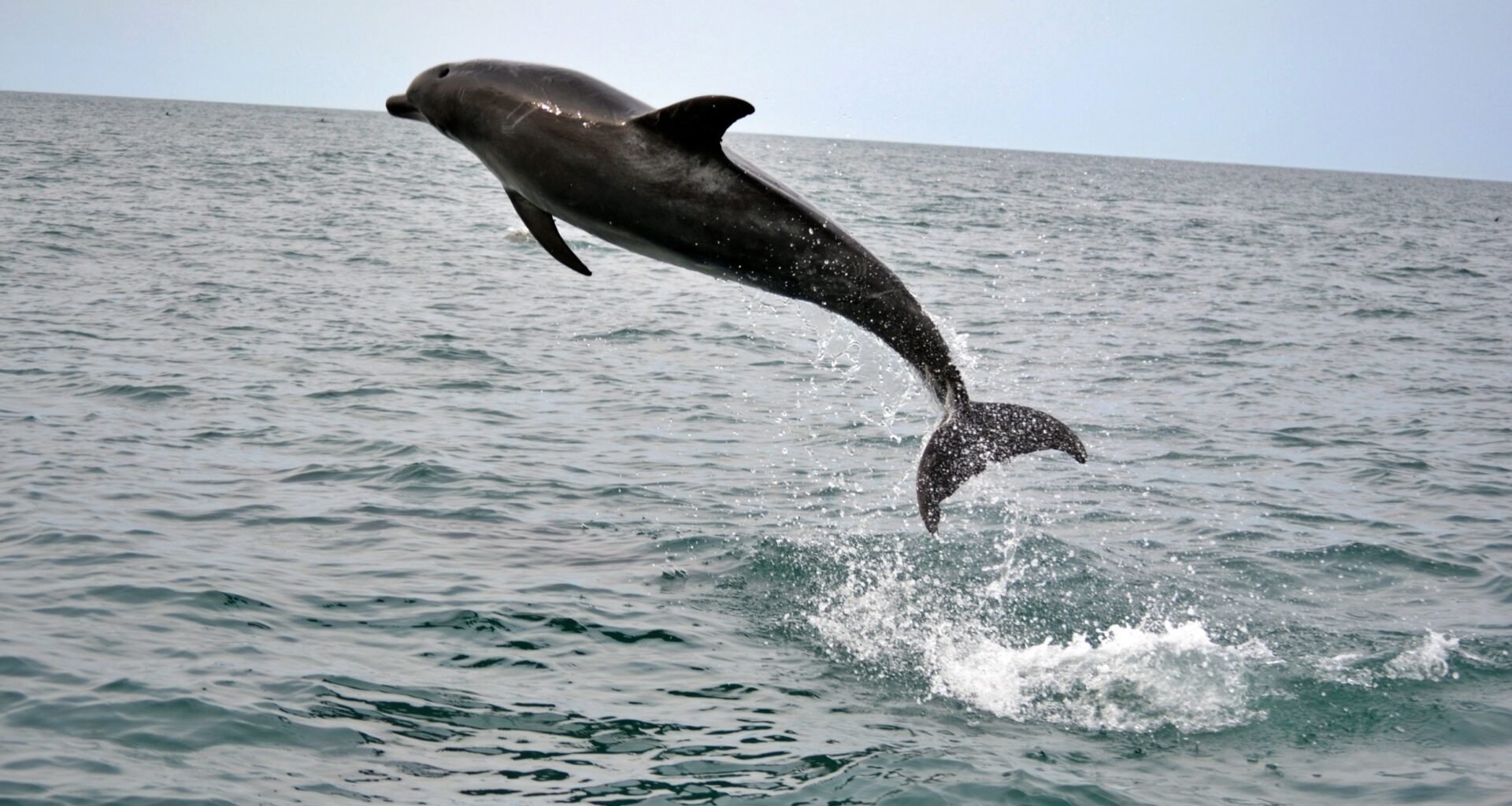
The clicks and whistles by themselves could not name the species. Photographs and fisher sightings filled that gap, and together they pointed to Indo-Pacific bottlenose dolphins (Tursiops aduncus) at both bays.
This dolphin sticks close to coasts, which fits two nearshore bays well. Other species could still slip through, so the team held back from a firm single-species conclusion.
Telling the clicks apart
The click detector did more than count noises. It measured how each click landed on its two microphones, a ratio that pulls the narrow, high clicks of porpoises away from the broader clicks of dolphins.
By that measure almost everything lined up with dolphins. In Aso Bay only about one in a hundred click bursts looked porpoise-like, and in Wakasa Bay none did.
When the dolphins showed up
Timing told its own story. In Wakasa Bay the detections bunched into the early morning, and that hour of the day was the only factor that clearly stood out.
Aso Bay carried a richer rhythm. Dolphins came around five in the morning and again near seven in the evening, appearing far more from July through November.
Water temperature mattered there as well, with activity climbing near 55°F and again around 64°F. Even the phase of the moon tracked with the comings and goings.
Squid may be the thread tying it together. The Japanese flying squid rises toward the surface after dark, and coastal dolphins are known to hunt fish and squid from night into early morning.
Two bays, two whistles
The recordings held thousands of whistles, 2016 from Wakasa Bay and 1223 from Aso Bay. Sorted by shape, the two sites refused to match.
Wakasa Bay leaned toward rising tones, with upsweeps making up 57.8% of its whistles. Aso Bay went the other way, where flat, steady whistles took the lead at 37.8%.
Aso Bay was also the louder place, carrying more background sound across the higher frequencies. Its whistles ran lower in pitch and shorter on sweeping shape than the ones from Wakasa Bay.
Dolphins are known to flatten and drop their whistles where the water is noisy. Whether the noise shaped the sound or the animals themselves simply differed, the team could not yet say.
A baseline for conservation
For a stretch of sea with almost no long-term dolphin data, this is a real starting point. It sketches when and where small odontocetes use these bays, plus what they sound like.
The method may matter as much as the numbers. Listening reaches animals too scarce to watch directly, and it keeps working for months with no boat on the water.
Kept up over years, that same listening could catch the sea shifting under its own weight. It could also sharpen exactly which species are passing through.
What comes next
The plan now is to keep the recorders running and pair them with more eyes on the water. Better species names and individual tracking should follow, along with links to prey and currents.
“With the help of local fishing communities, we were able to listen to the sea over long periods and begin revealing the lives of dolphins in familiar coastal waters,” says Kimura.
“We hope to continue working with local communities to better understand and conserve the marine life that shares the sea with us.”
The study is published in the journal Marine Mammal Science.
—–
Like what you read? Subscribe to our newsletter for engaging articles, exclusive content, and the latest updates.
Check us out on EarthSnap, a free app brought to you by Eric Ralls and Earth.com.
—–