
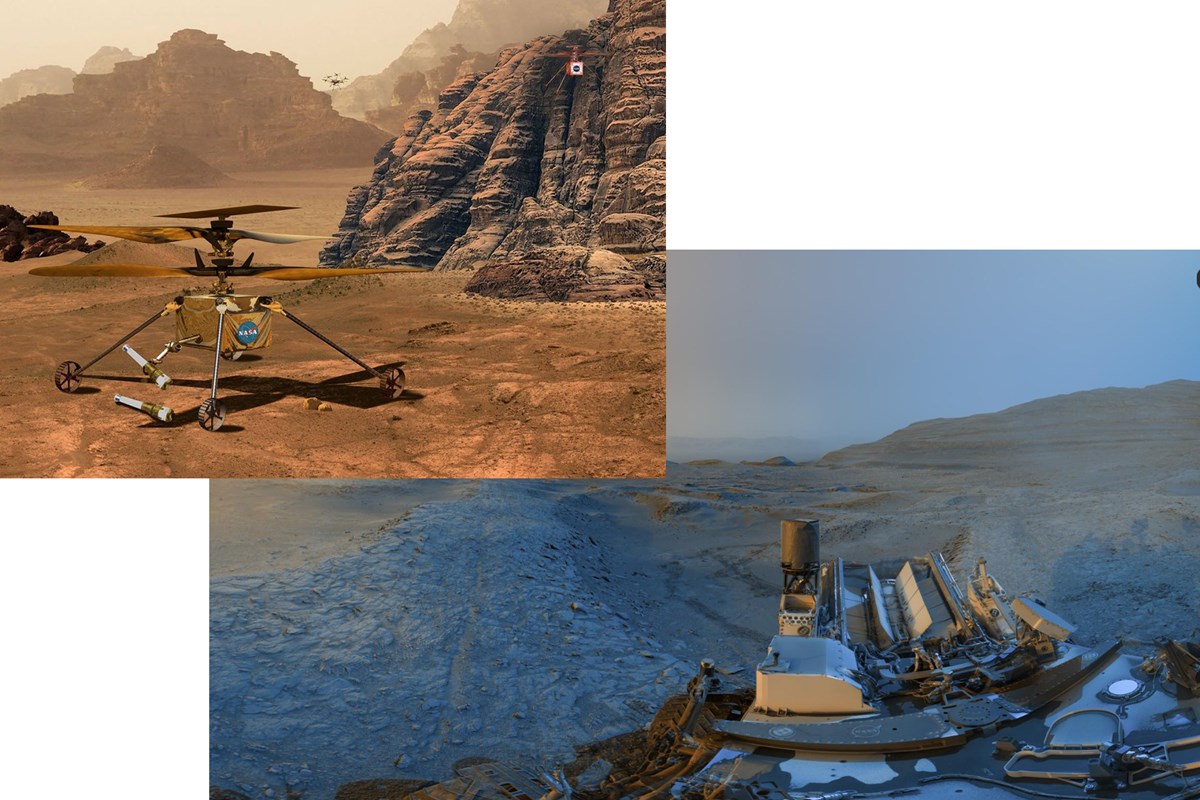
NASA has selected seven companies for contract awards under the Mars Exploration Program’s Science Transport and Robotic Innovation for Deployment and Exploration (STRIDE) initiative to advance next-gen commercial robotic surface mobility for future Mars exploration.
The STRIDE awards will support the development of innovative robotic mobility systems that may enable future Mars missions to access more challenging terrain, travel greater distances and investigate scientifically valuable regions that are difficult to reach with current mobility systems.
With a potential value of ≈$17 million and work targeted to begin in Q3 2026, the all-U.S. list of contract awardees includes:
AeroVironment (Arlington, Va.)
Astrobotic (Pittsburgh, Pa.)
Venturi Astrolab (Hawthorne, Calif.)
Ground Control Robotics (Atlanta, Ga.)
Honeybee Robotics (Longmont, Colo.)
Intuitive Machines (Houston, Texas)
MEI Technologies (Webster, Texas)
As reported by Mark Carreau in a July 2026 Aviation Week article, NASA currently has two rovers actively exploring Mars. Curiosity landed in August 2012 to investigate changes in the environmental habitability of Mars over time, while Perseverance touched down in February 2021 with the Ingenuity drone helicopter to seek evidence of past biological activity. Three previous NASA Mars rovers—the Mars Pathfinder Sojourner and the Mars Exploration Rovers, Spirit and Opportunity — landed in 1997 and 2004. Though successful, they struggled with issues that included mobility in the Martian sand and dust storms that inhibited solar power generation.
The mobility failures that STRIDE is meant to solve — rovers mired in soft sand, solar arrays choked with dust and mass budgets too tight for redundant systems — are problems composites have already been used to address elsewhere in Mars and Moon missions hardware. Carbon fiber composite rotor blades enabled Ingenuity to fly in an atmosphere less than 1% as dense as Earth’s while composite pressure vessels cut mass from Nova-C’s lunar landing-proven propulsion system. Composite rover wheels have also been engineered, at nano-rover scale, for the same loose-regolith traction problem NASA cited when describing Spirit and Opportunity’s struggles.
AeroVironment
AeroVironment led design and development of the Ingenuity Mars Helicopter’s airframe and major subsystems, including its rotor, rotor blades, hub and control mechanism hardware, using Toray Advanced Composites (Morgan Hill, Calif., U.S.) carbon fiber prepreg (see “AeroVironment celebrates composites-intensive Ingenuity”). The helicopter’s four carbon fiber rotor blades and four carbon composite landing legs were key to its success. NASA has since tested longer, stronger carbon fiber composite blades for larger, more capable next-generation Mars helicopters, spun to nearly Mach 1 in the Jet Propulsion Laboratory’s (JPL) 25-foot Space Simulator.
Astrobotic
Astrobotic’s Peregrine lunar lander carried Iris, a Carnegie Mellon University-built nano-rover with a box-like carbon fiber composite chassis and four bottle cap-shaped carbon fiber composite wheels, as cited by CW and Carnegie Mellon University. Iris used a vacuum-infusion process to mold spoked, cleat-like grousers into the wheels for traction on loose regolith — a design response to exactly the soft-terrain problem that hampered Spirit and Opportunity on Mars.
Venturi Astrolab
Astrolab’s FLEX rover uses a “hyper-deformable” wheel whose tread combines stainless steel blades with “relatively inextensible composites,” held together by a proprietary super-elastic material designed to flex across a roughly 370°C temperature swing at the lunar south pole, says Venturi Space. The wheel is engineered to warp around terrain irregularities under a two-tonne payload — the same category of obstacle (soft soil, uneven ground) that limited earlier Mars rovers’ range and speed.
Intuitive Machines
Intuitive Machines’ Nova-C lander uses an all-composite, unibody Type 5 pressure vessel design, as reported by CW in its coverage of the Nova-C launch. Composite tank supplier for the program, Scorpius Space Launch Co. (SSLC, Torrance, Calif., U.S.) explained that carbon fiber’s value for spaceflight goes beyond weight savings alone, citing corrosion resistance and compatibility with cryogenic propellants (see “Type V pressure vessel enables lunar lander”). Mass savings of this kind are directly relevant to Mars surface systems, where every kilogram not spent on structure is a kilogram available for science payload or extended range.
Aegis Aerospace
Aegis Aerospace, formed by the 2021 merger of Alpha Space Test & Research Alliance and MEI Technologies, owns and operates the Materials International Space Station Experiment Flight Facility (MISSE) on the ISS exterior, which has flown dedicated Polymers and Composites Experiment (PCE) sample sets to study how composite materials degrade under combined radiation, atomic oxygen and thermal cycling. The company also developed the Roll-Out Solar Array (ROSA) that uses one-piece composite slit-tube booms to provide deployed structural stiffness and strength. ROSA units were installed on the ISS in 2021.
Through its Artemis program, NASA plans to build a knowledge base for future human expeditions to Mars, first sending astronauts on increasingly difficult missions to the Moon with plans to establish a sustainable human presence via a base camp developed in phases starting in 2028 with the Artemis IV mission. CW will be watching to see if and how these STRIDE awardees apply composites as the start to develop Mars mobility design concepts.