
A new study has found that nature’s puncture tools – its fangs, stingers, spines and thorns – are all governed by one physical trade-off.
The same balancing act between piercing power and structural strength shows up in a scorpion’s stinger and a shark’s tooth alike.

The finding gives engineers a fresh way to think about pierce-resistant materials and the design of needles and surgical tools, since it describes what any good point must sacrifice to gain.
It also helps explain why evolution never settled on a single, perfect point, but instead produced thousands of different puncture tools suited to different jobs.
The physics of puncture
Philip S. L. Anderson, a professor of evolution, ecology and behavior at the University of Illinois Urbana-Champaign (UIUC), has spent more than two decades studying how physics steers the way living things evolve.
Few tricks in nature are as common as the sharp point, and puncture tools show up everywhere once you start looking.
Vipers strike with them, wasps and scorpions rely on them, plants bristle with them, and even fungi and viruses use them to break into cells.
What ties that sprawling collection together is not appearance but physics, according to Anderson.
“What underlies this vast diversity of puncture tools across the tree of life is fracture mechanics. All of them need to apply enough energy to create fractures/wounds in the target,” he explained to Earth.com.
Every puncture is a contest between the tool and the material fighting back. Getting through the surface is only half of it.
The point also has to survive the load pressing back, without bending, or folding first.
Those two demands pull against each other. A point that slides through flesh easily is usually flatter and thinner, which lets it cut deep without shoving much aside.
The trouble is that a slim build leaves a point prone to buckling, bending, or folding sideways before the job is done.
A rounder, stubbier point shrugs off that collapse, though it burns more energy driving the target apart.
Reading the geometry
To pin the physics down, the team stripped puncture to its bare geometry. They drove 3D-printed cones of different sharpness into blocks of silicone gel and recorded how each one behaved.
Every cone had two features they could dial up or down.
The first was taper, meaning how gradually a point stretches out to its tip. A short, broad cone and a long, needle-like spike sit at opposite ends of that range. The second was the outline you would see by slicing straight across the point.
Some tools come out nearly round, like an elephant’s tusk, while others are pressed flat into a blade, like the barb on a stingray’s tail.
A flatter cross-section pushes efficiency up, since a blade forces less material aside, but it also invites bending.
The whole method drew on a mathematical model that the lab built earlier, which set out the energy budget of a single stab and predicted how any form would fare.
With the physics mapped out, the researchers turned to the real world. They compared the puncture tools of 143 species from across the plant and animal kingdoms.
Each one earned a spot on a chart, scored on how efficiently it pierced and how well it held up. The spread was wide.
A handful of tools managed to do both jobs well at once, and the winners had almost nothing else in common.
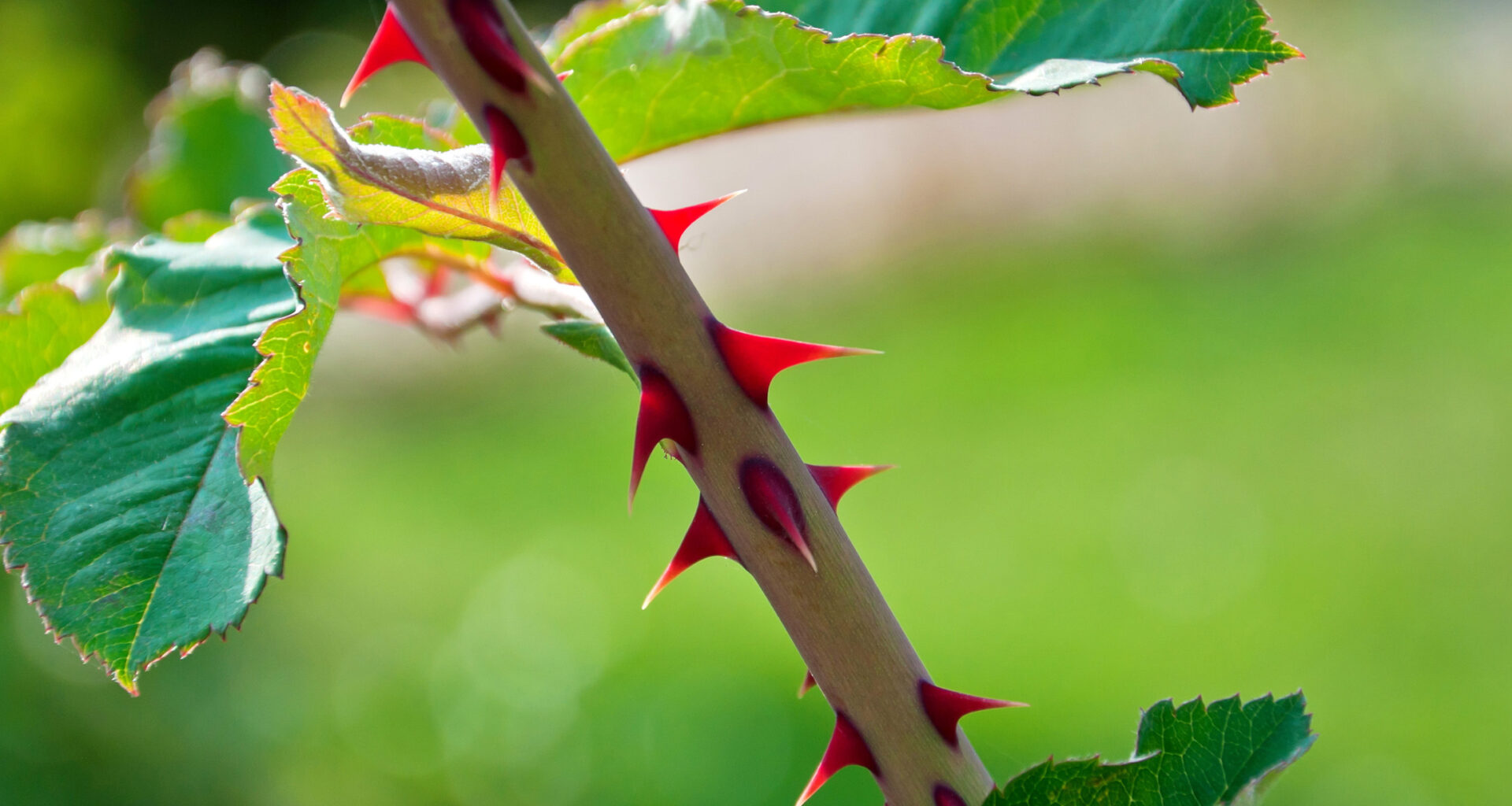
A scorpion’s stinger, a king cobra’s fangs, a rose’s prickle, a shark’s tooth, and the talons of a red-tailed hawk all landed near the top.
The picture turned out to be less tidy than Anderson expected. He had assumed each job – injecting venom, harpooning prey, fending off attackers – would stamp its own form on a tool. The data did not support this.
“While function does have a strong influence on tool shape, puncture tools are highly diverse within each functional group and show heavy overlap in form between said groups,” Anderson told Earth.com.
For example, strong similarities can be seen between shark teeth and cone snail harpoons as well as between mammalian canines and certain wasp stingers,” he expanded.
Curvature, by contrast, made almost no difference.
An earlier study from the same lab pitted straight spikes against hooked, crescent forms and found the curve barely changed how they pierced. That left taper and cross-section as the features that count.
Disposable versus durable
The tools that failed to balance both jobs were the most revealing. Some pierced beautifully but buckled easily, and many of those looked like cactus spines.
A weak spine is not much of a problem when the plant can afford to lose it. A cactus grows spines by the thousand. One that snaps off in an animal’s leg has still done its job, and may even hitch a ride to new ground.
At the other extreme sit tools built to last. A carnivore’s canines resist buckling well but pierce less efficiently, which may say something about their real job.
For an animal that has to grip a struggling meal, a tooth that holds without breaking beats one that slips in cleanly and then cracks.
That split between throwaway and reusable weapons shows up elsewhere in nature.
A separate study published this year found the same pattern in stingray spines, where some forms favor a single, hard-hitting strike and others hold up to being used again and again.
Every design has limits
What comes out of all this is a way to read almost any point in nature as a set of compromises rather than a perfect solution.
That has a practical edge for anyone designing things meant to pierce, or meant to resist piercing.
Hypodermic needles, surgical tools and pierce-resistant fabrics all live on the same trade-off as the animals do.
The study now gives engineers a chart of where the sweet spots lie. The lesson is that no single point wins everywhere.
Engineering inspired by nature
“I think the biggest takeaway from this work in terms of potential bio-inspired design is that there is not really a one-size-fits-all needle shape,” Anderson said in an email to Earth.com.
“Depending on the application being designed for, and especially what materials are being pierced, there may be different shapes that are more efficient than others.”
Until now, the physics of puncture had mostly been worked out one creature at a time – on viper fangs or cactus spines studied in isolation.
Laying 143 tools on a single chart shows that their variety is not random, but a spread of answers to one shared problem. The reach of the rule is the open question.
Puncture runs all the way down to the microscopic spikes that bacteria and viruses use to break into living cells, a scale that the same physics may yet help explain.
The study is published in the journal Science Advances.
—–
Like what you read? Subscribe to our newsletter for engaging articles, exclusive content, and the latest updates.
Check us out on EarthSnap, a free app brought to you by Eric Ralls and Earth.com.
—–