
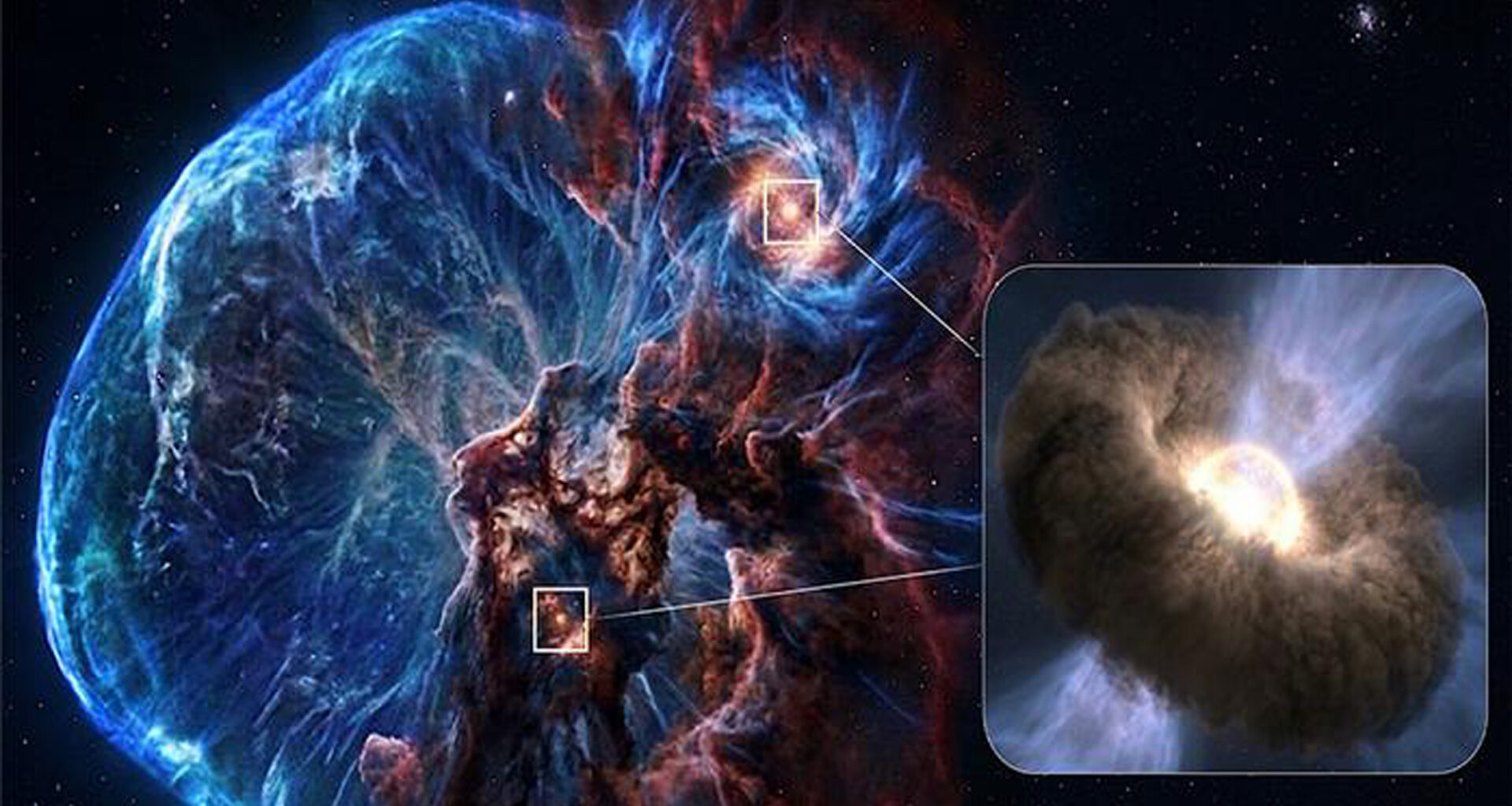
Astronomers have found warm cocoons of gas wrapped around newborn stars inside the wreckage of a star that exploded about 1,600 years ago.
Those cocoons are packed with complex organic molecules, and they are the first-ever detected inside a supernova remnant.

The finding suggests that the shredding violence of a supernova does not have to erase the delicate chemistry that builds new worlds.
That carries weight for our own story, because the Sun itself may have been born next to one of these explosions.
Cores within the shell
The blast left an expanding wreck catalogued as RX J1713.7-3946, a supernova remnant roughly 3,600 light-years away.
It is young as such objects go, and its shock fronts still tear through surrounding space at up to about 2,500 miles per second. Inside that shell, gas takes a beating.
Radiation there runs hundreds of times stronger than in a quiet corner of the galaxy.
An earlier study of clouds near other remnants found their molecular gas heated and compressed by passing shock waves.
Stars inside the remnant
Takashi Shimonishi, an astronomer at Niigata University in Japan, led a team that aimed the Atacama Large Millimeter/submillimeter Array, or ALMA, at two spots inside the remnant.
Earlier radio surveys had flagged both as likely sites of star birth. The giveaway was a pair of gas jets shooting in opposite directions from a hidden central object.
Observing in late 2024 and early 2025, ALMA turned up a compact, glowing source at each of the two spots.
Each source is a hot core, a dense knot of warm gas cradling a young, still-forming star.
Both are mid-sized protostars, heavier than the Sun but still pulling in material, and both sit deep within the remnant’s X-ray shell.
A rich chemical inventory
Attention turned to the brighter core, HC1, whose chemistry the team mapped in detail.
The gas is dense, packed with roughly ten million molecules per cubic centimeter and crammed into a space smaller than 500 times the distance from Earth to the Sun.
It also runs warm, about -280°F (100 kelvin). By everyday standards, that is painfully cold. Against the deep chill of interstellar space, however, where clouds hover near -440°F (11 K), it counts as toasty.
The warmth is enough to bake frozen molecules off dust grains and back into the gas. That warm gas turned out to be chemically busy.
Seeds of future worlds
The astronomers picked out dozens of molecular species built from carbon, oxygen, nitrogen, sulfur, and silicon.
This included familiar ones like methanol and ethanol, alongside larger compounds such as methyl formate, dimethyl ether, and formamide.
Some of these molecules string together as many as nine atoms, which puts them among the more elaborate compounds ever found in space.
Chemists count them as building blocks, the sort of carbon-rich pieces that later end up in comets, asteroids, and the raw ingredients for life.
Using ordinary science
The real surprise came from comparing HC1 with hot cores in calmer neighborhoods.
When the team measured how much of each organic molecule sat alongside methanol, the ratios matched those in ordinary star-forming regions that have never felt a supernova nearby.
That was not the obvious outcome. Cosmic rays and X-rays flooding a remnant can rip molecules apart. One paper on clouds caught in these blast zones found them bombarded up to a thousand times harder than gas in normal galactic surroundings.
Chemistry like HC1’s could easily have been stripped bare. Instead, the fragile compounds appeared largely unchanged, looking just like their cousins in gentler cradles.
“The environments capable of harboring complex organic molecules – potential building blocks of prebiotic chemistry – may be more diverse than previously recognized,” said Shimonishi.
Surviving a supernova
How the cores held onto their chemistry is still an open question, and Shimonishi’s team lays out two possibilities. The first is timing.
HC1 sits near the outer rim of the shell, so it may have slipped into the harsh zone only recently, leaving too little time for the radiation to rework its molecules. The other idea leans on magnetism.
Supernova shocks can amplify magnetic fields, and a strong enough field would fend off incoming cosmic rays, sealing the dense core against the worst of the bombardment.
The data cannot yet determine which explanation, if either, is correct. To the researchers, the takeaway is that a stellar nursery can weather a nearby cataclysm.
“These observations indicate that even in the harsh environment of a supernova remnant, newborn stars can remain well protected within their natal cocoons, preserving their rich molecular composition.”
A clue to our origins
That possibility reaches back to our own beginnings. Traces of short-lived radioactive elements locked in ancient meteorites hint that the newborn Sun sat near a supernova.
A long-running review of that evidence ties our birthplace to massive, short-lived stars. Before this work, no one had shown that organic-rich cores could persist inside a young remnant.
Now that they clearly can, the range of places where prebiotic chemistry might take hold grows wider.
The team plans further ALMA observations to learn whether HC1 is typical or a lucky exception.
The study is published in The Astrophysical Journal.
Photo credit: Niigata Universitry
—–
Like what you read? Subscribe to our newsletter for engaging articles, exclusive content, and the latest updates.
Check us out on EarthSnap, a free app brought to you by Eric Ralls and Earth.com.
—–