
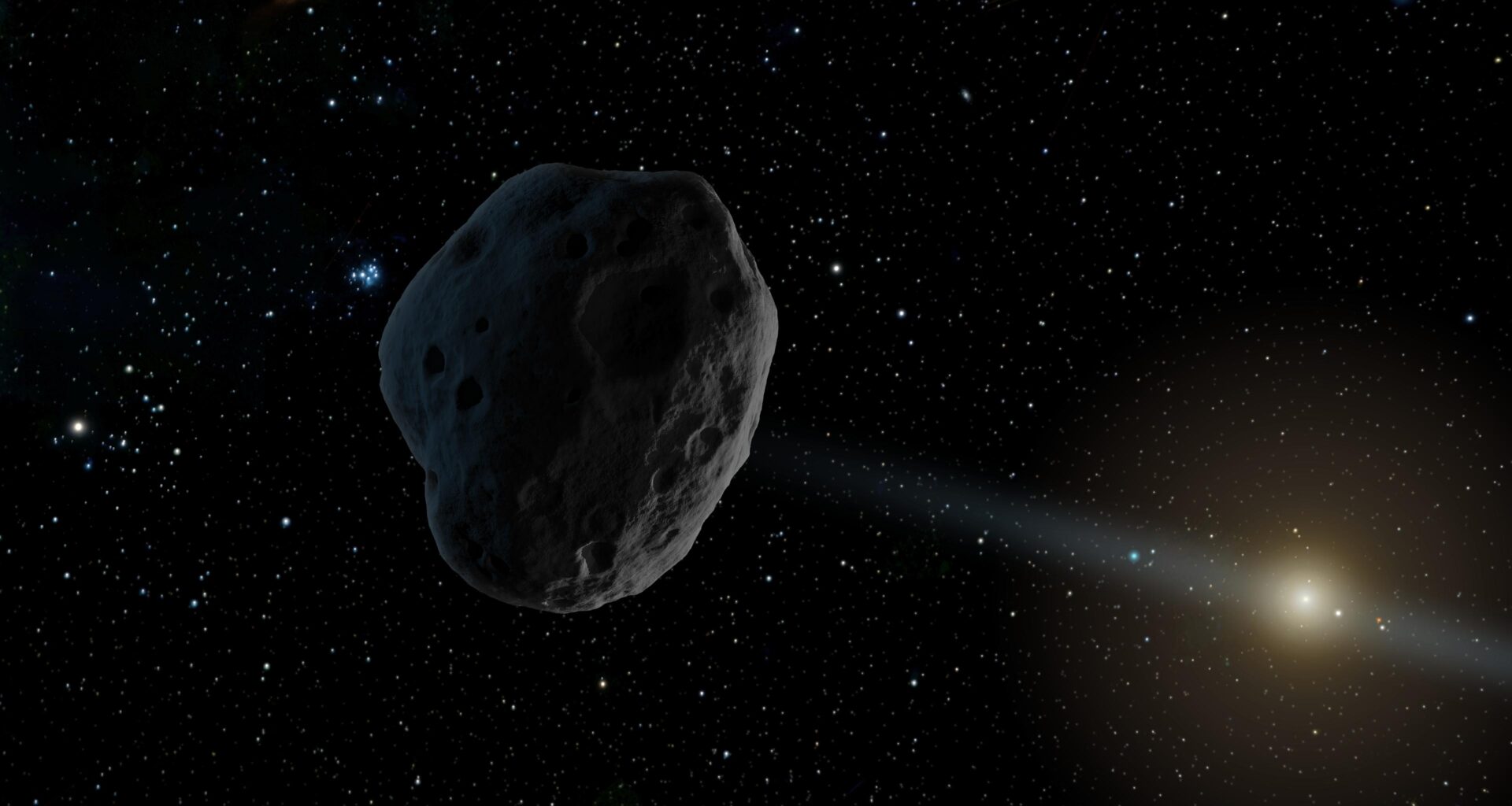
“The images we collected from these observatories showed a weak but clear tail, thus confirming that 1998 SH2 is, in fact, a comet,” said Olivier Hainaut, an astronomer with the European Southern Observatory and coauthor of the study. “That’s how science works — you form a hypothesis, and you set out to test it. This data is exactly what was needed to confirm our hypothesis that 1998 SH2 was a comet.”
As an outcome of the investigation, 1998 SH2 will receive an additional comet provisional designation, P/1998 SH2.
Planetary defense implications
The research also sheds light on another, even more unusual, class of objects called dark comets. Like 1998 SH2, dark comets exhibit significant irregularities, or perturbations, in their trajectory but lack other visible evidence of comet activity — there’s no coma, tail, or visible outgassing. These enigmatic objects fall into two distinct populations: larger ones with orbits similar to those of Jupiter-family comets (short period comets with highly elliptical, or eccentric, orbits), and smaller ones that orbit closer to the Sun. Since the 2016 discovery of the first dark comet, about a dozen more have been identified.
The paper’s authors suggest that many of the larger dark comets, which have orbits like 1998 SH2’s, could turn out to be regular comets if astronomers get the right opportunity to observe them with powerful telescopes capable of imaging incredibly faint objects. And by analyzing the motion of all near-Earth objects using precision astrometry data, researchers may reveal more comets that were previously designated as asteroids if they exhibit cometlike nongravitational perturbations.
“This work shows the importance of continuously tracking near-Earth objects,” said Farnocchia. “Because of outgassing, the motion of comets is more significantly perturbed than that of asteroids. Detecting these perturbations can be an important diagnostic tool for planetary defense that will help understand which objects may be comets rather than asteroids, how their orbits evolve, and how that influences their Earth impact risks.”
Hunting for near-Earth objects
NASA’s upcoming Near-Earth Object (NEO) Surveyor will collect data that can be used to support this effort. The first space survey telescope to be built for planetary defense, this next-generation mission will seek out some of the hardest-to-find near-Earth objects, such as dark asteroids and comets that don’t reflect much visible light.
NASA’s Center for Near Earth Object Studies, the Goldstone Solar System Radar Group, and NEO Surveyor all are managed by JPL and supported by the agency’s Planetary Defense Coordination Office in Washington. Caltech in Pasadena manages JPL for NASA. The DSN receives programmatic oversight from the SCaN (Space Communications and Navigation) program office, also at NASA headquarters.
More information about planetary radar, NASA’s Center for Near Earth Object Studies, and near-Earth objects can be found at: