
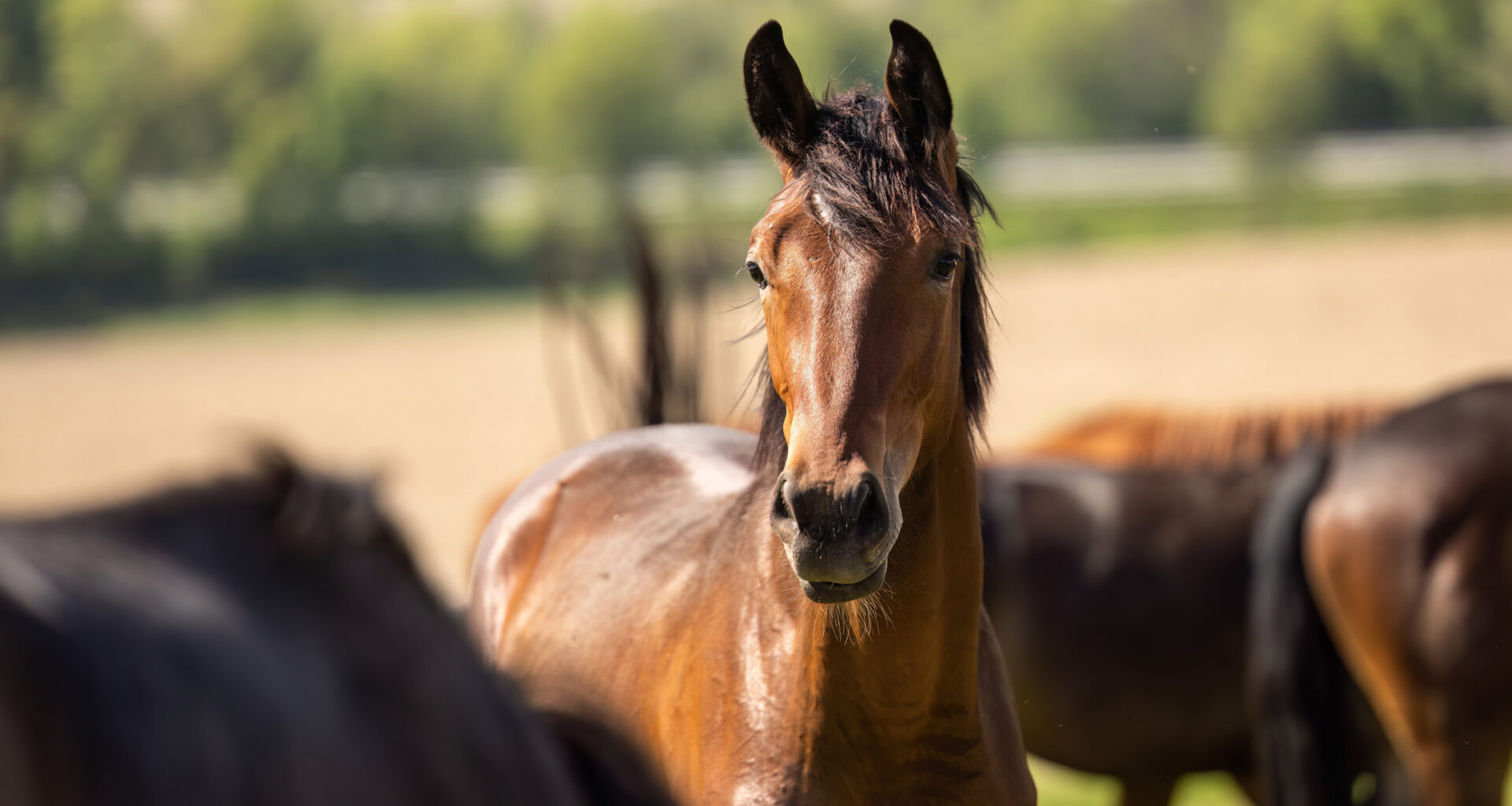
Domestic horses that were shown silent videos of wolves recognized the animals as a threat from sight alone, even though most had likely never met a wolf. Their heart rates climbed as they watched, but outwardly they gave almost nothing away.
The reaction shows that thousands of years under human care have not dulled a horse’s eye for a predator. It also means a horse can register alarm with no outward sign of it, which for a rider or handler can be the gap between a calm animal and a sudden bolt.
Can horses spot a predator?

At the Ohio State University (OSU) Equine Center, 18 horses were led one at a time into a familiar stall and shown a 60-second video with no sound. A heart monitor tracked each animal’s pulse while a camera recorded its face and body.
The footage opened with wombats – stocky, burrowing marsupials from Australia – grazing peacefully. This was the harmless control. It then moved to a pack of wolves, one clip showing them fighting and another showing them grooming one another.
The study was led by Zeynep Benderlioglu, a senior lecturer in evolution, ecology and organismal biology at the university. She wanted to know whether a horse could pick out a predator using vision alone.
That question builds on earlier work. Horses lean heavily on smell and hearing, and a 2020 study found they grow alert and bunch together when they hear the calls of an unfamiliar predator. Whether sight by itself could drive predator recognition had not been tested.
Wolves raise heart rates
The horses’ hearts told a clear story. At rest, their heart rate sat around 51 beats per minute, and the wombats barely moved the needle, holding at roughly 56. The moment wolves appeared, it climbed into the mid-60s.
That gap was statistically solid, and it meant something specific. The horses were not simply reacting to movement or to an unfamiliar animal, since the wombats were novel too and left their pulses flat. They were responding to the wolf.
What the wolves were doing made no difference. Benderlioglu had expected the horses to react more strongly to wolves fighting than to wolves grooming, but the two clips produced almost identical spikes. The sight of the predator was enough on its own.
The pattern suggests a prey animal treating any wolf as a threat rather than weighing its mood. Asked by Earth.com why the two clips drew the same response, Benderlioglu said, “A horse trying to figure out the exact intentions of a group of wolves would be at a distinct survival disadvantage compared to a horse that can react instantly.”
The reaction was also fast. Each clip lasted only 20 seconds, yet that was long enough for the horses to size up what they were seeing before it moved on.
The poker face
For all that internal alarm, the horses looked calm. They did not swish their tails, bob their heads, flare their nostrils, or flick their ears the way a stressed horse usually does. A person standing beside them would have seen an animal at ease.
That split between a calm body and a racing heart fits earlier findings. One study of horses during stressful handling found that outward behavior often fails to track what the animal is feeling inside. Heart data can reveal stress that the body hides.
How the horses looked at the wolves was a surprise too. Horses are thought to inspect threats with the left eye, which feeds the brain’s right side and its rapid alarm system. Here they showed no such bias, watching the wolves head-on with both eyes.
To Benderlioglu, the steady, two-eyed gaze looked less like panic and more like careful study. Both eyes give a horse sharper focus and depth. That is the look of an animal sizing something up, not running from it.
The heart data and the calm gaze lined up. Benderlioglu told Earth.com, “Instead, they appeared to engage in careful, detail-oriented evaluation of the wolf image rather than reacting with overt fear.”
Real encounters seem to play out the same way. In one set of field observations, adult horses kept at pasture showed no visible signs of distress when wolves came near. The calm is real on the outside, whatever the heart is doing underneath.
Differences among horses
The alarm was not the same in every horse. Males reacted far more strongly than females, their pulses climbing to close to 77 beats per minute during the wolf clips while females averaged about 55.
Social status made a difference too, and not in the direction the team expected. The horses that ranked highest in the herd, the ones that lead and control resources, showed the biggest jumps in heart rate at the sight of wolves. Lower-ranking horses stayed calmer.
That suggests a role, not just a temperament. A dominant horse often decides when the group moves, and the ones with the sharpest internal alarm may act as the herd’s lookouts.
Their bodies stay ready to move at the first sign of danger. In an email to Earth.com, Benderlioglu said, “By staying physiologically primed to spot danger quickly, these dominant individuals are uniquely positioned to make split-second decisions and safely lead the rest of the herd away from a threat.”
What riders can’t see
The practical worry is what a rider cannot see. A horse can be highly alert to a nearby dog while looking completely relaxed, and that hidden state can turn into a sudden bolt or spook. Knowing a horse’s sex, age, and rank could help handlers judge how it might react.
What the study establishes is that a horse’s calm face is not proof of a calm mind. Domestication has not erased its ability to know a predator on sight, and that recognition can run entirely beneath the surface.
“Its gaze and heart are giving something away,” Benderlioglu said.
The study is published in PLOS One.
—–
Like what you read? Subscribe to our newsletter for engaging articles, exclusive content, and the latest updates.
Check us out on EarthSnap, a free app brought to you by Eric Ralls and Earth.com.
—–