
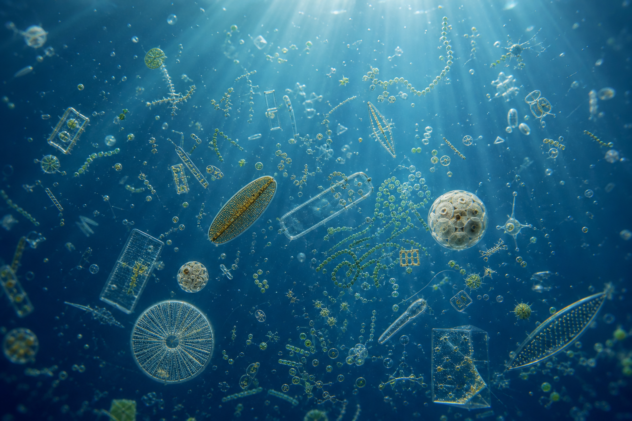
The most prolific oxygen producers on Earth are not towering trees. They are drifting cells in the sunlit skin of the ocean, many too small to see without a microscope. Together, marine plankton account for roughly half of the oxygen released by photosynthesis across the planet.
That familiar estimate needs one important qualification. It describes gross production, not a permanent annual gift of new oxygen to the atmosphere. NOAA says the ocean produces about half of Earth’s oxygen, but also notes that marine organisms and decomposition consume roughly the same amount. The same distinction explains why a rainforest can perform enormous amounts of photosynthesis without adding an equally enormous net quantity of oxygen to the air.
The useful comparison, then, is not ocean good and forest unimportant. It is a lesson in biological accounting. Photosynthesis releases oxygen, while respiration and decay take much of it back. What accumulates depends on the small imbalance left after both sides of the ledger are counted.
Half a planet’s photosynthesis in the sunlit sea
Photosynthesis uses light energy to build organic matter from carbon dioxide and water, releasing oxygen in the process. On land, this work is visible in leaves, grasses and forests. At sea, most of it happens in the upper layer reached by sunlight, often called the photic zone.
The organisms doing the work are collectively called phytoplankton. The category includes cyanobacteria as well as single-celled algae such as diatoms and coccolithophores. They drift with currents, divide rapidly and form the base of most marine food webs. A landmark 1998 analysis in Science estimated that land and ocean each contribute about half of the biosphere’s net primary production, despite their radically different landscapes and organisms.
This is possible because production is a rate, not a measure of how much living material is standing in one place. The ocean’s photosynthetic organisms turn over quickly. A cell may be eaten, die or divide on a timescale far shorter than the life of a tree. A global census published in the Proceedings of the National Academy of Sciences estimated that plants dominate Earth’s biomass, while marine primary producers maintain a much smaller standing stock. The small stock can still carry out a huge share of annual photosynthesis because it is replaced so rapidly.
One of the clearest examples is Prochlorococcus, a cyanobacterium only about half to one micrometre across. It inhabits vast areas of warm, nutrient-poor surface ocean. A person looking over the side of a ship would never see an individual cell, yet its abundance makes it one of the planet’s major photosynthetic organisms. Diatoms, meanwhile, build intricate walls from silica. Coccolithophores cover themselves in plates of calcium carbonate. The ocean’s oxygen production is not the work of one species but of an immense, shifting community.
Released oxygen is not the same as stored oxygen
The phrase “produces oxygen” can make the process sound one-way. It is not. Phytoplankton use some oxygen in their own cellular respiration. Zooplankton graze on them, fish eat the grazers and microbes break down dead organic matter. Each of those processes consumes oxygen. When a large algal bloom dies, decomposition can remove oxygen from the water faster than it is replaced, contributing to hypoxic “dead zones.”
Forests run a parallel cycle. A growing leaf releases oxygen in daylight, but the tree also respires. Animals, fungi and bacteria consume organic material, using oxygen and returning carbon dioxide. Fallen leaves and dead wood do not simply remain as a permanent store of photosynthetic output. In a warm, wet rainforest, decomposition can be especially fast.
Oxford ecologist Yadvinder Malhi’s explanation of the rainforest oxygen budget puts about half of terrestrial plant oxygen consumption in the plants’ own respiration and much of the rest in organisms that decompose plant material. That leaves land ecosystems close to neutral in net oxygen production over long periods, even though their gross photosynthesis is immense.
The ocean is not exempt from this cancellation. Most marine oxygen production is also balanced by respiration and decay. The key exception occurs when some organic carbon escapes decomposition. If dead cells or other particles sink and are buried in sediment before microbes can consume them completely, the corresponding oxygen can remain. A similar escape happens on land when organic material is preserved in waterlogged peat rather than fully decomposed.
A 2026 study in Nature Geoscience described Earth’s oxygen cycle as a nearly balanced loop and estimated that only about 0.1 percent of organic carbon escapes respiration through burial. Its analysis focused on peat accumulation in the Congo Basin, showing that wet tropical landscapes can make a small long-term contribution when carbon remains protected from decay. That is different from treating every year of forest photosynthesis as net new atmospheric oxygen.
The oxygen in a breath is an ancient reservoir
The atmosphere is about 21 percent oxygen. That enormous reservoir did not appear during the current growing season. It accumulated across geological time as photosynthetic production slightly outran the reactions that consume oxygen. Early cyanobacteria were carrying out oxygen-producing photosynthesis long before forests existed on land.
As the Woods Hole Oceanographic Institution explains, much of the oxygen made by ancient marine organisms was used in respiration or decomposition. A small share of organic matter escaped decay by sinking and being buried. Repeated over millions of years, that small imbalance helped build the breathable atmosphere.
This history is why “every second breath comes from the ocean” is memorable but imprecise. Air mixes globally, and an oxygen molecule inhaled today cannot usually be assigned to yesterday’s plankton bloom or a particular forest. The phrase is best understood as a statement about the scale of current global photosynthesis, not the immediate source label attached to each breath.
Rainforests remain essential for reasons beyond oxygen
Correcting the oxygen story does not weaken the case for protecting tropical forests. Rainforests store carbon, recycle water, shape regional rainfall, cool landscapes and contain much of the planet’s terrestrial biodiversity. Clearing or burning them releases stored carbon and destroys habitat. Their value does not depend on the inaccurate idea that they supply a large fraction of net new atmospheric oxygen each year.
Nor does the atmosphere’s large oxygen reserve make changes in marine plankton harmless. Phytoplankton feed ocean ecosystems and move carbon through the biological pump. Changes in their productivity or community structure can affect fisheries, carbon cycling and oxygen concentrations within seawater long before people face a shortage of oxygen in the air.
The organisms themselves are sensitive to a changing ocean. A 2025 study in Nature Microbiology, built from measurements of roughly 800 billion phytoplankton cells, projected that tropical Prochlorococcus production could decline by 17 to 51 percent under future warming scenarios. That is a modelled range for one important group, not a forecast that half of global oxygen production will disappear. Other phytoplankton may partly replace it, and atmospheric oxygen changes slowly. The more immediate concern is disruption to food webs and marine biogeochemistry.
Ocean deoxygenation is already a separate and serious issue. Warmer water holds less dissolved oxygen, while stronger layering can reduce the mixing that replenishes deeper waters. NOAA notes that climate change can expand oxygen-poor zones, threatening organisms that need well-oxygenated habitat. This concerns oxygen dissolved in the sea, not an imminent collapse of the atmosphere.
The deeper lesson is one of scale. Earth’s largest biological processes do not have to be visible. A thin, illuminated layer of ocean populated by microscopic cells can rival all land vegetation in annual photosynthetic work. Forests and plankton both release vast amounts of oxygen, and both consume much of it again. The breathable world exists because, over immense spans of time, a very small fraction escaped that cycle.
Produced with AI assistance. Reviewed by the ScienceBlog.com editorial team before publication. See our editorial policy and about page.