
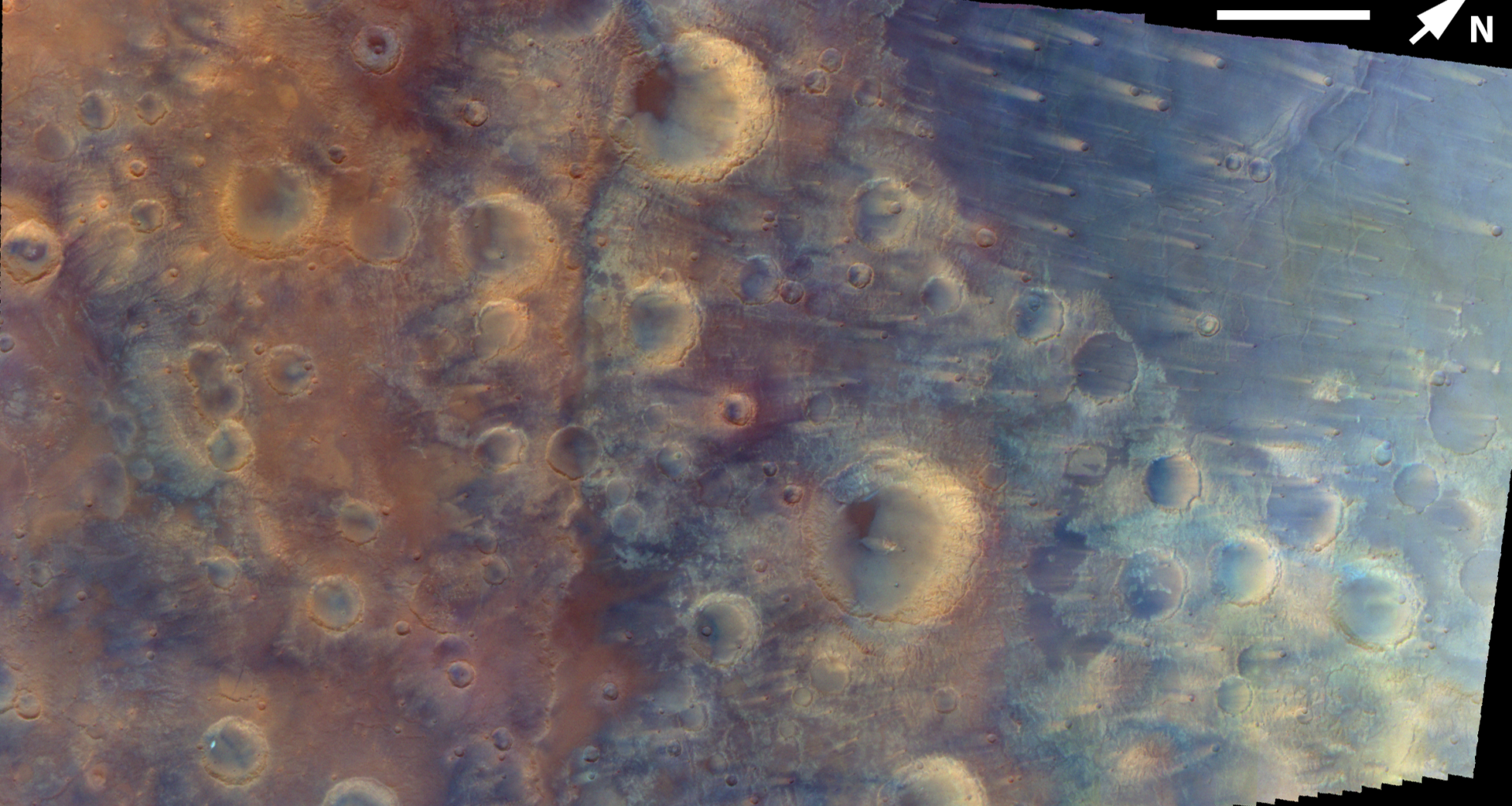
Peppered by Mars neutrons
The gamma-ray and neutron spectrometer, which will help scientists determine the chemical elements that make up the asteroid’s surface material, got a real workout during the flyby. As high-energy cosmic rays bombard a planetary body, the elements on the surface absorb the energy, emitting neutrons and gamma rays of varying energy levels. By measuring these emissions, scientists can match them to properties of known elements to determine what the body is made of.
While the flyby altitude of 2,864 miles (4,609 kilometers) was too far away to measure gamma rays from Mars, hopes were high that neutrons escaping the planet’s surface and atmosphere could be detected.
“Around the time of Mars closest approach, the neutron spectrometer detected a count-rate enhancement close to what we anticipated. It was very gratifying to see,” said David Lawrence, the science lead for Psyche’s spectrometer at the Johns Hopkins Applied Physics Laboratory in Laurel, Maryland. “As expected, we didn’t detect gamma rays from Mars, but we put the instrument through its paces, and it performed excellently.”
Magnetic Mars
Like the gamma-ray and neutron spectrometer, the mission’s magnetometer has been operating since the spacecraft’s journey began with its 2023 launch. Designed to measure the asteroid Psyche’s magnetic field, the instrument will help the mission test the idea that the object is the metallic core of a planetesimal — a building block of a rocky planet.
While the instrument has constantly been measuring the solar wind’s magnetic field during cruise — including when occasional coronal mass ejections washed over the spacecraft — this is the first magnetic field signature of a celestial body that the magnetometer has measured.
“As the spacecraft passed close to Mars, the magnetometer saw an intense uptick in magnetic field corresponding to the bow shock region, where the solar wind slams into the planet’s magnetic field,” said Ben Weiss, Psyche’s deputy principal investigator and the magnetometry investigation lead at Massachusetts Institute of Technology in Cambridge. “This flyby calibration effort validated the instrument’s performance under dynamic conditions while also revealing the fascinating physics of planetary magnetism.”