

A cold, dark cloud about 550 light-years from Earth is beginning the slow process of becoming a star, and astronomers have caught a key step as it happens. Inside the cloud, one kind of gas is slipping inward about 110 miles per hour (0.05 kilometers per second) faster than another, a tiny gap scientists had long predicted but never clearly measured.
Stars like the Sun begin inside clouds like this, so understanding their earliest evolution helps explain how solar systems eventually form. The finding gives astronomers one of their clearest looks yet at the moment a star starts to take shape, before any starlight has appeared.
Gravity’s role in star formation

The cloud sits in the Taurus star-forming region, about 550 light-years away, and goes by the name L1544. It is one of the closest places to Earth where a star is getting ready to form. This has made it one of the most studied objects of its kind.
A prestellar core like this is a knot of gas and dust, colder than -440°F (-262°C), and dense enough that its own gravity is trying to crush it inward. Left alone, gravity would win. What holds it back is magnetism.
Doris Arzoumanian, an associate professor at Kyushu University‘s Institute for Advanced Study, investigates how magnetic fields guide the birth of stars. She led the current research study.
Strong fields thread these cores. One that is too strong can stall a core’s collapse and hold off star formation. For her, the drift gets at something basic about how a star begins.
In an email to Earth.com, Arzoumanian said, “The result addresses one of the central questions in star-formation research: how gravity and magnetic fields interact in the earliest phases of collapse.”
How the grip loosens
Inside the cloud, only a sliver of the gas carries an electric charge. Those charged particles feel the magnetic field and stay locked to its lines. In contrast, the neutral particles, most of the gas, feel the field only through occasional collisions with the charged ones.
As a core grows denser, it shields its interior from the starlight and cosmic rays that keep a little of the gas electrically charged.
Charged particles become scarcer and the collisions grow rarer, so the neutral gas slips free and sinks inward under gravity while the charged gas stays pinned to the field.
This slow separation between the two gases is called ambipolar diffusion. The drift it produces is tiny, a small fraction of the speed of sound, so the two have to be measured against each other with great care.
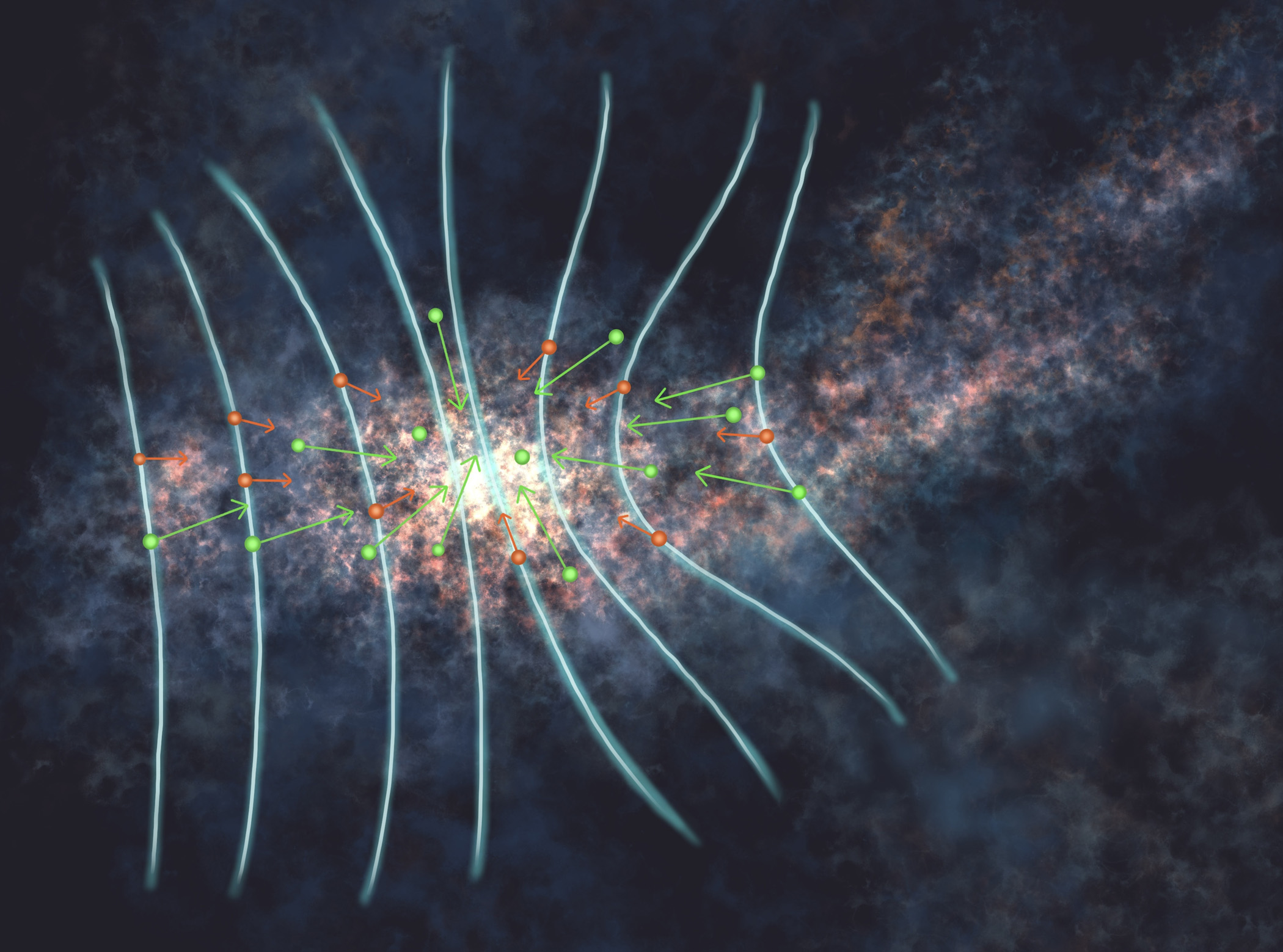 Illustration of ion-neutral drift in the L1544 prestellar core (blue lines = magnetic field lines bent by gravitational contraction; red/green dots = ions/neutrals with arrows tracing inflow). Complementary theory: Fukuhara, Tsukamoto et al. 2026.Tracing star birth
Many molecules used to map cold clouds freeze onto dust grains at these temperatures and vanish.
Silvia Spezzano, a group leader at the Max Planck Institute for Extraterrestrial Physics (MPE) in Germany, and her colleagues, found two that survive in the cold, both built with heavy hydrogen.
The two molecules sit in the same dense gas, one carrying a charge to trace the ions, the other neutral to trace the rest. Comparing their motion is what makes the drift measurable.
The drift shows up
To look for it, the team pointed a large radio telescope in the Spanish mountains at L1544. They mapped how fast each molecule was moving across the core.
Where the two maps disagreed, they could read off the difference in speed between the charged and neutral gas.
The average difference came out at the same 110 miles per hour (0.05 kilometers per second). That is close to the smallest speed the instrument could resolve, so the team worked near the limit of the data.
The signal was strongest toward the dense heart of the core, where the two gases should pull apart most.
Closing the loophole
Earlier searches had come up mostly empty. Others found differences, but nothing they could tie to this one process.
A separate study of a dense core called Barnard 5 measured a speed gap of about the same size. However, its two tracer molecules did not sample the same gas, so the drift could not be pinned down.
By choosing molecules that trace the same dense gas, the L1544 team closed off that loophole. Before this work, no one had cleanly caught the drift between ions and neutrals inside a core just prior to star formation.
How dust shapes stars
The interpretation leans on the dust. In a young cloud, dust comes as tiny grains, some far smaller than the wavelength of visible light. As a core ages, they stick together and grow, with the smallest ones vanishing first.
Those smallest grains are what couple the neutral gas to the magnetic field. As they disappear, the link between gas and field weakens and the drift between ions and neutrals grows.
New calculations from members of the same team show that once the tiniest grains are gone, a core can produce a drift of roughly 0.05 to 0.1 kilometers per second (110 to 220 miles per hour), matching what the telescope saw at L1544.
The team still cannot rule out that the two molecules trace slightly different gas, a question sharper maps will settle.
The core’s magnetic field
The match also lets the team estimate the core’s magnetic field, which works out to a few hundred microgauss, hundreds of thousands of times weaker than a kitchen magnet.
That agrees with a separate estimate made from the way dust grains align with the field.
The drift, in other words, reveals things that are otherwise hard to pin down. In an email to Earth.com, Arzoumanian said, “This observed drift provides also indirect information about the magnetic field strength and the dust grain size distribution, both being difficult to constrain observationally.”
Whether dust really grows this way in cold cores has long been debated, but the evidence is building.
Recent space-telescope observations of a nearby cloud found icy grains growing to about a thousandth of a millimeter across well before any star switches on, which is early enough to drive the process seen at L1544.
Star formation begins
The team showed that a prestellar core can be caught in the act of loosening its magnetic grip through the faint drift of neutral gas past charged gas.
Scientists had predicted that drift for decades and searched for it many times. Now the team has measured it in a core that has not yet formed a star.
The next step is to study more cores at different stages and in finer detail. This will establish whether the same drift appears as a rule rather than a lone case.
Instruments now coming online should resolve the motion more sharply and across a wider range of conditions.
Understanding solar origins
The payoff reaches past one cold cloud. These cores are the starting point for stars like the Sun and the planets around them.
Their frigid chemistry assembles some of the molecules that later seed young planetary systems. It may even reach all the way to our own beginnings.
“Understanding how widespread the physical and chemical properties of prestellar cores are can help us constrain how unique our own Solar System and our planet Earth are,” Arzoumanian told Earth.com.
The study is published in Astronomy & Astrophysics.
—–
Like what you read? Subscribe to our newsletter for engaging articles, exclusive content, and the latest updates.
Check us out on EarthSnap, a free app brought to you by Eric Ralls and Earth.com.
—–