
Over 23 million electric vehicles (EVs) will be sold globally this year, according to an analysis by BloombergNEF – representing an increase of 9% over last year.
Amid falling lithium-ion battery prices, more affordable models, and a squeeze on oil prices amid the US-Iran conflict, EV adoption in emerging markets like New Zealand is beginning to surge.
In New Zealand, EV registrations in the June quarter rose by 165% and in June itself, battery electric vehicles (BEVs) and plug-in hybrids (PHEVs) represented almost four of every 10 cars sold in this country.
That gives EV makers like Lexus – who enjoyed a record sales year in New Zealand in 2025 and retains its number two position in the luxury segment – an opportunity.
The luxury manufacturer’s pioneering electrification strategy is designed to capture a healthy slice of global and New Zealand markets by producing luxury EVs which embody unique technology, driving advances and accessible pricing.
Their long-term vision – exemplified by its goal of having a 100% BEV product line by 2030 – is at odds with other manufacturers, who have scaled back ambitious EV plans amid high costs, soft sales, the axing of government subsidies, and a lack of charging infrastructure in some nations.
Lexus has instead stayed the course in pursuit of its “electric mobility” era, with broader parameters than a focus solely on BEVs, as pursued by other makers.
Lexus New Zealand vice president Andrew Davis says the “multi-pathway” strategy still relies on futuristic, hi-tech, next-gen technology involving manufacturing techniques, battery development and design advances to meet specific consumer needs.
“I am lucky enough to drive the Lexus RZ,” says Davis of the marque’s new electric SUV models, the RZ 500e and RZ 550e. “But I mostly use it to get to work and around town. I am doing 20-30km a day and plug it in every day.
“So that’s great for me, but it’s not going to suit a customer who lives in the South Island and needs to do many more kilometres a day. That’s why we continue to focus on providing different powertrains for different needs – a multi-pathway.”
Different forms of Lexus EVs, including PHEVs and hybrids, will be developed with those different consumer preferences in mind – but will also incorporate driving pleasure, comfort, convenience and performance thinking that will shape the Lexus brand in coming years.
The strategy aims for a 100% electric range across all categories by 2035 and references upcoming breakthroughs in design, modular manufacturing, technology and high-performance batteries targeting ranges of over 1000km and ultra-fast charging times of 10 minutes or less.
While that represents a jaw-dropping advancement in EV tech, Davis says New Zealand needs will range wider in the meantime, “which is why we are offering multi-pathway options at accessible prices.”
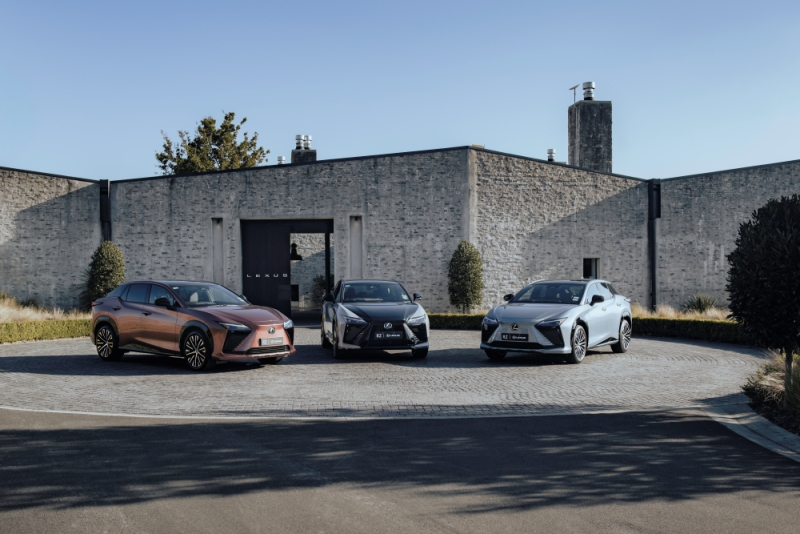
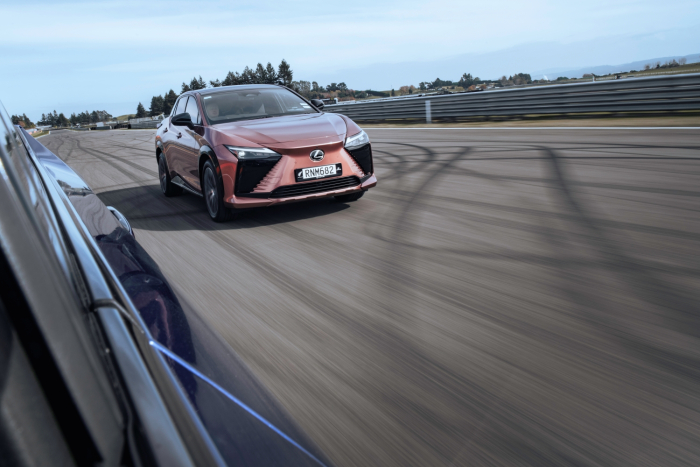
The Lexus RZs have already made a splash price-wise, with the 500e retailing for $41,700 less than its predecessor at just $109,990. The F-Sport 550e sells for $134,000, with the added benefit of being able to reach 100km/h in just three seconds. The 500e has a range of 457km with the 550e reducing range slightly to 437km because of its enhanced power. The models boast much faster charging times.
Lexus’ focus on innovation and technology to enhance driving pleasure has always been a huge part of all Lexus vehicles developed in all categories, says Davis – and can be seen in the RZ and the all-new ES.
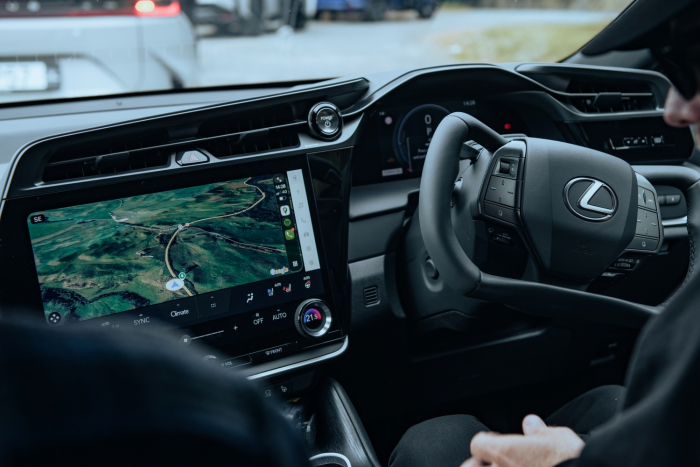
Among the RZ’s most arresting features is its steering yoke, with Steer-By-Wire technology – a prime example of Lexus’ strategy in action and the emphasis on market-leading hi-tech and performance. Instead of a round steering wheel, a butterfly-shaped ‘yoke’ brings an entirely new dimension – much like the controls found in an aircraft, complete with intuitive thumb and finger controls for various other features.
It changes the way a car is driven, in line with the Lexus strategy of innovation and evolution of driving pleasure. While it’s a whole new way of steering, Davis says it is easy to master, requires less arm control and has several other advantages.
“It’s a variable steering ratio system, so it adapts how much to turn the tyres based on your speed,” he says. “It just feels natural and is great on winding roads. At low speeds it really shows up too – whether you are making a U-turn or in a parking building; it makes parking the car so easy.”
Other advances include innovative manufacturing techniques like gigacasting – which produces lighter, stronger modular frames and which simplify vehicle body parts, reducing costs and streamlining production. A new Arene OS operating system uses AI to produce more helpful content and processes as it learns driver habits.
There is clearly more to come from the Lexus innovators as their electrification offering sparks further into life.
For more information go to www.lexus.co.nz/en/models