

Ten years after he was jailed for drug dealing, a former gang leader has made a deal with police to have $414,000 of his cash and property confiscated.
Peter William Evans, now in his late 60s, was the president of the Capital City Chapter of the Highway 61 motorcycle gang in the early 2010s.
At that time, he was running a drug-dealing operation from his house in Miramar, Wellington.
He was caught by the police’s Operation Fantail, which in 2014 targeted a large-scale methamphetamine and fantasy supply network.
In 2016, Evans was sent to prison for three years and 11 months for possessing meth and fantasy for supply, supplying fantasy, offering to supply morphine and participating in an organised criminal group.
In addition to the criminal charges, police also obtained restraining orders over Evans’ house, three cars, a rare Harley Davidson CVO Breakout motorcycle, $102,400 in cash and a bank account containing more than $40,000.
At the time, there were only five of the limited edition CVO Breakout motorcycles in New Zealand.
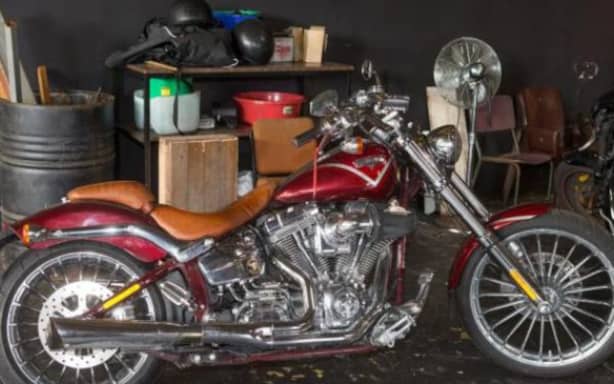
Peter Evans’ Harley Davidson CVO Breakout motorcycle was seized during Operation Fantail in 2014.
Open Justice / NZME / NZ Police
Police said the assets placed under the restraining order had been obtained or “tainted” through Evans’ criminal offending, making them liable to be confiscated under the Criminal Proceeds (Recovery) Act 2009.
The cash – including a single stash of more than $72,000 – had been found at Evans’ house and another property he had access to.
Police said they used a “cash dog”, specially trained to sniff out large amounts of currency, to find some of it.
In the years since Evans served his sentence, court hearings and negotiations have continued over the fate of the property that was placed under restraining orders when that phase of Operation Fantail wound up in June 2014.
The police alleged that Evans derived an “unlawful benefit” of $616,500 from his drug operation, backed up in part by an analysis of his banking transactions.
This meant he was liable to have up to that amount of cash and assets seized under the proceeds of crime law, which aims to separate criminals from their ill-gotten gains.
However, Evans claimed some of the funds could be attributed to legitimate enterprises and business dealings.
Evans and the police eventually agreed to do a deal limiting his liability to $414,000, avoiding the risks and expense of continuing to argue the case in the courts.
The settlement deal has now been approved in the High Court by Justice Christine Grice.
Under the agreement, the assets to be forfeited include the $102,400 in cash seized, the $40,500 in the bank account, $90,800 from the sale of the cars and motorcycle, and more than $31,500 earned in interest since 2014.
This leaves a shortfall of $185,800, which Evans has to produce within the next five months.
If he does not, police will seek to obtain that amount of money from the sale of his Miramar house, in which he has lived for more than 30 years and which is still under a restraining order.
If he does come up with the money, the restraining order over the house will be lifted, and court formalities will be sought to make the deal a “full and final settlement”.
The proceeds of assets forfeited under the Criminal Proceeds (Recovery) Act go into a fund, much of which is used to offset the social effects of crime, including funding rehabilitation programmes.
Some of the money is used for crime-fighting or prevention measures, including the training of “cash dogs”.
* This story originally appeared in the New Zealand Herald.

Open Justice