
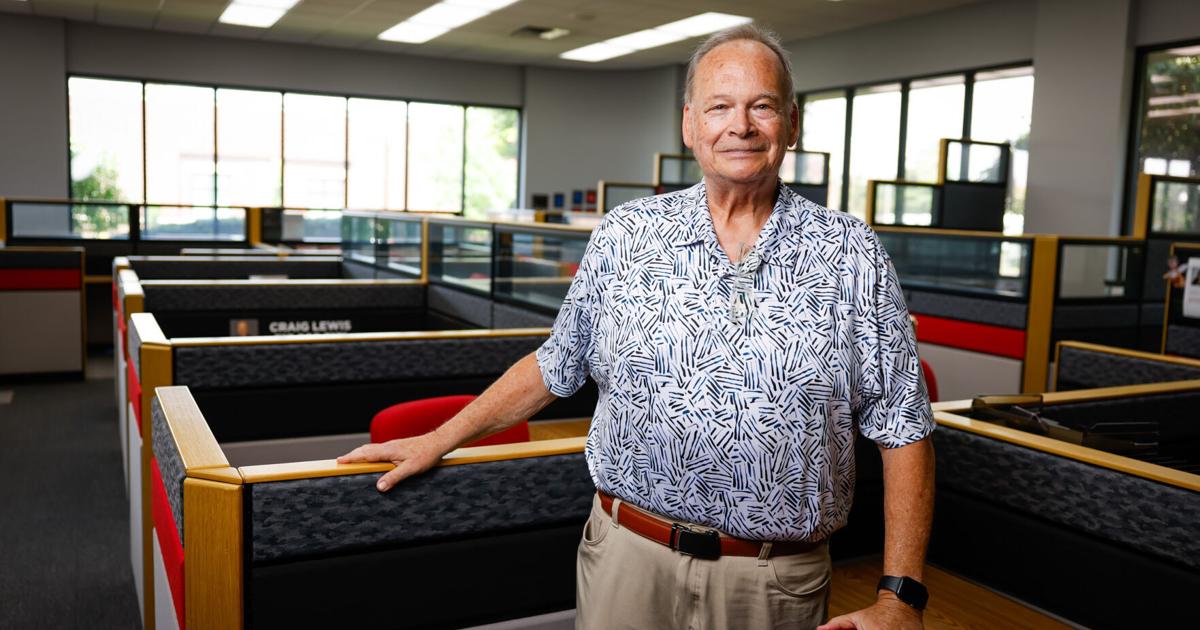
Bill Dartnall works as a real-estate agent for Sibcy Cline in Fairfield. He said returning to work was needed financially to supplement Social Security income, but beyond finances, working gives him a sense of belonging.
Bill Dartnall retired at 67 after a career that ranged from managing a Towne Properties high-rise condominium to running local fast-food restaurants.
His retirement didn’t last long.
Soon after leaving the workforce, Dartnall began substitute teaching for the Lakota, Fairfield and Hamilton school districts during the COVID-19 pandemic while simultaneously working toward his real estate license.
After completing his real estate education, he worked for Star One Realtors before returning to condominium management with Towne Properties.
“I worked 20 hours a week, but my load was like a full-time manager,” Dartnall said. “When that load became working on my off days, I decided I better retire again.”
For the third time.
Now 73, Dartnall still works. While he enjoys staying active and engaged, he said financial realities played a role in each decision to “unretire.”
“The money was very helpful,” he said.
Dartnall is far from alone.
An AARP survey conducted in February found 7% of retirees had reentered the workforce during the previous six months. Nearly half, 48%, said their primary reason for returning to work was financial. The desire to stay active ranked a distant second at 14%.
“Basic expenses are the No. 1 reason older adults continue to work or job hunt,” said Carly Roszkowski, AARP’s vice president of financial resilience programming. “With the cost of living still high and many people worried that they don’t have enough saved for retirement, the trend of older adults working longer will likely continue.”
Interviews with local retirees and workforce experts suggest many older adults are working longer not because they want to, but because rising housing, food, health care and other costs have made retirement increasingly difficult to afford.
Number of adults older than 65 employed in area counties
Number of adults older than 65 employed in area counties
Butler County
Ages 65-74: 9,143
75 and older: 1,479
Champaign County
Ages 65-74: 1,128
75 and older: 222
Clark County
Ages 65-74: 3,980
75 and older: 443
Greene County
Ages 65-74: 5,172
75 and older: 900
Miami County
Ages 65-74: 3,293
75 and older: 722
Montgomery County
Ages 65-74: 14,889
75 and older: 3,084
Warren County
Ages 65-74: 6,473
75 and older: 1,039
‘I need to do this’
Jesse Fleming, market manager for staffing agency Manpower, said calls from retirees seeking work have increased over the past three years.
Fleming’s territory stretches north to Sidney, west to the Indiana border, east to Springfield and south to Franklin. He has worked for Manpower for three years and spent 15 years in the staffing industry.
Three years ago, when he started with Manpower, he said retiree inquiries were relatively rare, about one for every 50 calls from younger job seekers, he said. Today, he estimates the ratio is closer to 30-to-1.
“It’s definitely a different tone of conversation with those candidates,” Fleming said. “It is a little more urgent because of the financial meaning behind it.”
In the past, retirees who contacted Manpower were usually looking for something to do.
“It’s no longer ‘I want to do this.’ It’s ‘I need to do this,’” Fleming said.
Rising costs are the top reason older adults are seeking employment, Fleming said.
Does your electric bill seem high? Here are some reasons for that
For Middletown resident Michael Owens, 72, returning to work was a financial necessity.
Owens took a part-time job at Menards in 2020 because of rising living costs, housing expenses and what he described as insufficient Social Security income.
“When we first got this house, we paid a little over $500 a month for a house payment,” Owens said. “Now we’re up to $983.”
He had retired a few years prior due to health issues.
After three years working at Menards, however, his health issues worsened. Frequent standing contributed to plantar fasciitis, neuropathy and gout in his right ankle.
“I can hardly walk,” he said. “I never know in the morning what medical device I’m going to use: my cane, crutches or the walker.”
Before retiring, Owens worked 19 years at Tropicana on Princeton Glendale Road.
Today, he and his wife, Bonnie, 75, largely rely on Social Security. Bonnie works a couple days a week despite having her own health challenges, while Owens can no longer work because of his medical conditions.
“With the other bills, we don’t have luxuries,” he said. “We don’t go anywhere.”
Stories like Owens’ have become increasingly common as retirees grapple with rising housing, food and health care costs.
Xenia resident Lynne Carroll said she returned to full-time work in October 2025 as a co-responder for police agencies in Oakwood, Moraine, Centerville, Miamisburg and West Carrollton.
Nick Graham
Working for more than a paycheck
For some retirees, however, financial concerns are only part of the equation.
Lynne Carroll, 68, works full time as a co-responder for several Montgomery County police departments, including Oakwood, Moraine, Centerville, Miamisburg and West Carrollton.
She accompanies officers on calls involving mental health crises, overdoses, suicides and other emergencies that require specialized support.
“Whatever is out there that they need some help with,” Carroll said.
The Xenia resident spent 40 years as a social worker before retiring in 2019 at age 62. She left the workforce to care for her father, who had been diagnosed with a terminal illness, and took custody of her granddaughter, Gracie, who was 2 months old at the time.
For years, caregiving responsibilities prevented Carroll from working. About a year ago, she began receiving part-time assistance from a home health aide through the Area Agency on Aging, allowing her to return to the workforce. She started her current position in October 2025.
Carroll said her decision to return to work was driven by several factors, including finances, student loan debt and her own mental well-being.
“Helping other people helped me keep my mind off what was going on here at home,” she said.


Lynne Carroll, 68, said her granddaughter, Gracie, 6, is one of the reasons she continues to work as a co-responder for police agencies in Montgomery County. Nick Graham / staff
Each month, Carroll receives about $1,300 in Social Security benefits, $900 for caring for Gracie and a $500 pension from the Department of Veterans Affairs, where she worked as a social worker.
Two weeks ago, her father died at the age of 89.
While he was alive, his Social Security check covered the family’s mortgage payment but little else, she said.
“We struggled a lot,” Carroll said, noting their combined income placed them just above the threshold for many assistance programs.
Without her job, Carroll said, most of her monthly income would go toward housing expenses, with the remainder stretched across utilities, groceries and other necessities. Food prices have climbed sharply, she said, and utility bills have nearly doubled in recent months.
“I need to work,” she said. “If I had to stop working, I could. It would just be very tight.”
Carroll worries not only about paying the bills but also about providing opportunities for Gracie, now 6.
“I want to live a little comfortably and get Gracie situated in life,” she said. “I want Gracie to go to school, to college. She’s a very bright girl. She’s fun. She was born into a lot of adversity, and I don’t want that lifestyle for her.”
“She deserves to have things that other kids have, and she probably wouldn’t if I wasn’t working,” Carroll added.
Even with the financial pressures, Carroll said she considers herself fortunate compared with many retirees living solely on fixed incomes.
“I don’t know how people do it,” she said.
Quote
When you retire, it’s supposed to be your fun time. But I think for a lot of retirees, it’s not their fun time, because they worry so much about money and health care.
Stretching retirement dollars
For Dartnall, finances remain a significant consideration.
He supports his wife, who has ongoing medical problems and has never worked outside the home. Although both have Medicare, Dartnall said copays remain expensive and everyday costs continue to rise.
Food prices alone have increased 20.5% since January 2022, according to a CBS News price tracker.
Dartnall also worries about the future of Social Security and Medicare. The Ohio Capital Journal reported in June that more than 2 million Ohioans could face Social Security benefit reductions beginning in 2032 if Congress fails to address the program’s funding shortfall. Medicare Part A is projected to become insolvent by 2033.
The income he earns as a real estate agent serves as what he calls a “nice supplement” to his Social Security benefits, which total a little more than $3,000 a month.
The average Social Security recipient in Ohio receives about $1,900 a month, or roughly $23,000 a year, according to the Ohio Capital Journal.
“In this day and age, you read about people living on their Social Security,” Dartnall said. “I have no idea how they do that.”
Montgomery County home values rise 19% in past year
Without returning to work, he said, life would have been far more restrictive.
“My wife and I would not have been able to take any vacations or anything like that,” he said. “It would basically be staying home and watching everything we spent. When you retire, it’s supposed to be your fun time. But I think for a lot of retirees, it’s not their fun time, because they worry so much about money and health care.”
Dartnall said his wife’s parents retired about 20 years ago and lived comfortably.
“They were able to take trips and buy anything they wanted,” he said.
Today, Dartnall works 20 to 30 hours a week as a real estate agent for Sibcy Cline in Fairfield.
“The money I make as a real estate agent, it’s not fabulous,” he said. “It’s a tough market.”
Still, he enjoys staying engaged.
“I just like to keep my mind going,” he said.
He also values the relationships and daily routine that come with working.
“I have some place to go,” he said.
Retirement isn’t what it used to be
National data suggest more older Americans are staying in the workforce, whether by choice or necessity.
According to the U.S. Bureau of Labor Statistics, 38 million Americans age 55 and older were employed in June. Labor force participation among that age group was 37%, compared with about 19% for people 65 and older.
Among adults age 50 and older who are working or looking for work, 41% said their primary motivation was covering everyday expenses. At the same time, 67% said it would be difficult to find a job in today’s labor market.
AARP data show older workers historically remain unemployed longer after losing a job than younger workers. In June, 27.2% of unemployed people age 55 and older were considered long-term unemployed, compared with 24.6% of job seekers ages 16 to 54.
ICE contract gives Butler County sheriff’s budget a big boostThe value of experience
Many older workers also cite age discrimination as the biggest obstacle to finding employment, according to AARP data. Despite those concerns, experts say older workers bring significant value to employers.
“Older workers contribute a wealth of experience, skills and perspectives to the workplace, and many are eager to learn new skills and technology,” Roszkowski said. “For employers, tapping into their skills and expertise makes good business sense.”
Fleming said many employers recognize that value.
“There’s no training that gives you 30 years of experience,” he said.
That experience has created opportunities for retirees looking to return to work, Fleming said, noting older applicants are often placed as successfully as other job seekers.
Dartnall and Carroll feel the same way.
“I hope people see this as a strength when older folks go back to work,” Carroll said. “We have a lot of experience, and the strength that we have to do some of these jobs is pretty intense.”
“I still believe I have knowledge to contribute,” Dartnall said.
And for now, he has no plans to retire for a fourth time.