
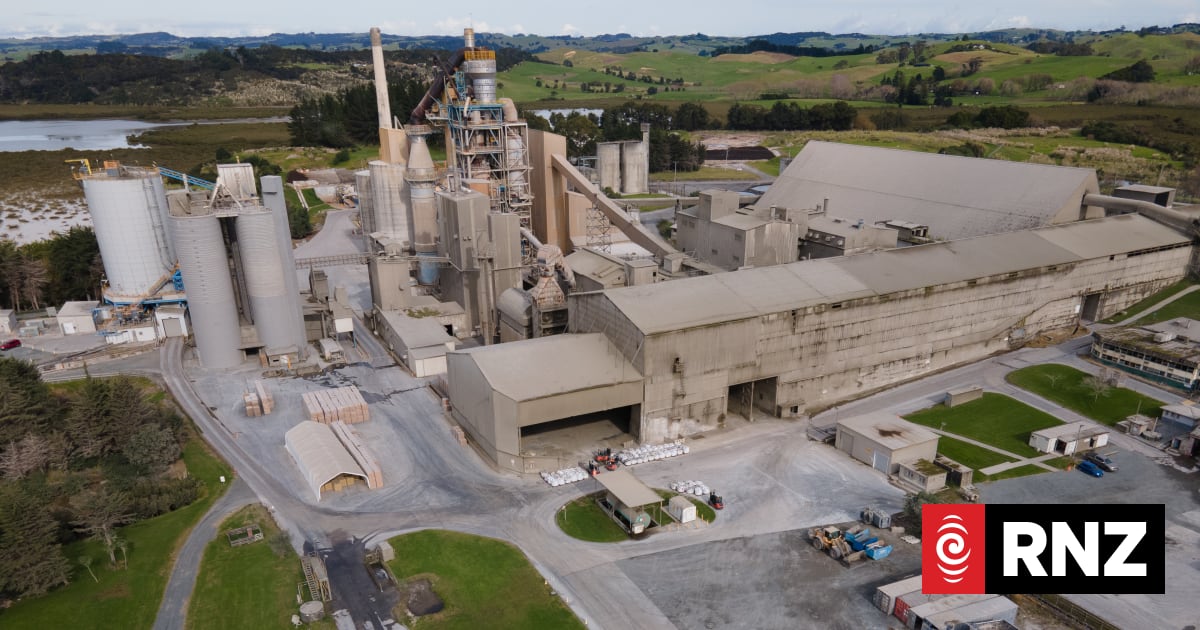
The government is providing up to $60 million in financial support to Golden Bay Cement to ensure its Northland operations can continue.
The move was announced in a release to the NZX on Monday morning by Golden Bay Cement’s owner, Fletcher Building.
Fletcher Building said the support reflects a specific, one-time response to an exceptional set of circumstances.
The release states the government has granted Golden Bay Cement up to $60m, but does not go into detail about the terms of the support or the form it will take.
Fletcher Building said the agreement recognises the strategic importance of domestic cement manufacturing to New Zealand’s infrastructure supply chain and national resilience, and addresses the carbon cost disadvantage Golden Bay Cement faces relative to imported cement.
Golden Bay Cement’s operations in Northland are the country’s only domestic cement manufacturing facility, supplying about 60 percent of the cement used in New Zealand.
The financial support follows an independent assessment, which Fletcher Building said confirmed that without support, rising costs, including carbon costs, would force the plant to close and result in a shift to an import-only model from 2030.
Earlier this month, the Employers and Manufacturers Association issued a pre-election policy wish list calling on the government to consider financial incentives for industries deemed critical to the country’s economic future.
Fletcher Building chief executive and managing director Andrew Reding said: “Without government support, increasing costs, including carbon emission costs that our competitors importing cement from overseas do not currently incur at the same level, would likely have required us to close the plant and move to an import-only model from 2030.
“Domestic cement production matters for New Zealand’s resilience as much as for its economics.”
As part of the announcement, Golden Bay Cement has agreed to invest $150m through to 2040 in continued operations, optimisation, resilience and decarbonisation initiatives at its Northland plant.
The investment will be phased over time and remains subject to Fletcher Building’s normal capital governance and approval processes, with the specific programme to be agreed with the government.
In a separate statement, Economic Growth Minister Nicola Willis said the government “did not take this decision lightly” and undertook “rigorous” analysis of the situation, including the risk of setting a new precedent.
“Ultimately, we concluded that this is an exceptional case, which meets the very high bar needed to justify taxpayer support.”
She said the country would have been left “massively exposed” to global supply disruptions if the Golden Bay factory shut down, as it was New Zealand’s only fully integrated cement manufacturing plant.
“Cement has no practical substitutes. It is needed for the building of homes, hospitals, schools, roads, and other nationally significant infrastructure. Any reductions in its availability could bring essential construction and infrastructure development, and the economic activity they support, to a standstill.”
Cabinet ministers considered the case in May and included a “limited envelope of funds” in the Budget’s operating allowance as a “tagged contingency”. They have since been in negotiations with Fletcher over the size of the grant and the conditions attached.
Willis said Cabinet also considered “alternative forms of regulatory relief” to the costs imposed by the Emissions Trading Scheme, but ultimately decided against that so not to undermine the scheme’s integrity.
“In an uncertain world, the government has acted to secure New Zealand’s national economic resilience,” Willis said.
The ACT party – which has long bemoaned “corporate welfare” – said it supported keeping New Zealand’s only cement plant operating.
But ACT’s climate change spokesperson Simon Court said the need for taxpayer intervention proved the country’s climate settings were not working.
“The government has loaded emissions costs onto local production, put it at a disadvantage against imported cement, and then handed Fletcher Building $60 million to keep the plant open.
“This is why ACT is campaigning to reset New Zealand’s climate targets, so they work for New Zealand, rather than driving jobs and production offshore.”
Fletcher Building said Golden Bay Cement directly employs more than 150 people and supports a further 450 jobs across the Whangārei district, underpinning the country’s ability to build homes, hospitals, roads and infrastructure with locally sourced materials.