
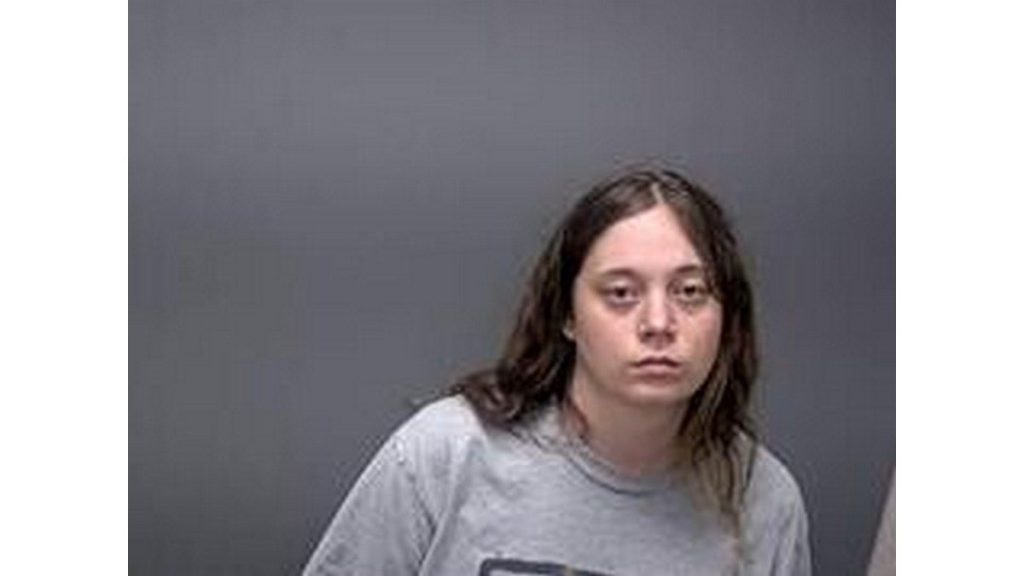
A woman initially jailed after she was alleged to have caused a vehicle accident is now accused of leaving her housing pod at the Baxter County Detention Center without permission.
Efforts are underway to get 23-year-old Kylie Breann Mulholland into a treatment facility to deal with what have been described as serious mental problems.
In late May, Mulholland whose last known address is listed as Lakeview ran out of her housing pod during a routine check.
Mulholland is said to have left the pod “with foul intentions toward jail staff.”
Baxter County Sheriff John Montgomery has filed a request with the court to issue an emergency order in Mulholland’s case to move her from the jail and into a treatment facility.
According to the petition, since Mulholland has been incarcerated, she has “engaged in conduct that has the potential to cause and has caused physical injury and harm to herself. She has had to be restrained for her own safety and protection.”
She is reported to have “engaged in violent and aggressive behavior” and to have been unaware of her situation or surroundings at times.
Mulholland has been placed in short term treatment by a contractor working for the state Department of Human Services (DHS) but the placement “has resulted in no improvement or mitigation of her mental health condition or needs” according to the sheriff’s petition.
Mulholland is “gravely disabled” by her mental health problems, “poses a clear and present danger to herself and others and should immediately be placed into a longterm care facility for care and treatment,” according to the sheriff.
While in the Baxter County Detention Center, Mulholland is reported to have done harm to herself to an extent that required her to be hospitalized.
An involuntary commitment petition has also been obtained in the effort to have Mulholland transferred from the detention center to a facility equipped to treat her. The question now is: how long will it take to get her into treatment?
Mulholland’s situation is only one example of a chronic problem in Arkansas. The state’s mental health treatment system has been described as severely limited and those with mental problems are often left to sit in jail cells for lengthy periods because acceptable alternative are not available.
Mental health professionals agree that jail is not the proper place to treat people with mental illnesses. Those charged with running jails in the state agree.
Advocates for the mentally ill have expressed disappointment that the treatment system is so strapped at a time when state government is reporting a total budget surplus of nearly $4 billion.
The head of one group said, “the money is there, but the political will has not been.”
The Sanders administration’s major focus is said to be using the surplus to reduce or eliminate the state income tax.
SANDER’S ADMINISTRATION RESPONSE
In a written response to questions from KTLO, Classic Hits and the Boot News, regarding the surplus and why more money is not being allocated to make needed improvements to the state’s mental health treatment system, a spokesman for Sanders said that the state’s chief executive “is showing that you can both invest in needed priorities, like education and public safety, while also cutting taxes by 25 percent in four years.”
The state has recently signed a new contract with an outside provider that allows for the hiring of new assessors, makes improvements to the evaluation process and creates a Restoration Service Program to assist individuals in jail with receiving court ordered mental evaluations, the spokesman said.
He points out that a pilot program has been launched to allow individuals to receive mental health treatment outside of jail and another allows individuals to complete treatment within 90 days rather than the current average of one year in the Arkansas State Hospital.
The spokesman said the administration also worked with the Arkansas Association of Counties and the Arkansas Sheriff’s Association to pass Act 733 to speed up mental evaluations and move some restoration services to local jails.
The spokesman said that thanks in large part to Act 733, the number of individuals in county jails waiting to go to the State Hospital has dropped from 134 in May 2024 to 23 in May this year.
Reviews on the changes are mixed. Some mental health advocates are concerned, for example, about relying on jails as treatment facilities. They say incarcerating individuals with mental illnesses instead of providing adequate therapeutic care leads to poorer outcomes and higher rates of repeat offenses.
Arkansas is generally ranked as one of the worst states in terms of mental health care.
Arkansas’ mental health treatment and assessment system was declared unconstitutional by a federal judge in 2002. The class action lawsuit, captioned Terry-vs-Hill, was filed by representatives of inmates struggling with mental health problems who had been languishing in county jails for a year or more waiting to be assessed.
After members of the class bringing the suit were processed, the court’s decree expired, according to a DHS attorney.
However, the head of one mental health advocacy group said, “if the system was unconstitutional then, it would be unconstitutional now – almost 25-years later.”
LATEST DISTURBANCE
Mulholland’s unauthorized trip around the jail came in late May. According to the Baxter County Sheriff’s Office, she left her cell as a jailer was conducting a routine check of C-Pod.
Security cameras show Mulholland running out of the pod, looking around beneath the control tower and then going into the booking area where she was met by two detention center staffers.
Officials said Mulholland was first told to sit on a bench in the booking area. She is reported to have begun yelling and making repeated demands to see her mother and to be taken to the hospital, claiming medical issues.
She was eventually handcuffed to the bench.
As she was being returned to her housing area, she was alleged to have been dragging her feet and kicking at those escorting her.
Charges filed stemming from the jail incident are second degree escape and impairing the operations of a vital public facility.
JAILED FOR VEHICLE ACCIDENT
Mulholland was in the detention center after being charged initially with grabbing the steering wheel of a vehicle in which she was riding causing it to turn into a ditch on State Highway 178 West.
According to the Baxter County Sheriff’s Office, the vehicle was being driven by Mulholland’s mother who was taking her daughter to the hospital for what was described as a mental evaluation.
The car traveled about 100 feet after leaving the road narrowly missing several trees and damaging a fence before coming to a stop in a driveway.
At the accident site, Mulholland was reported to have resisted officers attempting to handcuff her and refused to cooperate in other ways.
Charges filed against her stemming from the traffic accident included resisting arrest, second degree criminal mischief, obstructing governmental operations and third-degree assault on a family or household member.
Court documents also show that Mulholland has allegedly grabbed at the steering wheel of at least one other vehicle while it was in motion. Her young son was reported to have been a passenger at the time of the incident.
According to various court documents, Mulholland has been described as a heavy user of nitrous oxide and has been found with a number of nitrous oxide canisters in her vehicle.
Nitrous oxide, commonly known as laughing gas, has legitimate uses in the medical/dental and culinary fields.
However, if misused, the gas can be extremely dangerous, even life-threatening. The gas displaces oxygen in the bloodstream which can result in immediate loss of consciousness or sudden cardiac arrest.
Mulholland’s bond is now set at just over $19,000.
WebReadyTM Powered by WireReady® NSI