
A meteorite that crashed through the roof of a New Jersey home carried a chemical record of salty water that once soaked the asteroid it came from. That briny mix is the kind of setting where the raw ingredients of life can begin to assemble.
Researchers had never seen this kind of near-surface, salt-soaked chemistry inside a meteorite of its type.

The discovery strengthens a long-held idea that primitive asteroids delivered water and the building blocks of life to the early Earth.
Because a member of the public gathered the rock within hours of landing, it is also the cleanest sample of its kind yet studied.
A daytime fireball
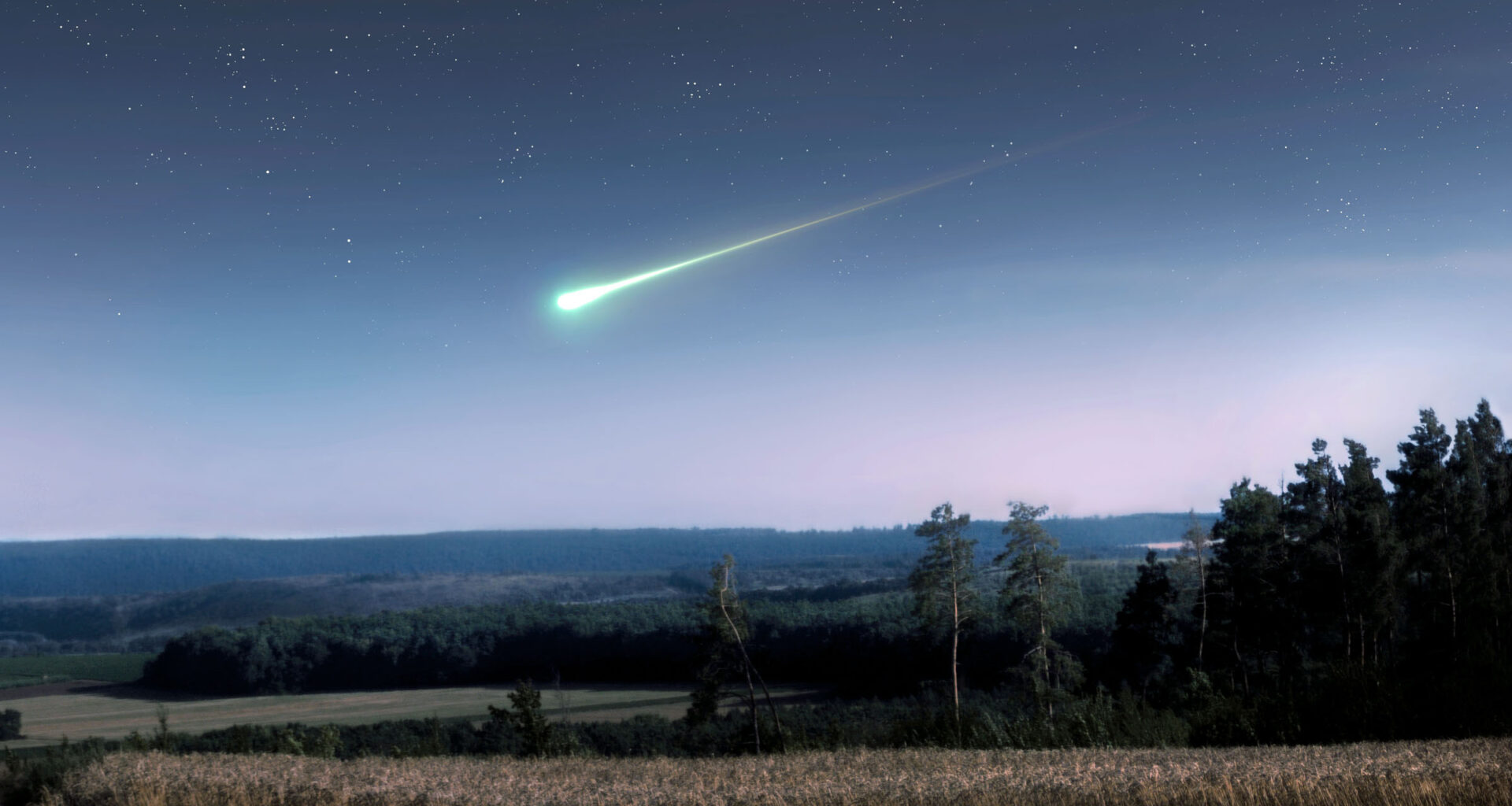
On July 16, 2024, a fireball tore across the daytime sky over New York City and boomed as it passed just south of the Statue of Liberty. Sixty people across five northeastern states reported the flash, and 16 of them felt the shockwave.
The rock hit the atmosphere at about 32,000 miles per hour (51,500 kilometers per hour) and quickly broke apart. It faded from view roughly 22 miles (35 kilometers) up . Scientists only ever recovered one piece – the one that crashed through a bedroom ceiling.
That fragment, more than 2 pounds (1 kilogram) of rock, came down in Hillsborough, New Jersey, where an amateur astronomer happened to live. He heard the crash and found the damage in his primary bedroom.
Hillsborough meteorite quickly protected
“I was at home at the time, heard a loud crash and found a hole in the ceiling of the master bedroom. I smelled a strong, sulfur-like odor and saw many black fragments along with debris and black dust that covered my bed, carpet and surrounding areas,” the homeowner said.
Scientists named it the Hillsborough meteorite, after the town where it landed. It drew a forensic study led by meteor astronomer Peter Jenniskens of the SETI Institute and NASA’s Ames Research Center.
In an email to Earth.com, Jenniskens said the homeowner had quickly wrapped the fresh fragments, thereby protecting their chemistry. The team was then able to analyse them in unusual detail. If not wrapped, meteorites soak up traces of their surroundings.
“Terrestrial contamination is a concern in any study of sodium and organics. Indeed, we could detect that this meteorite fell through the roof and ended up on a carpet,” he said.
The rarest kind
Scientists sorted the rock into a family of primitive meteorites called carbonaceous chondrites. These are dark, carbon-rich stones that have changed little since the solar system formed.
The Hillsborough example belongs to a branch of meteorites that have been altered by water. Its fragments proved to be soaked by water even more thoroughly than most.
That extra alteration puts it in a seldom-seen category. It is only the second meteorite of this water-worked subtype ever seen falling – one landed in Indonesia in 2020.
In excellent condition
Its condition set it apart as much as its chemistry. Because the homeowner sealed the fragments so fast, using gloves, foil and glass jars, the sample kept its delicate record.
It contained minerals and molecules that rarely survive intact. In fact, Jenniskens noted that these were the most pristine fragments of this rare kind yet found.
Quick recovery has paid off before. A separate analysis of a carbonaceous meteorite recovered in England within days of its 2021 fall found water and fragile organics barely touched by their time on the ground.
Salt near the surface
The most striking result sat in a few small, salt-rich flecks inside the rock.
Chemical maps revealed that they contained unusually high levels of sodium compared with the surrounding material. This is a sign that liquid water had once evaporated here and left its salts behind.
The excess sodium is a signature of brines, water so loaded with dissolved salt that minerals crystallize out of it. Interestingly, the flecks seem to have formed near the surface of the parent asteroid. This is where water would have been lost over time, leaving the salt behind.
Scientists had not seen this kind of near-surface brine before in a meteorite of Hillsborough’s type.
Salts help trace meteorite’s origin
Astronomers have built the same picture from asteroid samples returned by spacecraft. A study of material scooped from the asteroid Bennu found a sequence of sodium-rich salts left behind when an ancient brine dried up early in that asteroid’s history.
The tracked fireball did more than record the fall. It let the team follow the rock’s path back into the inner asteroid belt, toward the family of asteroids it likely broke from.
Asked by Earth.com what else stood out, Jenniskens turned to where the rock began.
“My personal favorite is that the impact orbit points to this meteorite having originated from the Erigone asteroid family, which includes asteroid Donald Johanson that was visited recently by NASA’s Lucy mission,” he stated.
Ingredients for life
Inside the rock, researchers also found a rich mix of carbon-based molecules. Among them were many amino acids. Living creatures link these small compounds together to build proteins.
Carbon made up close to 2% of the rock’s weight, and the amino acids resembled those in less water-altered meteorites of the same family.
The rock’s chemistry places it in a larger delivery story. “CM carbonaceous chondrites are thought to have delivered water and organic matter to the early Earth, together with CI types and comets,” Jenniskens told Earth.com.
He noted that the brine chemistry adds a further flavor of molecules to what compounds would have fallen to Earth
The spread of amino acids also suggests they formed on the asteroid itself, not on Earth. The briny fluids of the asteroid could have driven the reactions. A paper on samples from the asteroid Ryugu reached a similar conclusion about its amino acids.
Looking ahead for the Hillsborough meteorite
Not every thread is tied off. Metals are bound up with some of the organic compounds, but the team cannot yet say whether the brines forged them. They could perhaps have survived from ancient collisions that shook the asteroid.
One thing is now clear. Salty, concentrated water once worked near the surface of a primitive asteroid, in a setting that also held amino acids and other building blocks of life.
That bolsters the case that asteroids, like this one, gave the Earth both water and the raw material for biology. It also gives researchers a clean new sample to weigh against material brought back from Bennu and Ryugu.
A natural history museum in New York will care for some of the fragments. “We are thrilled that nature delivered such a precious asteroid sample on our doorstep,” said curator Denton Ebel.
The study is published in Science Advances.
—–
Like what you read? Subscribe to our newsletter for engaging articles, exclusive content, and the latest updates.
Check us out on EarthSnap, a free app brought to you by Eric Ralls and Earth.com.
—–