
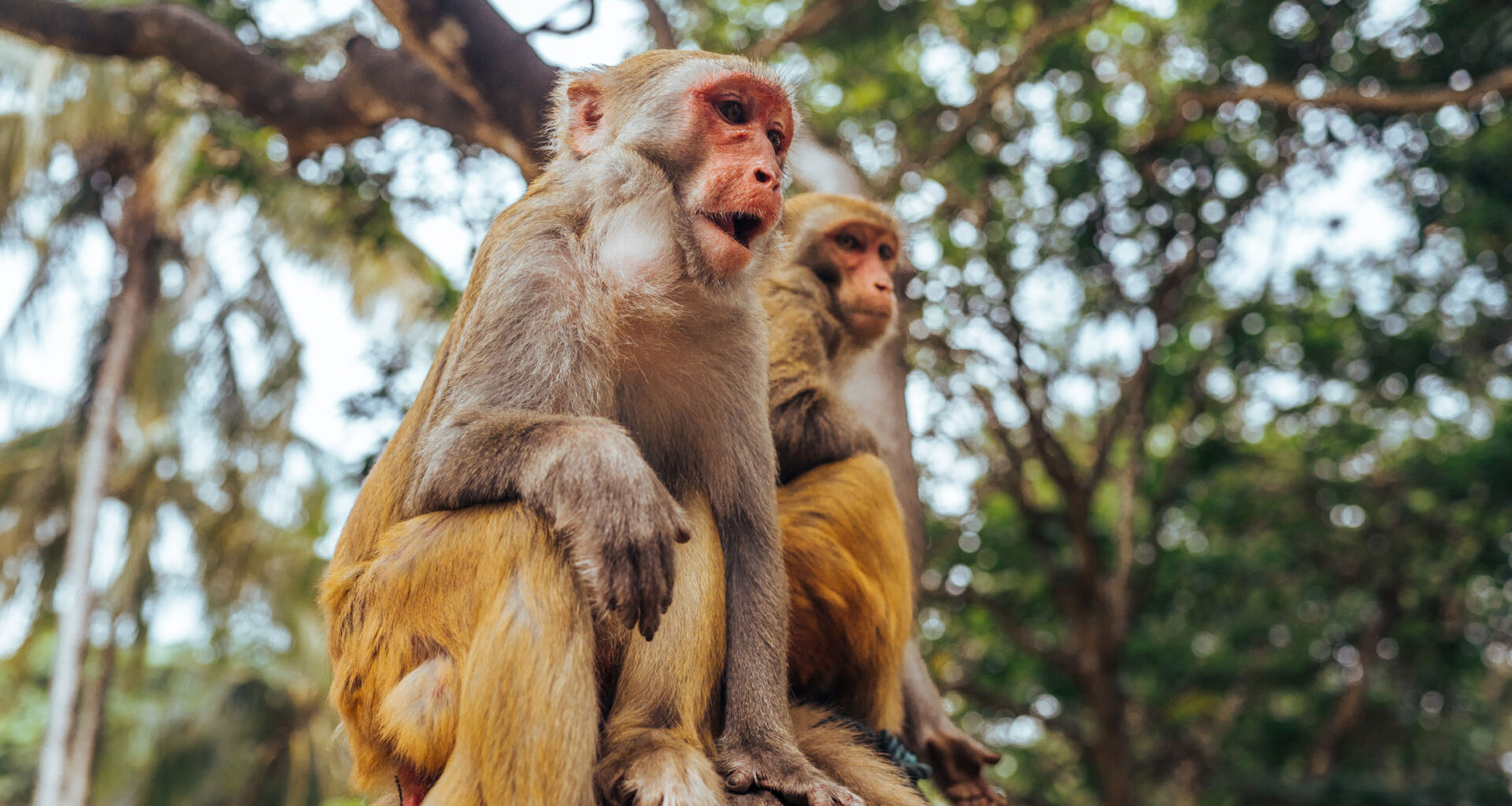
A new study finds that monkeys show signs of the uncanny valley – the unease people get around near-human robots and lifelike digital characters – when they look at another monkey’s body. Shown a highly realistic animated monkey, they watched it much as they watched real footage, but a slightly rougher version drew fewer glances, as if something felt subtly wrong.
Rhesus macaques are the main animal stand-in for studying how the human brain reads faces and bodies. That comparison holds up only if both species process social signals alike. The finding is evidence they do. It also gives brain scientists a controllable digital monkey they can pose, strip down, and replay to isolate which cues the brain reacts to.
Building a digital monkey

To study how the brain recognizes a walk or a gesture, scientists need to replay the same movement while changing one feature at a time. Real video gives them no such control. Lucas M. Martini, a doctoral researcher at the University of Tübingen, and his colleagues built a digital stand-in for exactly that and named it MacAction.
Professor Martin Giese, the study’s senior author, studies how the brain reads social signals. In an email to Earth.com, he said, “We think that understanding the neural mechanisms of social perception is important for many clinical applications.”
The avatar is a commercial three-dimensional monkey model, detailed down to its fur. Its body can move at 86 separate joints. Making it move like a real animal is the hard part. Reflective markers are the standard tool for motion capture in film and sports, but they fail on a monkey. The animal either picks them off or behaves differently once something sticks to its fur.
Tracking a monkey without markers usually demands banks of cameras and thousands of hand-labeled frames, work only large labs can afford. MacAction cuts the labor sharply. A neural network learns a monkey’s pose from a few frames marked by hand, then fills the gaps. It can rebuild a whole action from as few as two labeled frames per second.
Faces came first. The same group had already shown, in an earlier study, that a carefully built monkey face avatar could win over real macaques. A body was harder, bending in far more directions than a face, and no one had made a lifelike one that moved.
Reading the monkeys’ eyes
To find out whether the animation passed as real, the team turned to eight rhesus macaques at KU Leuven in Belgium. A monkey cannot say what it sees. So the researchers used eye tracking. Where and how long each animal looked served as a stand-in for interest and preference.
Each monkey watched a stream of clips – some real footage, some the animation – presented in random order. Each clip lasted about 2.4 seconds. When the animated monkey was fully realistic, the animals looked at it much as they looked at real video. Their gaze followed the same patterns and lasted for similar lengths of time. By that measure the two were indistinguishable.
Researchers had never demonstrated this response to a moving monkey body before. The animals’ eyes treated a computer-generated body the way they treated a real one. This suggests the animation was realistic enough to stand in for a real monkey in an experiment. Everything after that depended on this result.
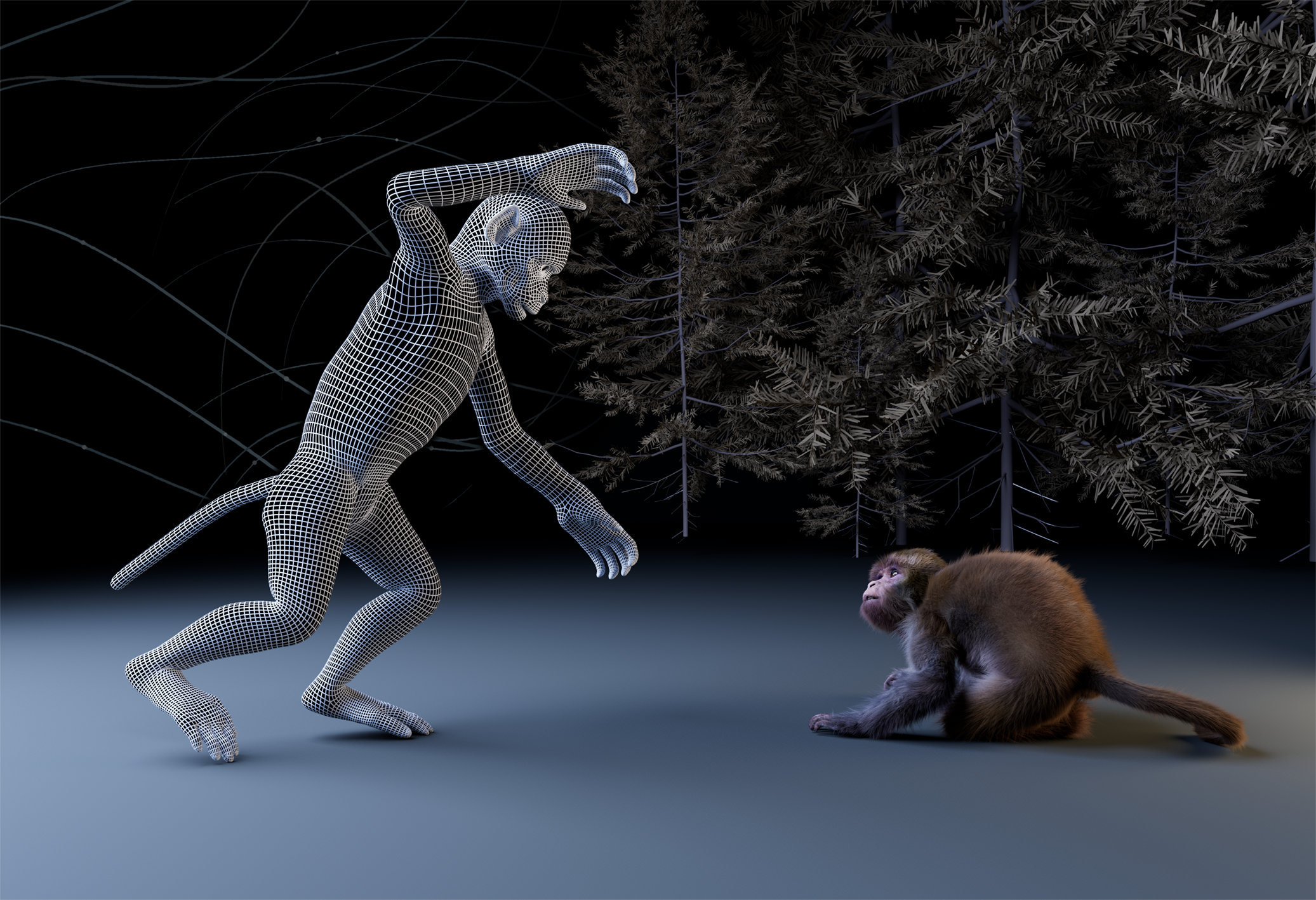 Researchers varied the realism of virtual monkeys to test how macaques respond to lifelike and artificial bodies. Photo credit: Martin Giese / MacAction.Testing the uncanny valley
With a believable monkey in hand, the researchers began stripping away its realism. They ran the same walk and turning gesture through four versions of the avatar. With each version, the monkey became less realistic. It went from full fur to bare skin, then a flat gray figure, and finally a plain white wireframe outline. The real video sat at the top of the range.
The monkeys’ attention did not steadily decrease as the avatars became less realistic. Instead, it dropped sharply for the versions in the middle. The monkeys gave the fully realistic versions and the crudest wireframe plenty of attention, but the gray figure in between drew the fewest looks of all – a dip in the middle that is the signature of the uncanny valley.
The name comes from robotics researcher Masahiro Mori, who proposed the idea in 1970. He suggested that people become more comfortable with a robot or animated figure as it grows more humanlike.
But when it gets close to looking real without quite getting there, that comfort suddenly plunges. Something almost right, but not right, reads as wrong. People feel it around waxworks and near-human game characters.
Beyond monkey faces
Evidence of the uncanny valley had already appeared in monkeys more than a decade ago. In that experiment, macaques looked away from realistic synthetic faces while lingering on real and cartoonish ones. Those were faces. Whether a body could do the same was open until now.
The effect held up under scrutiny. It was not explained by simple differences in brightness, contrast, or the number of edges in each image, all of which the team checked.
The same dip appeared in still images, ruling out any effect caused solely by motion. The low point also drifted slightly between individuals, as it does with faces.
Shared primate vision
The finding reaches past one clever animation. It says something about how primates see.
If a monkey’s brain sorts real from almost-real the way a human’s does, the two may rely on similar machinery for reading social signals from a body. That similarity helps justify using monkeys to study human social vision.
Asked by Earth.com what that shared response means, Giese said, “This implies that the mechanisms of social perception are shared between different primate species.” In his view, those brain circuits are old, laid down in evolution long before humans appeared.
Building better avatars
This work also joins a small push to build virtual monkeys for research. Independent groups have built digital macaque heads to study social behavior, and at least one paper warned that an avatar can look too realistic, tipping into the same eerie zone. Getting an avatar past that zone, not stranded in it, is what makes it useful.
The method was designed for broader use. Because it needs only a few cameras and light hand-labeling, smaller labs can use it. Researchers could also adapt it for other animals, including hard-to-film endangered species where footage is scarce. The work could have implications for digital humans in games and films, where the uncanny valley has long been a stubborn obstacle.
What began as a way to animate monkeys ended by showing that unease at the almost-real is not a human quirk. It runs deeper in the primate family, part of how the brain reads its own kind. With a monkey that can be rebuilt and replayed at will, researchers can now ask where in the brain that judgment happens.
The study is published in PLOS Biology.
—–
Like what you read? Subscribe to our newsletter for engaging articles, exclusive content, and the latest updates.
Check us out on EarthSnap, a free app brought to you by Eric Ralls and Earth.com.
—–