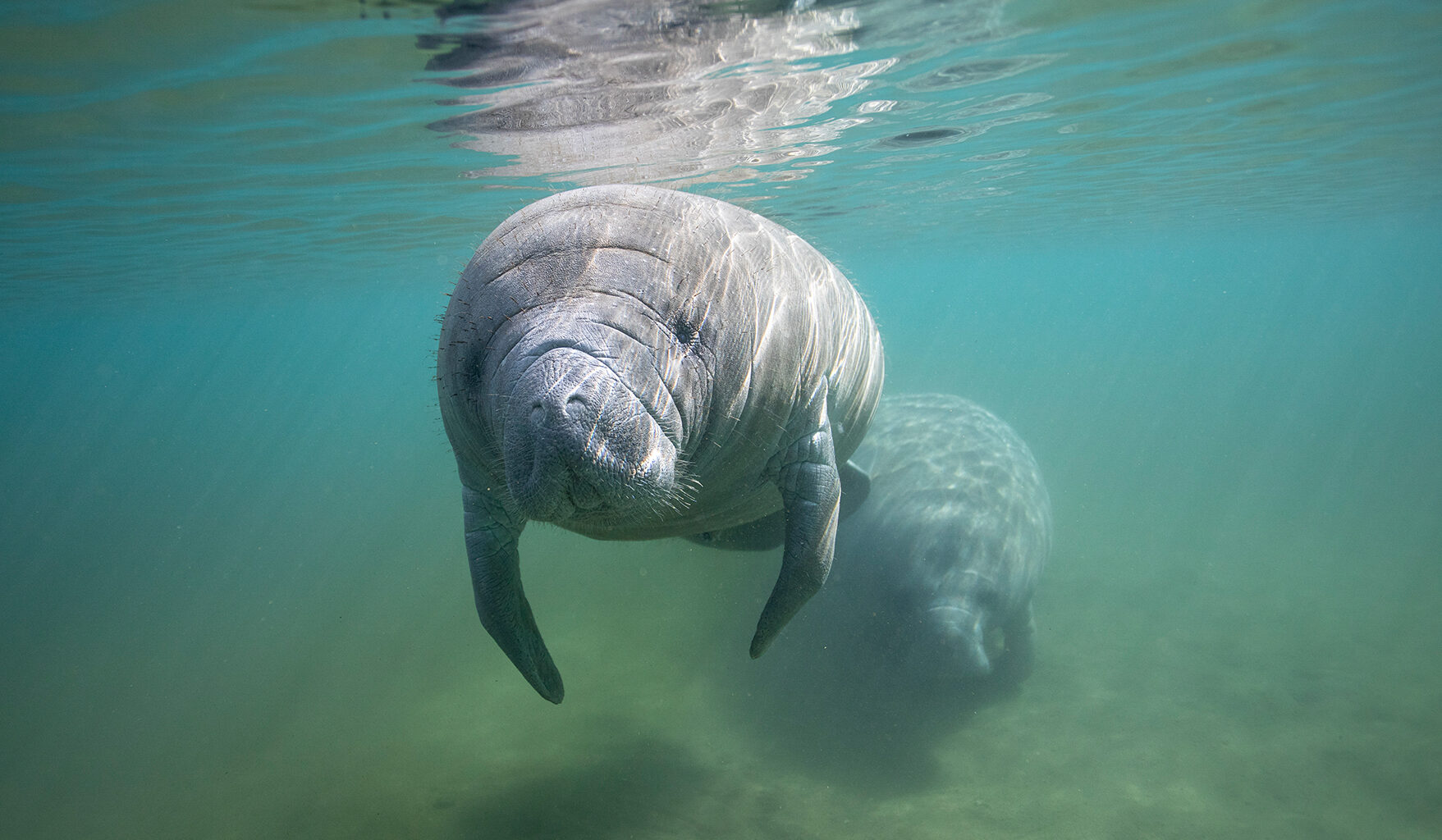
Florida’s manatees could be among the species left more vulnerable by the Trump administration’s rollback of Endangered Species Act protections, conservationists warn, as the Center for Biological Diversity moves to challenge the changes in federal court.
The Center has filed a motion challenging the administration’s decision to scrap the Endangered Species Act’s (ESA) “blanket rule,” which automatically protected plants and animals listed as threatened, unless officials developed a rule specific to that species.
The rule’s removal is one of two related changes announced Friday, both concerning Section 4 of the Act, which governs how federal agencies decide which species to list and whether they’re classified as ‘threatened’ or ‘endangered’. ‘Endangered’ is the more severe designation of the two and one reserved for species facing more imminent extinction.
The blanket rule protected threatened species from “take” – legally defined as any attempt “to harass, harm, pursue, hunt, shoot, wound, kill, trap, capture or collect.” That prohibition was “the meat of the ESA,” according to Elizabeth Neville, director of environmental law and policy for Save the Manatee Club, a nonprofit advocacy group based in Longwood, Florida.
“It’s a bit of a common-sense mechanism in efficiency for the agency: that, if a species is threatened with extinction, the baseline prohibition should be prohibition against take,” Neville told Central Florida Public Media. “Those are the common-sense protections to prevent an already imperiled species from declining further.”
The second change will require federal agencies to weigh economic and national security interests when designating critical habitat for a protected species, allowing areas to be excluded from that designation “if that exclusion will not cause the extinction of the species,” according to the Interior Department, as reported by Central Florida Public Media.
Neville considers all of the recently announced changes concerning, but has singled out the critical habitat revision as particularly troubling, if not “flagrantly illegal.”
“It makes critical habitat really vulnerable to economic considerations, when the statute requires the best available science,” Neville said. “It’s going to put a weight on the scale in favour of economic interests over conservation.”
Under the revised rule, if the economic costs of designating critical habitat in a given area are found to outweigh the conservation benefits, agencies will be required to exclude that area from the designation. For manatees, Neville said, that raises the risk of losing the warm-water refuges and forage habitat the species depends on to survive – a loss she warned could carry a steep long-term cost, both ecological and economic.
“Keystone species like manatees provide incredible ecosystem services,” Neville said. “And it’s really amazing the millions and millions of tourism dollars that manatees alone bring into the state.”