
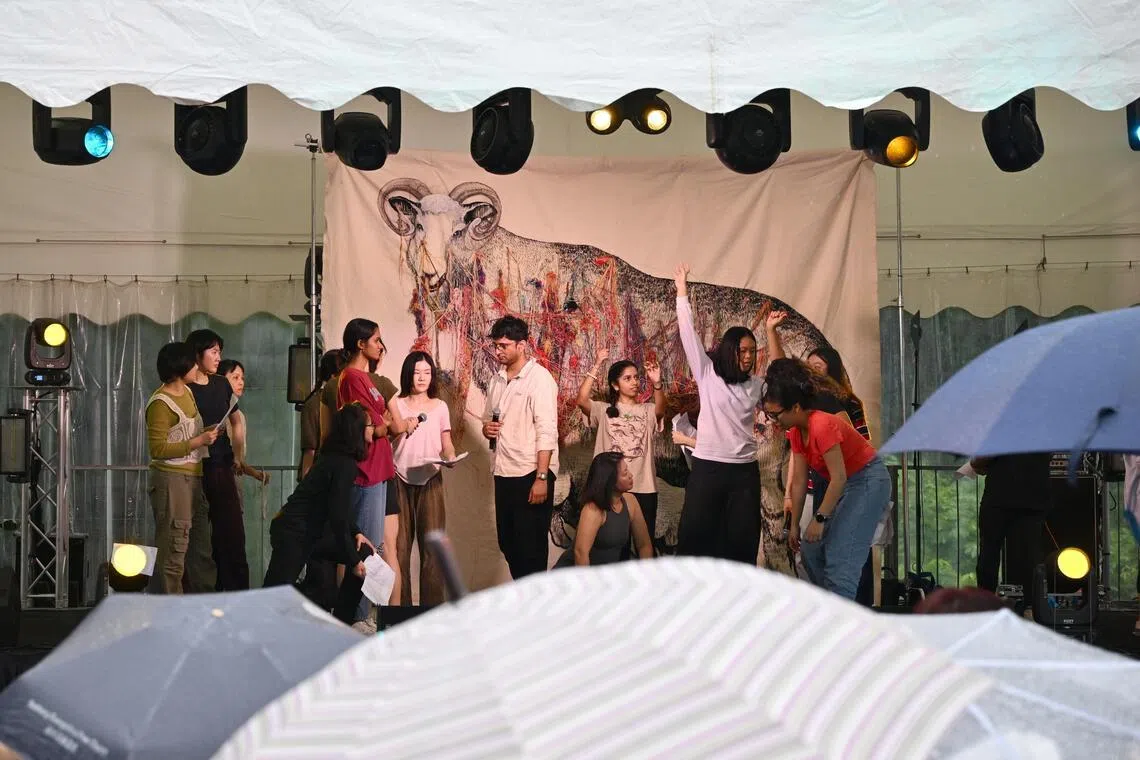
SINGAPORE – Art galleries at Gillman Barracks are maximising their leases, with several recently signing or prepared to sign extensions till 2030.
At least half of the 11 arts tenants have committed or are ready to continue operating in the former British military barracks, despite confirmation on July 10 that they are living on borrowed time and will have to depart by 2030, The Straits Times has learnt.
They harbour minimal hopes of staying on in the future housing estate. Though their Lock Road and Malan Road blocks are slated for preservation, all tenants have been asked to leave after 2030 so the two-storey structures can be repurposed for residential shops or services.
Still, galleries are holding on and anticipating more visitors in the interim seeking what will be imminently lost.
Art gallery Yeo Workshop founder Audrey Yeo says: “After 14 years, the precinct is finally gaining wider recognition as an established arts district, and we anticipate that visitorship will continue to grow in the next few years until 2030.”
Asia and Singapore are getting more attention on the international art scene, and now is not the time to feel deflated, the president of the over-40-strong Art Galleries Association Singapore adds. “Galleries must seize this moment with confidence rather than become disheartened by local frictions to our existence.”
The Government launched Gillman Barracks in 2012 as a new arts district after a $10 million makeover, attracting 13 international and local galleries to sink their roots in the southern end of Alexandra Road – a vision that has now been dropped.
Richard Koh Fine Art director Stella Chang says the gallery is in the midst of renewing its lease that ends in August. “We still have a few more years to go on our time at Gillman Barracks, so we intend to stay put for now. Four years is still quite a decent length of time for galleries to make the best use of the space.”
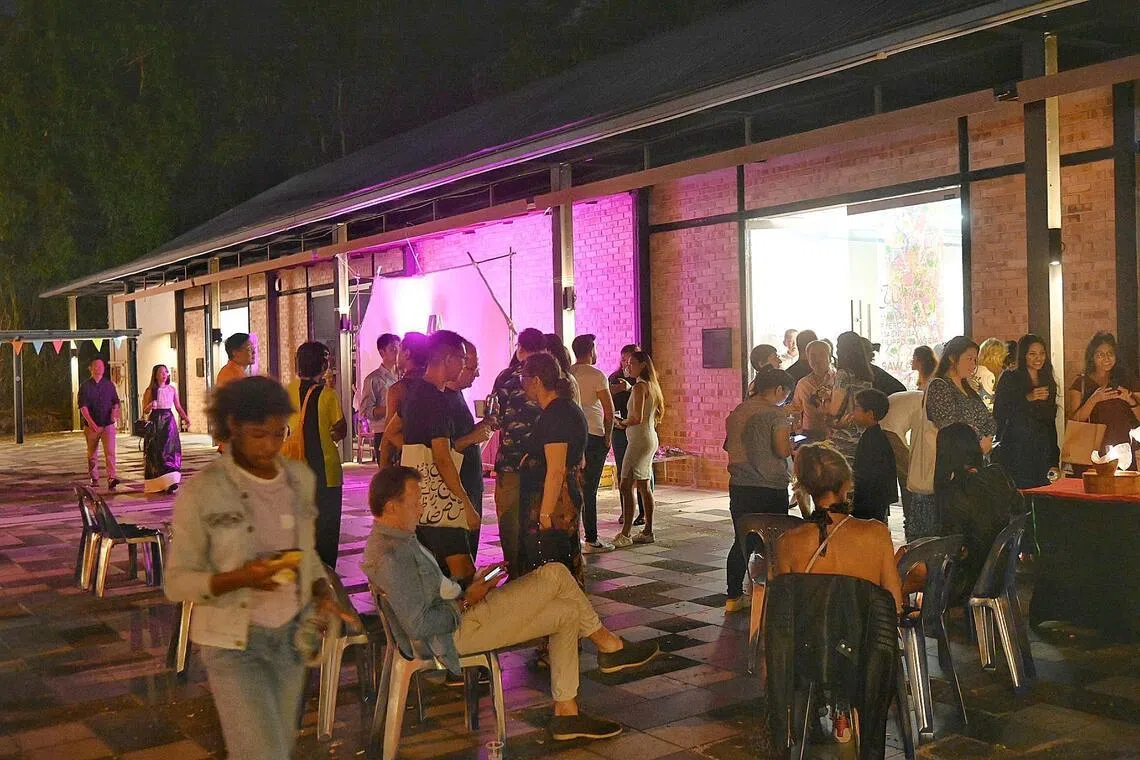
‘A sense of freedom’: Visitors at block 47 Malan Road in Gillman Barracks during the Art After Dark event during Singapore Art Week in 2023.
ST PHOTO: DESMOND WEE
She describes it as “business as usual” – exhibitions are changed every two to three months, and thousands are expected to descend on Gillman Barracks for the annual Singapore Gallery Month in August and September.
On the finality of the two-year heritage and environment impact study for the 6.6ha site that was first announced in 2024, Chang adds: “It is mixed feelings, honestly. We understand the need for housing and respect the decision. At the same time, Gillman Barracks has been a special home for the arts in Singapore, and it has shaped our gallery and the community around it.
“We hope that agencies will do their part to keep the cluster active and programmed for as long as tenants remain.”
The sprawling property is managed by the Singapore Land Authority.
The Columns Gallery president Dong Jo Chang has a similar calculation. He renewed his gallery’s lease for another three years earlier in 2026 fully expecting the site to lose its status as an arts hub.
It is the environment that he could not let go of. “One of the main reasons I chose this location was its heritage buildings and the strong community of established galleries,” he says. “Although Gillman Barracks is not the most accessible destination, it offers a unique atmosphere and a sense of independence that I felt was important for the gallery’s identity.”
In June, he arranged for a Steinway piano to be brought into his gallery so Singapore-based pianist Tiffany Leu could play the meditative music of Philip Glass amid the desolation of Brazilian artist Lina Kim’s photographs – an immersive experience that would have been much harder to achieve in a mall setting.
He has flirted with alternatives, organising a well-received exhibition of Filipino artists at Tanjong Pagar Distripark during Singapore Art Week in January. But rent there was 20 to 30 per cent higher, and the warehouse-style setting may also not be as suitable for his regular programming, he says.
Colin Wan, general manager and chief creative at gallery and non-profit organisation Art Outreach, says it is partly a matter of sunk costs. “We have invested quite a lot into our space,” Wan says. “As a non-profit, we naturally want to make the most of that investment.”
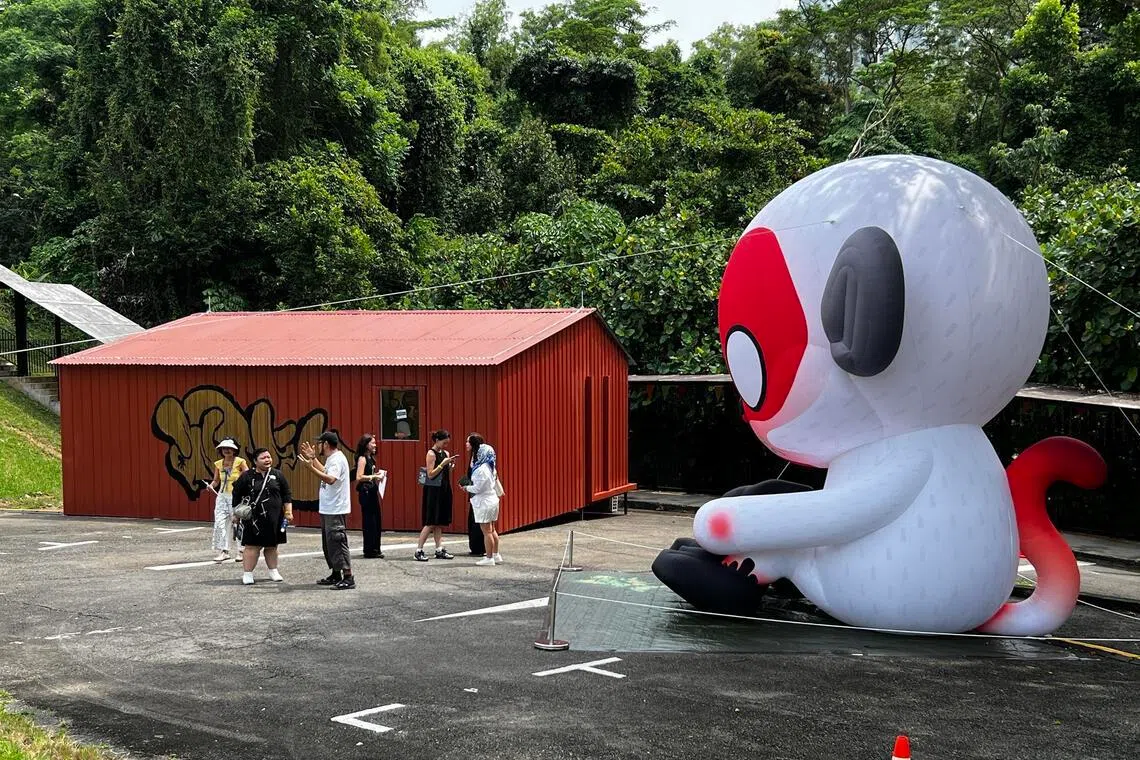
Art Outreach produced several shows, including the Monkey King installations around Gillman Barracks by Singapore artist Antz.
PHOTO: BT FILE
Art Outreach’s lease ends in Oct 2027, with an option to stay on for another two years. The organisation is on the lookout for other opportunities, but has a clear preference. “We’ve been part of the Gillman Barracks community since 2012 and would like to stay until 2030.”
Another longstanding space at Gillman Barracks, Nanyang Technological University’s Centre for Contemporary Art – which includes office and research spaces and, until 2021, exhibition halls and residency studios – also recently extended its lease till end-2029.
Yeo says her gallery has begun exploring spaces in the city, taking advantage of retail slowdown that has led to more vacant central premises. It recently set up a second space in Downtown Gallery, attracting more incidental crowds.
Her lease expires in 2027, and could be extended till 2030, leaving her among the final ones to bid the space farewell.
The community of galleries cannot be easily replaced. Yeo says: “2030 is soon but also distant in this rapidly changing world, and the art world in particular, is changing rapidly. Galleries like us chug on because being part of a strong gallery network and ecosystem remains one of the only and best ways we know how to stay connected to global and local art developments, build meaningful relationships, and respond to these shifts.”