
The surface of Mars is no place for anything fragile. Radiation pours down, and the ground’s chemistry tears delicate molecules apart.
Carbon complex enough to hint at life should not last on Mars, so any traces lie buried deep, out of reach.

A rover just complicated that picture. Without digging or drilling, it turned up a rich trace of complex carbon on the bare face of a rock, exactly where it should not be.
Jezero’s ancient lakebed
Billions of years ago, Jezero crater held a lake. Rivers ran in and dropped sediment that piled into a delta, the fan of debris that builds where flowing water meets still water.
NASA’s Perseverance rover has crawled across that dried-up basin since 2021, poking at rocks for any trace of biology. Ashley Murphy, a geologist at the Planetary Science Institute (PSI) in Arizona, led the new work.
Their attention landed on a pale band of stone at the edge of the old delta, the Bright Angel outcrop. It is the kind of place where water once pooled and any traces of life might survive.
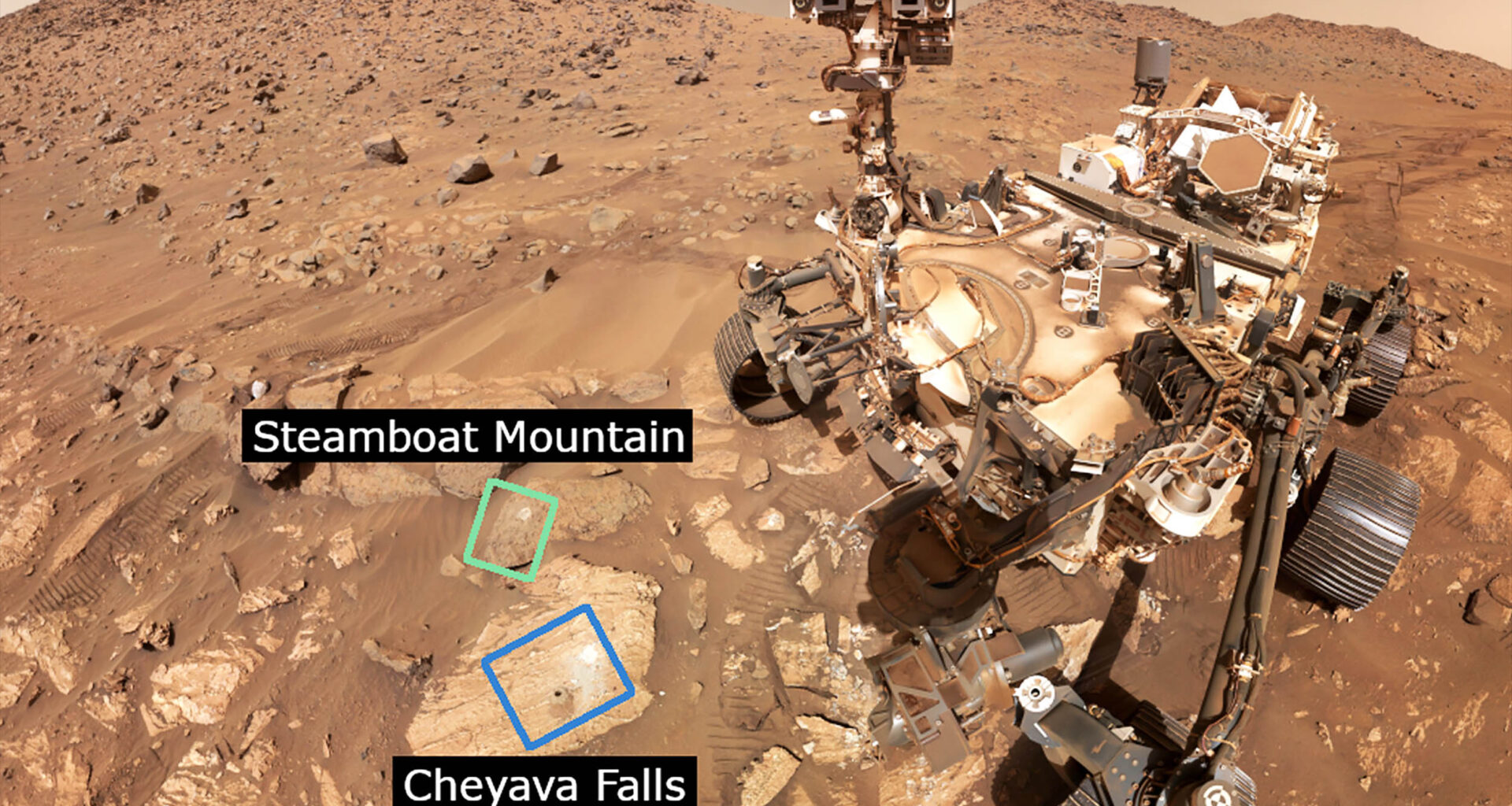
One slab there, nicknamed Cheyava Falls, had already drawn stares. Its face is freckled with dark-rimmed spots that resemble the marks microbes leave in Earth rock, a pattern a 2025 study called a possible sign of past life.
Richest carbon haul yet
The rover reads a rock by shining a light on it and measuring how that light bounces back, which reveals the molecules inside.
Aimed at two Bright Angel mudstones, rocks made of hardened mud and silt, it kept turning up carbon.
This was not plain carbon, but macromolecular carbon – big, tangled molecules of many carbon atoms strung together.
The rover logged hundreds of hits across the two rocks, the largest haul of carbon found anywhere on Mars yet.
Carbon is the backbone of every living thing we know of, so finding it this complex, in this much quantity, draws attention. On its own, though, it proves nothing was ever alive.
Carbon on a Mars rock
The real surprise was where the carbon showed up. No drilling, no grinding into weathered rock. It sat on the natural surface, beneath nothing but a film of dust.
No one had ever caught macromolecular carbon resting on bare Martian rock like this.
Kyle Uckert, an astrobiologist at NASA’s Jet Propulsion Laboratory (JPL), called it the shallowest detection of organic matter ever made on Mars.
That is odd, because the Martian surface is brutal. Radiation rains down, and the chemistry of the ground slowly tears fragile carbon molecules apart. Anything this complex should have been destroyed long ago.
Two ideas fit. The carbon may have been uncovered recently, before the surface could chew it up, or nearby minerals may have shielded it from the radiation. The team cannot yet say which.
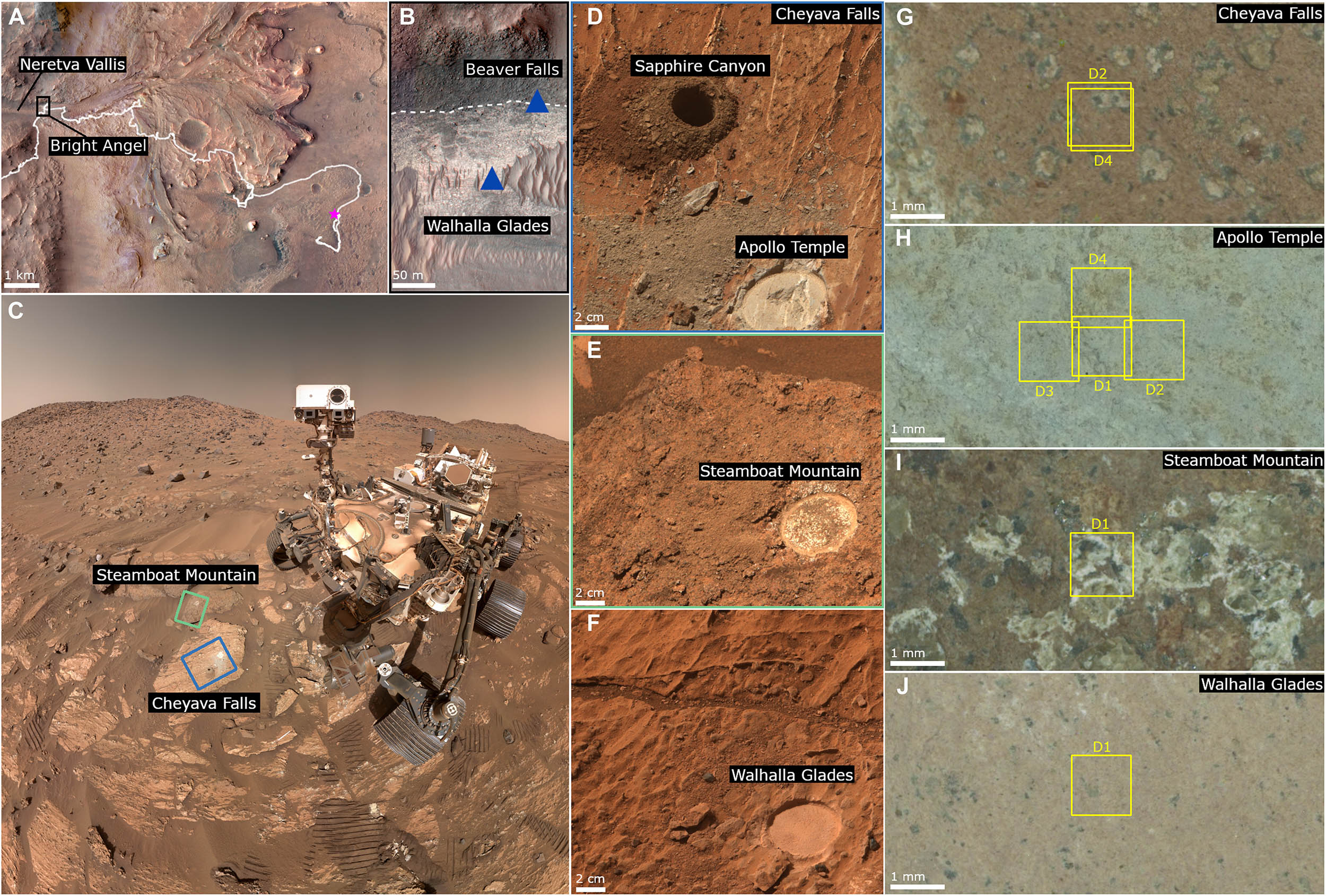 Geologic context of the Bright Angel outcrop. (A) Location of Bright Angel in Jezero crater, Mars (the white line shows the path that the rover traversed and the pink star marks the landing site on the crater floor). (B) Zoomed-in view of the black box in (A). Credit: NASA/JPL-Caltech/ASU/MSSS. Click image to enlarge.Where the carbon came from
Here is the snag. The signal the rover caught looks the same whether the carbon came from something living or something that never lived at all.
On Earth, carbon with this fingerprint shows up in the crushed remains of ancient microbial mats and in coal, both made by life.
It also forms in meteorites and in rocks cooked by hot underground water, where life plays no part.
“Macromolecular carbon on Mars does not prove the existence of life there,” said Murphy.
The carbon might have drifted in on space dust or inside a meteorite, formed in hot water underground, or be the remains of something once alive. The rover cannot tell which.
Spread far and wide
The find was no fluke. Rather than a single lucky spot, the carbon turned up again and again across the Bright Angel rocks, tied to different minerals in different settings.
Far across the planet, NASA’s Curiosity rover has spent years pulling organic molecules from the floor of Gale crater.
The two sites lie more than 2,200 miles (3,540 kilometers) apart, yet both hold carbon-rich remains that a paper ties to a once-wetter world.
Carbon spread that far hints that the conditions life needs, and the raw material for it, may once have reached across much of Mars. And what Bright Angel holds looks more complex than most carbon found there before.
Closer to an answer
Stacked against everything before it, the picture is sharpening. This is the richest, most complex batch of carbon yet drawn from Jezero, sitting beside spots that already looked like the work of microbes.
Not proof of life, but the strongest hint of it so far.
Proving whether life made it will take a lab on Earth, which means carrying a chunk of Mars home. The Cheyava Falls sample was supposed to make that trip in the 2030s.
But the U.S. program built to fetch it has been scrapped, and China’s own sample mission, aimed at an easier site, will not fly before 2028. The clearest test of the question may sit sealed in a tube, waiting on Mars.
The study is published in the journal Science Advances.
—–
Like what you read? Subscribe to our newsletter for engaging articles, exclusive content, and the latest updates.
Check us out on EarthSnap, a free app brought to you by Eric Ralls and Earth.com.
—–