
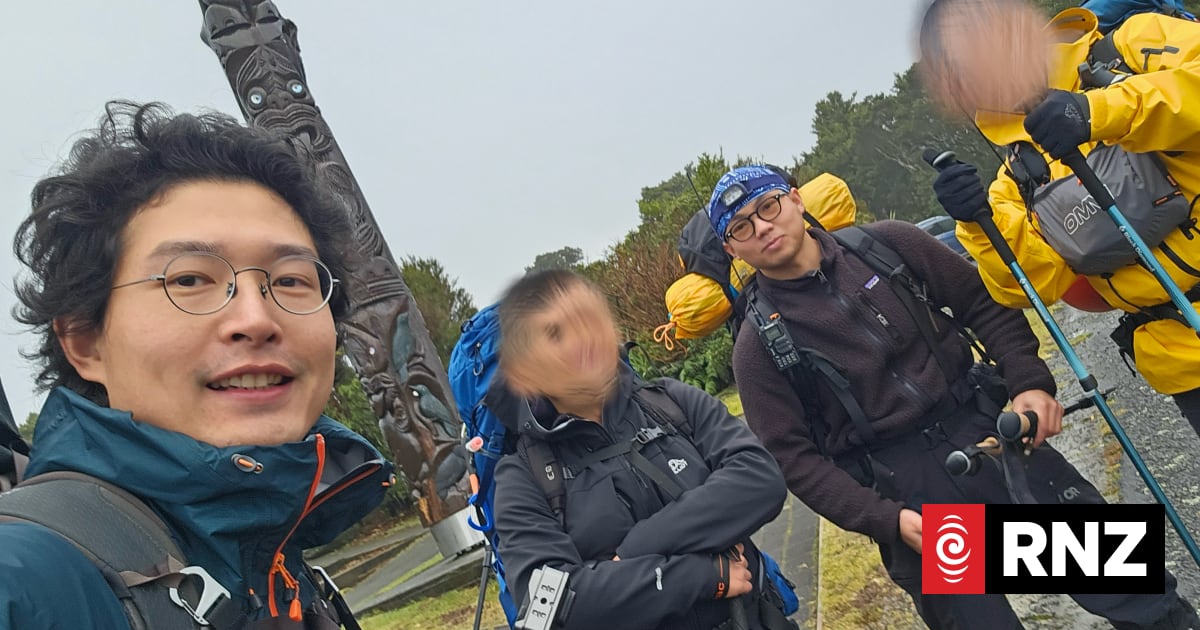
Aucklander Ash Shi feels grateful to be alive upon being discharged from hospital after multiple surgeries.
One of three climbers rescued from Mount Taranaki earlier this month, Shi suffered fractures to his neck, face, skull and ribs after sliding down “steel-like” ice while trying to save another climber who had fallen.
An experienced climber, Shi described the conditions as the most dangerous he had ever encountered.
Shi and three friends had planned to summit from the south side of the 2518-metre mountain.
They made the attempt on a weekend during which the weather was expected to be clear and still after observing conditions on the mountain for several weeks.
One of the men in the group felt uncomfortable with the conditions during the ascent and so abandoned the attempt.
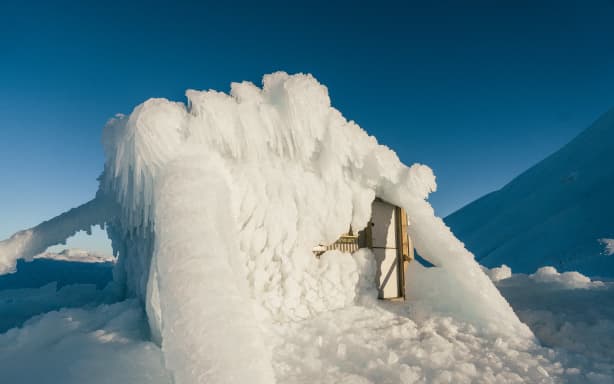
Climbers had to hack through ice on the door of Syme Hut on Mount Taranaki to get in.
Supplied / Ash Shi
The remaining members of the party climbed to Syme Hut, which sits at an elevation of 1940 metres.
They stayed in the hut overnight and decided to descend the next day as conditions were too poor to continue climbing.
Another team of three staying at the hut also planned to descend the next day.
“We got up to see the sunrise. It was beautiful,” Shi said. “I also got up at the middle of the night to take photos of the starry sky.”
Coming down, however, was difficult due to the extremely hard ice and steep gradient.
“It meant I had to extend my ankles almost to their limit just to get my crampons into the ice,” Shi said.
“That pushed my centre of gravity forward, making it dangerous.”
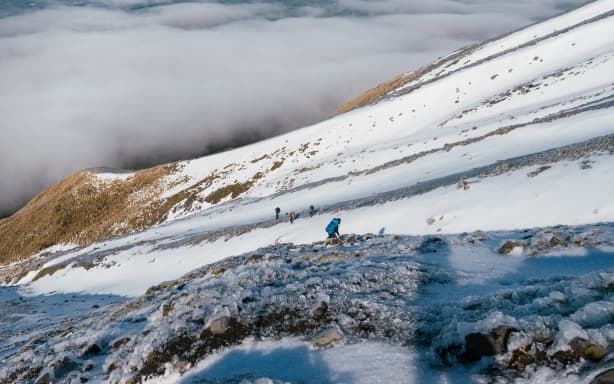
Climbers descend Mount Taranaki in difficult conditions earlier this month.
Supplied / Ash Shi
Despite the treacherous conditions, Shi and his team made it down the steeper part of the slope. The other team of climbers was below them.
Shi noticed another man descending the mountain a short distance behind him.
“I heard a scream and then [something like] the sound of an avalanche, and saw that he was sliding down,” he said.
Shi said he had no time to think.
“I immediately moved to my right, trying to stop him,” he recalled.
“I dug my ice axe into the ice, hoping I could arrest his fall. However, I completely underestimated the force.
“The ice was so slippery that there was no friction. The other man hit me with enough force to knock me off my feet, and we were both sliding down.”
His mind went blank after the collision, and the next thing he remembered was desperately trying to drive his ice axe into the ice.
“It just didn’t bite,” Shi said. “Then I remember hitting rocks and tumbling several times.”
“The next thing I remember was waking up with the three climbers of the other group around helping us, taking off their jackets and putting them over us.
“We were lying on the ice at the bottom of the slope.”
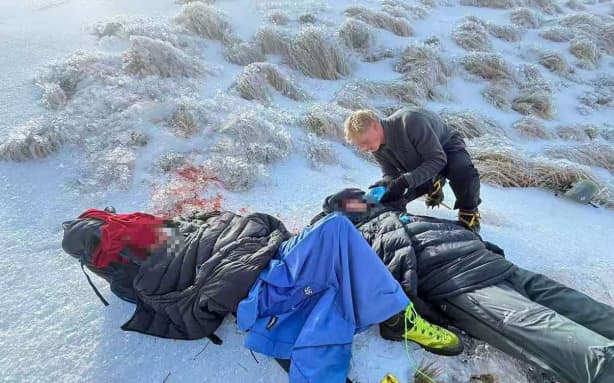
Micah Sharp attends injured climbers on the slopes of Mount Taranaki.
Supplied
The trio walking in front of Shi’s group included experienced hikers Simon Sharp and his 18-year-old son, Micah.
Micah slipped on rocks when scrambling over to where the two men landed and ended up fracturing a collarbone, although he only realised this later.
First on the scene, Micah said the two men were “pretty much on top of each other”.
He tried to get the climbers into a comfortable position while not moving them too much given their injuries.
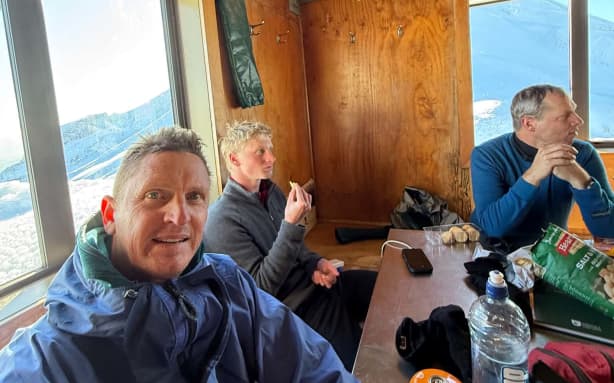
Simon Sharp, Micah and a friend at Syme Hut.
Supplied / Simon Sharp
“My dad said to chuck some warm gear on them, so I took out all of my gear out of my bag and just tried to cover them with as many warm clothes as we had,” he said.
Sharp said he knew the situation was bad when he saw Micah’s face, but he tried to keep calm.
He said they tried to keep the injured men warm and their necks straight.
They also constantly spoke to the injured climbers to ensure they were conscious while awaiting rescue.
“The ice was extremely hard at that time,” Sharp said.”[It] was probably the hardest ice I’ve climbed for a very long time.
“I know for a fact that where they fell was a dangerous little gully, and the ice was incredibly creepy hard because there was no sun on that area at all.”
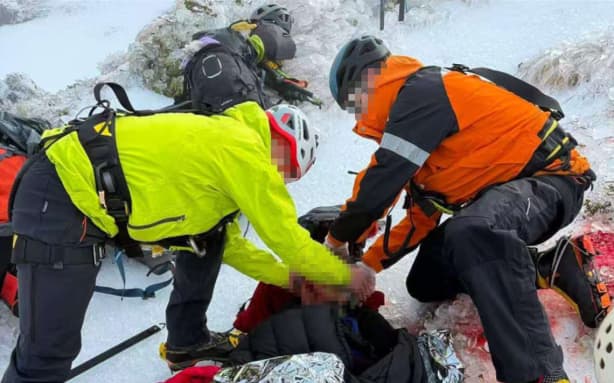
Members of the rescue team attend to Ash Shi and another injured man on the slopes of Mount Taranaki on 12 July.
Supplied
The rescue helicopter had been summoned but was having difficulty reaching them due to fog.
It was finally able to reach the injured climbers when the weather cleared more than two hours after the accident had happened.
Shi and the other climber were taken to hospital with serious injuries.
Shi felt grateful he was alive thanks to the men who provided first aid on the mountain and the prompt actions of the rescue team.
“Life is too important, yet too fragile,” he said. “Things can happen anytime.
“I feel incredibly lucky. [I’m sure this experience] will have a profound impact on how I live my life, although I don’t yet know exactly how. I think it’ll make me appreciate life even more.”
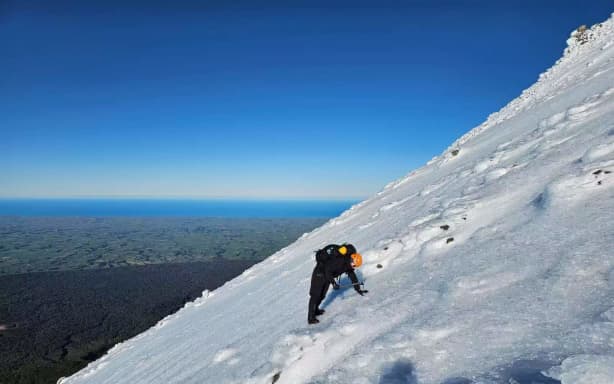
Bondee Jia climbs Mount Taranaki the day prior to the accident.
Supplied / Ash Shi
Bondee Jia was descending Mount Taranaki with Shi before the accident.
He was airlifted off the mountain from a higher position on the slope behind Shi and the other climber who fell.
“[I saw them] hit a rock, get launched into the air, slam back down, get launched again and slam back down again,” Jia said.
Jia said he couldn’t see the injured climbers clearly in the fog after they tumbled approximately 300 to 400 metres down the slope.
He called emergency services after learning from the other teammate who was closer to the fallen climbers that the situation wasn’t good.
Jia realised it was too dangerous to attempt to descend any further and so stayed where he was until help eventually arrived.
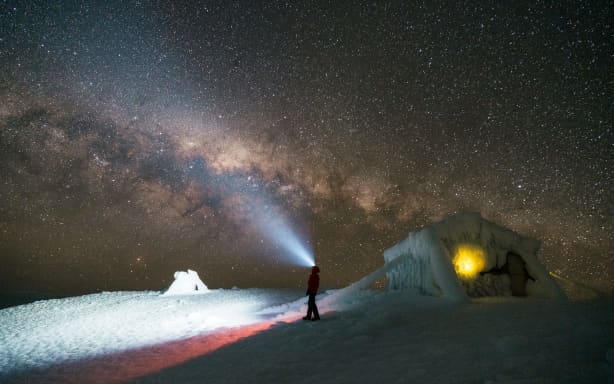
Ash Shi admires stars in the night sky at Syme Hut on Mount Taranaki before the accident.
Supplied / Ash Shi
Sharp said it was “incredibly lucky” no one died and was happy to learn that both men were recovering.
Shi’s wife, Melody Kee, was also thankful that her husband was alive.
“I’m so grateful to all of those who helped during the process,” she said, thanking the nurses, doctors, surgeons, police, rescue team and the three men from the other group.
Kee had also been in touch with the other injured man’s family and was relieved to learn that he was also in a stable condition.
Shi urged climbing enthusiasts to assess risks constantly and turn back if conditions became difficult.
Jia offered some advice of his own from the experience.
“It’s important to ensure your own safety before trying to save others in the mountains,” he said.
Mountain Safety Council chief executive Mike Daisley said 166 people had been rescued on Mount Taranaki summit climbs between July 2010 to March 2026.
“When comparing rescues of trampers with other tracks across the motu, Taranaki Maunga is the second highest after Tongariro Alpine Crossing,” he said.
Daisley urged people to have the appropriate skills and experience before they attempted a climb.
He warned climbers to use appropriate equipment, know their limits and be prepared to change their plans.