
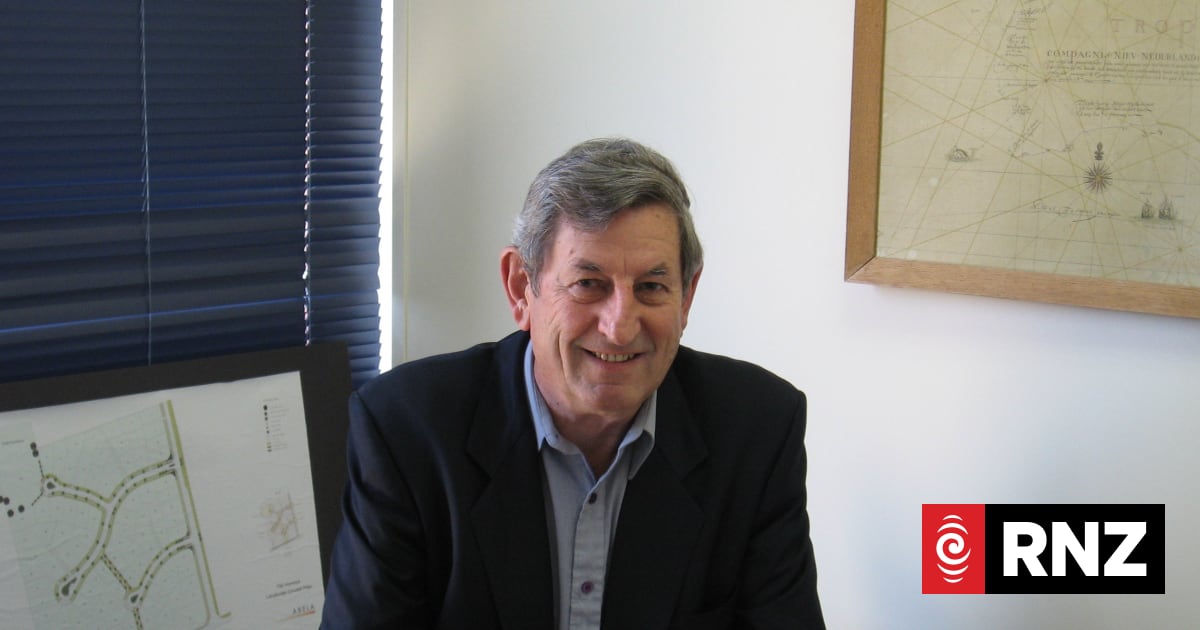
“Famous for making things happen,” the “best prepared minister around the cabinet table” and a “legendary” work ethic, that’s how Sir William Birch has been remembered.
The former finance minister who served 27 years in Parliament and 12 years in government was farewelled at a public service in Pukekohe on Friday.
The Prime Minister and Speaker of the House were both in attendance, along with former prime ministers Jenny Shipley and Bill English.
Born in Hastings in 1934 and educated at Hamilton Technical College, he qualified as a surveyor in 1957.
Usually known as Bill, he had his own practice in Pukekohe and served his political apprenticeship in local government. He had twice been Pukekohe’s deputy mayor when he retained Franklin for the National Party candidate in the 1972 election that delivered a landslide victory to Labour.
A friend of Sir Bill’s, National MP Andrew Bayly, was the MC. He highlighted the presence of Joan Bolger, the late Jim Bolger’s wife.
“Everyone knows how close Bill was to you and your husband, and it’s just lovely to have you here.
“Gee, I hope I’m not going to get emotional,” Bayly then said.
He shared a story told by a constituent, who Sir Bill helped into a home, to highlight his ability to connect with a wide range of people.
The constituent described being a young family that wasn’t able to afford a house.
“But after approaching Bill, within a week, we moved into a flat in Ōtara, and my parents also got help to move into a better place in Māngere.”
“I’ve never thought a parliamentarian would help ordinary people,” said Bayly, acknowledging Sir Bill was “famous for ringing up people late at night and doing what he had to do to make things happen.”
Sir Bill’s granddaughter Sarah Bosgra spoke as well, saying he worked hard for his electorate and was well respected throughout the community.
She described his “outstanding work ethic” being evident at family lunches where, after eating, Sir Bill would excuse himself to read the “two huge bags of prep reading” ahead of the week in Parliament.
Christopher Luxon also spoke of his “legendary” work ethic, and the sacrifices MPs make.
He described Sir Bill’s final contribution to Parliament where he said that “separation from his family, with whom he loved very much, was the biggest sacrifice he had made in politics”.
Luxon spoke directly to his family, saying he hoped when they looked around the room, and the country, “you see how much progress happened, not just because of Bill’s service to New Zealand, but also because of the sacrifices that you made to support him”.
Luxon listed the different portfolios Sir Bill held over his time in government, including health, energy, labour, regional development and finance.
“People used to joke that if you didn’t know which minister was in charge of something, it was probably Bill because he was, as has been well said, the minister for everything.
“But what really mattered wasn’t how many jobs he had; it was that he did each one properly.”
Brad Tattersfield, who wrote Sir Bill’s memoir, spoke about him being “the best prepared minister around the cabinet table” because he read all his papers.
He described a high point of Sir Bill’s political career, as the man who lead “Think Big,” which was later “vilified”. But he later returned in Bolger’s government.
“It was a time of massive reform, right across government activity. Much more change than any government since then has attempted.
“It was controversial, stressful, and beset by almost daily political crises, and Bill was in the thick of it, steering the government’s solutions to seemingly endless problems.”
Tattersfield said it was likely no decision of any consequence was made by that government without Sir Bill’s hand in it.
Barbara Knowles, who worked for Sir Bill, described him as being “very focused” on his constituents in the electorate. He held the Franklin, Rangiriri, Maramarua and Port Waikato electorates at various times, which Pukekohe was always included.
“Any constituent who was meeting with him had his full attention.
“He was always very calm, listened carefully, and treated everyone with respect.”
She said it was an “honour and a privilege” to work for him.