
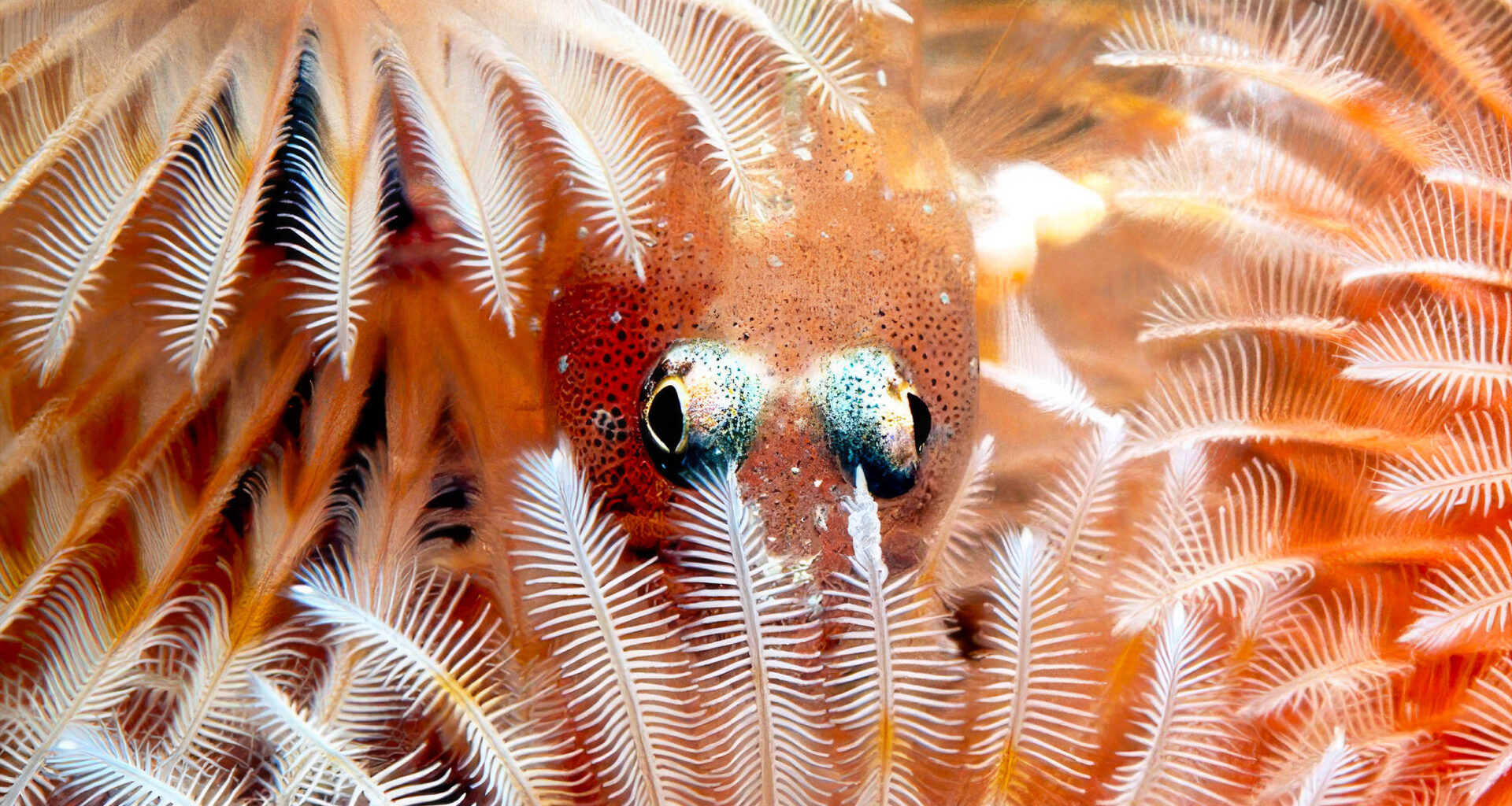
A Christmas tree worm spends much of its existence hiding in plain sight on coral reefs.
At the slightest disturbance, its brightly colored, spiral-shaped crown snaps back into its tube in an instant.

That reflex is what makes its behavior so puzzling. Small fish settle right inside those arms while the worm barely reacts.
Location of the research
The project grew out of the Boston University Marine Program (BUMP) a hands-on course that puts undergraduates on real reefs.
Its divers spent a week in November 2025 working the reefs and seagrass beds of Turneffe Atoll.
Much of that time ran through the Calabash Caye Field Station, a marine base off the coast of Belize.
The station is run by the University of Belize Environmental Research Institute (UB ERI).
Hidden reef relationships
Morgan Bennett-Smith, a PhD candidate at Boston University, led the work. He had already seen the same behavior an ocean away, on reefs in Papua New Guinea.
“It may represent a widespread ecological phenomenon that scientists have simply overlooked and suggest that there are potentially many micro interactions that remain undocumented,” said Bennett-Smith.
“Coral reefs are host to various forms of life and observing these small interactions could unveil new discoveries of how coral reef ecosystems function.”
Tree worms stayed open
Christmas tree worms live embedded in living coral, showing only their radioles. Those branched crowns handle both breathing and catching food that drifts past.
The crown is also a tripwire. A shadow or a nearby movement, and it retracts fast, sometimes staying shut for a minute or more.
So a worm that tolerates a fish sitting in its crown is doing something unexpected. That small mismatch is what pulled the team in.
Fish remain stationary
The fish here are cryptobenthic species, the tiny bottom-dwellers most divers glide right past. In Belize, the primary species involved was the Caribbean neon goby, a blue-striped sliver of a fish.
Again and again it perched inside the worm’s crown without triggering the retreat. It often laid its tail against the radioles, a move the team named tailing.
In about a quarter of the encounters the fish touched the crown directly. The worm still stayed open.
Older photos from Bonaire caught a yellownose goby and a glass blenny doing the same. A second worm, the star horseshoe worm, tolerated the gobies too.
Counting the species
To test whether this was chance, the divers logged every coral colony they crossed.
Each one was marked for gobies, worms, both, or neither. Across more than 1,600 colonies, only 12 held the two animals together.
Yet that pairing turned up far more often than random chance allows, by roughly eleven times.
 Small coral reef fishes and Christmas Tree worms interacting. Credit: Morgan F. Bennett-Smith. Click image to enlarge.Coral preferences matter
Coral type mattered more than habitat. Gobies favored large brain corals and star corals, while the worms packed onto mustard hill coral instead.
Colony size split them further. Gobies showed up more often on big coral heads. The worms leaned the other way, toward smaller ones.
Where a large colony happened to host both, the odds of finding a goby tucked into a worm climbed sharply. The animals were not just sharing the reef by accident.
Benefits on both sides
No one yet knows who benefits. The nature of the bond stays open. The paper considers three possible explanations.
The fish might be a thief, snatching food particles the worm’s crown pulls from the water.
Or it might be a harmless lodger, using the crown for cover and a raised perch above the reef.
The friendlier reading is a trade. Neon gobies are known cleaners, so the worm’s fine, hair-like arms could brush parasites and mucus off the fish, while the fish tidies debris from the crown.
A built-in alarm signal
One clue hints at a real partnership. When a worm suddenly pulled back, the goby beside it bolted at the very same instant.
That timing suggests the fish reads the worm’s retreat as a warning. A worm feels a disturbance and pulls in. Its small guest gets a free head start on danger.
The reverse could hold too. A goby’s sharp eyesight might spot a predator well before the worm does, giving the crown a moment to close.
Students who found it
The discovery came from a class, not a big lab. Undergraduates learned to dive, ran the surveys, and spotted the pattern themselves.
“Participating in projects like this is all I’ve ever wanted to do,” said Boston University undergraduate Mason Murchison.
“From poring over marine science books as a kid to now having the opportunity to work with researchers in the program and explore marine ecosystems, that’s what I spent every night dreaming about. It was the opportunity of a lifetime for me.”
The art of noticing
“Modern biology often focuses on genomics, big datasets, and advanced technology. Those tools are incredibly important, but discoveries still begin with people paying attention to the natural world,” said Bennett-Smith.
“This study started because divers noticed something unusual and asked questions.”
“The fact that we were able to connect observations from Papua New Guinea, Belize, and archival photographs from Bonaire highlights that many hidden interactions on coral reefs are waiting to be discovered.”
The class project fed directly into the published data. The students’ field surveys became an important part of the published research.
The tests that lie ahead
The honest answer is that the relationship remains a puzzle. Field notes can show that two animals sit together, but not why.
The team’s next step is a controlled tank comparing worms housed with gobies to those without them. Dyed food would then reveal whether the fish steals meals or pays its way.
Until then, the little fish in the worm’s crown stays an open mystery of the reef. It is the kind of discovery that only close watching turns up.
The study is published in the journal Symbiosis.
—–
Like what you read? Subscribe to our newsletter for engaging articles, exclusive content, and the latest updates.
Check us out on EarthSnap, a free app brought to you by Eric Ralls and Earth.com.
—–