Mapped: Which Countries Are Best for Women?
Key Takeaways:
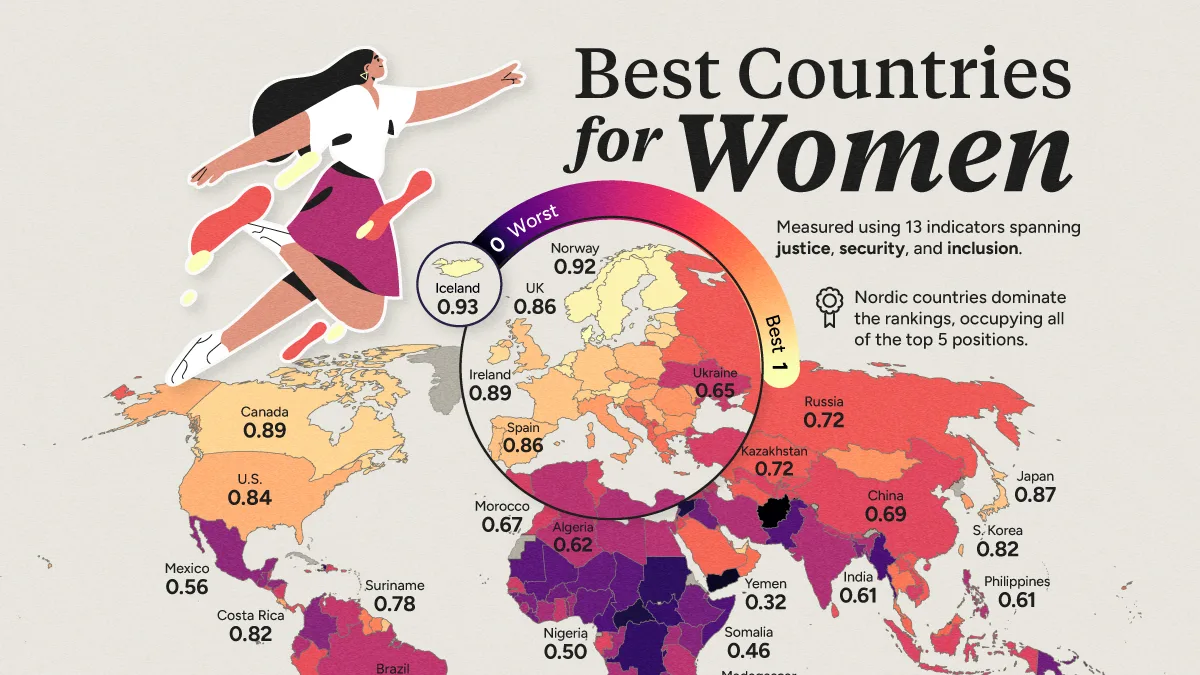
Denmark ranks as the world’s best country for women, while Nordic nations occupy all five of the top positions.
Afghanistan remains the lowest-ranked country, with Denmark’s score more than three times higher.
Costa Rica and Uruguay enter the top global quintile for the first time, marking notable progress in Latin America.
Where is the best place in the world to be a woman? According to the latest Women, Peace and Security (WPS) Index, the answer remains Northern Europe, where Nordic countries occupy all five of the top positions.
Published by the Georgetown Institute for Women, Peace and Security, the 2025/26 WPS Index ranks 181 countries using 13 indicators spanning women’s inclusion, justice, and security. The results form the basis for this 2026 ranking.
The World’s Best and Worst Countries for Women
The following table ranks countries based on the Women, Peace and Security Index.
RankCountryWPS Index Score
1🇩🇰 Denmark0.939
2🇮🇸 Iceland0.932
3🇳🇴 Norway0.924
3🇸🇪 Sweden0.924
5🇫🇮 Finland0.921
6🇱🇺 Luxembourg0.918
7🇧🇪 Belgium0.912
8🇳🇱 Netherlands0.905
9🇦🇹 Austria0.898
9🇳🇿 New Zealand0.898
11🇦🇺 Australia0.896
11🇪🇪 Estonia0.896
13🇮🇪 Ireland0.891
14🇸🇮 Slovenia0.889
15🇱🇹 Lithuania0.887
16🇨🇦 Canada0.885
17🇱🇻 Latvia0.884
17🇸🇬 Singapore0.884
19🇨🇭 Switzerland0.877
20🇦🇪 United Arab Emirates0.872
21🇩🇪 Germany0.869
22🇯🇵 Japan0.866
23🇫🇷 France0.864
23🇬🇧 United Kingdom0.864
25🇪🇸 Spain0.862
26🇵🇹 Portugal0.861
27🇵🇱 Poland0.854
27🇹🇼 Taiwan0.854
29🇷🇸 Serbia0.844
30🇲🇹 Malta0.841
31🇺🇸 United States0.840
32🇨🇿 Czechia0.832
32🇭🇺 Hungary0.832
34🇨🇷 Costa Rica0.824
35🇺🇾 Uruguay0.822
36🇲🇩 Moldova0.821
37🇰🇷 South Korea0.815
38🇧🇬 Bulgaria0.814
39🇮🇹 Italy0.811
40🇸🇨 Seychelles0.810
41🇭🇰 Hong Kong0.809
42🇧🇧 Barbados0.807
43🇷🇴 Romania0.801
44🇲🇳 Mongolia0.799
45🇬🇪 Georgia0.798
46🇸🇰 Slovakia0.797
47🇦🇷 Argentina0.791
48🇭🇷 Croatia0.788
49🇬🇩 Grenada0.787
49🇲🇰 North Macedonia0.787
51🇸🇷 Suriname0.779
52🇨🇾 Cyprus0.770
52🇬🇾 Guyana0.770
54🇵🇾 Paraguay0.768
55🇧🇭 Bahrain0.765
56🇦🇲 Armenia0.762
57🇹🇭 Thailand0.761
58🇴🇲 Oman0.755
59🇧🇦 Bosnia and Herzegovina0.753
60🇬🇷 Greece0.752
61🇲🇪 Montenegro0.743
62🇨🇻 Cabo Verde0.741
63🇧🇾 Belarus0.739
63🇨🇱 Chile0.739
63🇵🇼 Palau0.739
63🇸🇦 Saudi Arabia0.739
67🇲🇾 Malaysia0.738
68🇦🇱 Albania0.731
68🇫🇯 Fiji0.731
70🇰🇼 Kuwait0.723
70🇶🇦 Qatar0.723
72🇰🇿 Kazakhstan0.722
73🇻🇳 Viet Nam0.721
74🇹🇲 Turkmenistan0.720
75🇷🇺 Russian Federation0.718
76🇵🇷 Puerto Rico0.707
77🇱🇰 Sri Lanka0.706
78🇲🇻 Maldives0.704
79🇯🇲 Jamaica0.703
80🇧🇴 Bolivia0.701
80🇵🇪 Peru0.701
82🇽🇰 Kosovo0.700
83🇱🇦 Lao PDR0.698
84🇮🇱 Israel0.697
84🇰🇬 Kyrgyzstan0.697
86🇵🇦 Panama0.696
87🇸🇻 El Salvador0.691
88🇯🇴 Jordan0.686
89🇨🇳 China0.685
89🇼🇸 Samoa0.685
89🇹🇯 Tajikistan0.685
89🇹🇴 Tonga0.685
89🇹🇹 Trinidad and Tobago0.685
94🇬🇦 Gabon0.679
94🇲🇺 Mauritius0.679
96🇮🇩 Indonesia0.678
97🇩🇴 Dominican Republic0.675
98🇺🇿 Uzbekistan0.674
99🇧🇹 Bhutan0.673
100🇹🇳 Tunisia0.671
101🇲🇭 Marshall Islands0.670
102🇲🇦 Morocco0.668
102🇹🇱 Timor-Leste0.668
104🇧🇿 Belize0.667
104🇰🇭 Cambodia0.667
106🇹🇷 Türkiye0.664
107🇳🇮 Nicaragua0.659
108🇧🇼 Botswana0.658
108🇸🇧 Solomon Islands0.658
110🇸🇳 Senegal0.657
111🇦🇿 Azerbaijan0.653
112🇰🇮 Kiribati0.652
113🇫🇲 Federated States of Micronesia0.648
113🇿🇦 South Africa0.648
115🇻🇺 Vanuatu0.646
116🇺🇦 Ukraine0.645
117🇬🇭 Ghana0.639
118🇻🇪 Venezuela0.638
119🇧🇷 Brazil0.632
120🇳🇵 Nepal0.631
121🇷🇼 Rwanda0.624
121🇹🇿 Tanzania0.624
123🇩🇿 Algeria0.621
124🇸🇹 São Tomé and Príncipe0.620
125🇪🇬 Egypt0.617
126🇱🇸 Lesotho0.614
127🇪🇨 Ecuador0.612
128🇮🇷 Iran0.608
128🇱🇾 Libya0.608
128🇳🇦 Namibia0.608
131🇮🇳 India0.607
131🇵🇭 Philippines0.607
133🇦🇴 Angola0.601
133🇸🇱 Sierra Leone0.601
135🇰🇲 Comoros0.590
135🇿🇼 Zimbabwe0.590
137🇨🇮 Côte d’Ivoire0.589
138🇧🇯 Benin0.587
138🇺🇬 Uganda0.587
140🇨🇬 Congo0.583
141🇱🇧 Lebanon0.575
142🇿🇲 Zambia0.566
143🇹🇬 Togo0.562
144🇬🇹 Guatemala0.561
144🇭🇳 Honduras0.561
146🇩🇯 Djibouti0.560
147🇲🇽 Mexico0.558
148🇸🇿 Eswatini0.556
149🇨🇴 Colombia0.551
150🇲🇼 Malawi0.549
151🇲🇿 Mozambique0.548
152🇰🇪 Kenya0.542
153🇬🇲 Gambia0.528
154🇬🇳 Guinea0.527
155🇧🇩 Bangladesh0.526
156🇪🇹 Ethiopia0.516
157🇱🇷 Liberia0.512
158🇮🇶 Iraq0.510
159🇬🇼 Guinea-Bissau0.508
160🇧🇫 Burkina Faso0.507
160🇵🇬 Papua New Guinea0.507
162🇳🇬 Nigeria0.495
163🇳🇪 Niger0.492
164🇲🇱 Mali0.478
165🇹🇩 Chad0.476
166🇲🇷 Mauritania0.475
167🇵🇸 Palestine0.469
168🇲🇬 Madagascar0.466
169🇵🇰 Pakistan0.462
170🇸🇴 Somalia0.455
171🇨🇲 Cameroon0.451
172🇲🇲 Myanmar0.442
173🇸🇸 South Sudan0.411
174🇧🇮 Burundi0.407
175🇨🇩 Democratic Republic of the Congo0.405
176🇭🇹 Haiti0.399
177🇸🇩 Sudan0.397
178🇸🇾 Syrian Arab Republic0.364
179🇨🇫 Central African Republic0.362
180🇾🇪 Yemen0.323
181🇦🇫 Afghanistan0.279
The rankings reveal a sharp geographic divide. Northern Europe continues to set the global benchmark for women’s wellbeing, while countries affected by conflict and political instability cluster at the bottom.
Denmark ranks first with a score of 0.939, followed by Iceland, Norway, Sweden, and Finland. Luxembourg, Belgium, the Netherlands, Austria, and New Zealand round out the global top 10. Afghanistan ranks last, with a score less than one-third of Denmark’s.
Why Nordic Countries Continue to Lead
Nordic countries occupy all five of the top positions thanks to consistently strong performance across the index’s three dimensions: inclusion, justice, and security.
Women in these countries generally benefit from high levels of education, workforce participation, legal protection, financial inclusion, and political representation, alongside relatively low rates of violence. Strong public institutions and broad social safety nets also help support gender equality throughout life.
While no country scores a perfect 1.0, the Nordic region remains the global benchmark for women’s wellbeing.
Outside Northern Europe, Australia and New Zealand continue to perform strongly. Costa Rica and Uruguay also enter the top global quintile for the first time, reflecting sustained gains in women’s rights and wellbeing and making them notable standouts in Latin America.
Conflict Remains the Biggest Divider
At the opposite end of the rankings are Afghanistan, Yemen, the Central African Republic, Syria, Sudan, Haiti, the Democratic Republic of the Congo, Burundi, South Sudan, and Myanmar. Many of these countries have experienced years of armed conflict, political instability, or humanitarian crises that disproportionately affect women.
More than 70% of women living in the 12 lowest-ranked countries reside within 50 kilometers of armed conflict, exposing them to higher risks of displacement and gender-based violence. Countries with greater exposure to conflict also tend to score worse on access to justice and maternal health.
This aligns with broader research showing that violence against women rises during periods of instability, while fragile institutions often struggle to provide legal protections and support services. According to the World Health Organization, violence against women remains one of the world’s most widespread human rights violations.
Women’s Wellbeing Reflects Broader Society
The WPS Index measures more than gender equality alone. By combining indicators across security, economic inclusion, healthcare, legal rights, and political participation, it provides a broader snapshot of how supportive countries are for women to live, work, and thrive.
Countries that rank highly typically combine economic opportunity, strong legal protections, accessible healthcare, and low levels of violence. Nations facing prolonged instability, by contrast, often struggle across several dimensions at once.
The rankings therefore offer a broader view of social resilience and institutional strength, not just women’s outcomes in isolation.
Learn More on the Voronoi App 
To explore more global demographic and workforce trends, check out This Map Shows Where Women Work on the Voronoi app.