

Households aren’t as flush as they used to be. Rather than locking funds away in term deposits to work their money harder, they are holding it in ready cash to be more resilient in case the unexpected happens
The growth of household deposits in the banking system has taken a step-change lower. And it has stayed down.
The Reserve Bank has the data (S40). For all of 2024 and the first eight months of 2025, year-on-year growth in household deposits averaged more than $15 billion per month.
But that then transitions lower to an average of just over $10 billion per month.
Year-on-year growth of household bank deposits
2024
2025
2026
$ bln
$ bln
$ bln
Jan
14.437
16.791
9.829
Feb
13.676
17.130
9.585
Mar
14.383
15.940
10.719
Apr
14.173
17.456
10.659
May
14.794
16.158
10.710
Jun
13.530
16.819
Jul
15.201
15.427
Aug
13.433
15.256
Sept
15.873
13.024
Oct
16.011
11.928
Nov
15.732
11.181
Dec
17.451
10.582
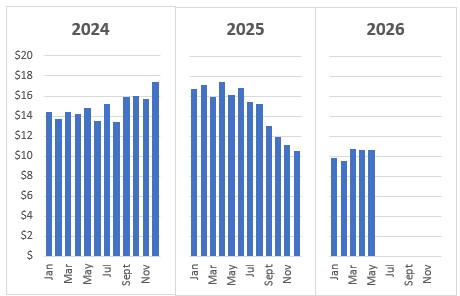
The latest data update, for June, is due this Friday and it will be a surprise if it doesn’t extend the lower trend.
Households with term deposits are noticing this step down. And they seem to regards this in a risk-aversion sense.
Their reaction has been to hold more in transaction accounts. The liquidity impulse is stronger.
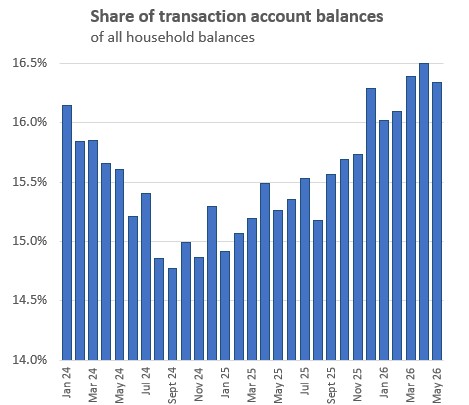
Although the chart shows this impulse is definitely there, it would be wrong to overstate it. Check the left-hand axis – the shift is only about 1½%. However that is 1½% of $142 billion, which means households are keeping an extra $3 billion every month in ready cash, rainy day cash reserves.
Retailers will notice that caution too.
It’s a move that reprises the pandemic shift, one that was much more pronounced back then. For most of 2019 households had less than 15% of their bank account balances in transaction accounts. But as fear and uncertainty rose in the 2020 to 2022 period, that jumped to over 24%. The current worry levels are not back at those levels, but this analysis shows that they are rising and that households are shifting their ready cash allocations to a more risk-averse mode.