
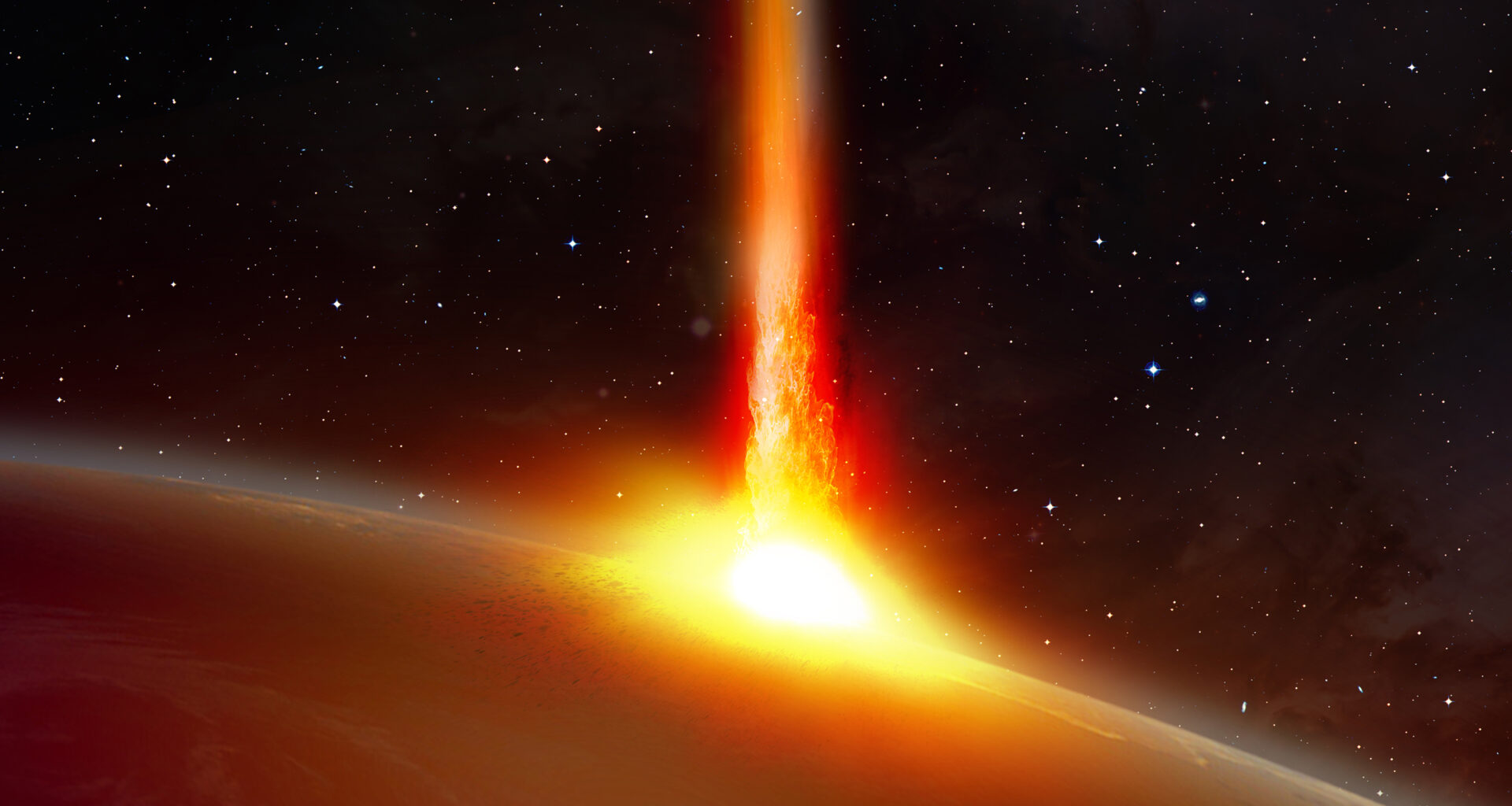
A new study has found that the asteroid that killed the dinosaurs was a rare, dry type of space rock. It formed in the cold outer reaches of the asteroid belt, near the orbit of Jupiter. Only two or three of every hundred meteorites that fall to Earth resemble it.
The result settles part of a long argument over exactly what struck the planet 66 million years ago. It ties the deadliest day in the history of life to a specific, ancient family of asteroids that orbit far from the Sun.
Nickel identifies the asteroid

Buried beneath the Gulf of Mexico, the crater the impact left carries the name Chicxulub, after a town on Mexico’s Yucatán Peninsula. Most clues about the object itself come instead from the thin sheet of debris the collision threw around the world.
The work came from an international team that included Christian Köberl, an impact researcher at the University of Vienna, working with colleagues in France, Belgium, and Canada.
“These ejecta layers hold higher concentrations of extraterrestrial material than the crater itself,” said Köberl.
To identify the rock, the team measured nickel isotopes, versions of the same metal mixed in proportions set when the Solar System formed.
Bodies from the warm inner Solar System and the cold outer edge ended up with slightly different blends. Those ratios act like a chemical signature that no process on Earth can reproduce.
The asteroid’s rare family
Matched against known meteorites, the nickel in the boundary layer lined up with one specific type.
An earlier study in 2024 had shown the impactor was carbon-rich and born beyond Jupiter, and it argued against a comet. Its exact subtype stayed unknown. The new measurements close part of that gap, though not all of it.
Philippe Claeys is a geologist and planetary scientist at the Vrije Universiteit Brussel and visiting professor at the University of British Columbia and a co-author on the study.
In an interview with Earth.com, he said, “The Ni results refine the characterization of the projectile to a specific and unique type of meteorites, but does not shed all the light on the origin of the projectile.”
A primitive space rock
The match was to a CO chondrite, one branch of the wider family of carbonaceous chondrites – dark and carbon-rich stones counted among the oldest solid material in the Solar System.
These are not common rocks. Only two or three of every hundred meteorites reaching Earth are carbonaceous at all.
Ornans – a stone that fell in eastern France in the 1860s – gave the CO group its label and its reference example. Its members are studded with tiny once-molten beads called chondrules, held in a dark, fine-grained rock.
What sets this branch apart is how little water and volatile material it holds. “CO chondrites are relatively dry, with few volatile elements and little water compared with other carbonaceous chondrites,” said Köberl.
These rocks never grew hot enough to melt, so they still carry their starting chemistry largely intact. Researchers call such material primitive, because it preserves conditions from the Solar System’s first few million years.
Fixing the impactor to CO refines an argument that had run for more than a decade. Earlier chemical clues had suggested a small set of candidate subtypes, and one recent analysis of impact glass favored either CO or a wetter relative known as CM.
Where did the killer asteroid come from?
Rocks like this sit at the outer edge of the asteroid belt, the ring of leftover material between Mars and Jupiter where the cold zone begins. Sending one all the way to Earth takes a push.
Gravity from the giant planets can tug such a body off its stable path and start it falling inward. “When the orbits of these bodies are disturbed, they can be deflected into the inner Solar System and strike Earth,” said Köberl.
Computer modeling of large impacts over the past billion years points to a pattern. Dark, primitive asteroids from the outer belt cause a sizable share of the biggest strikes. An arrival from far out fits this object well, and helps explain why it looks so unlike a typical Earth impactor.
Working out exactly where in that cold zone the rock began is the next step. Asked by Earth.com what would narrow it down, Claeys pointed to the need for better composition data on the many loose bodies circling the Solar System.
Claeys added that the current classification may not be fully correct, with dry asteroids possibly spread far more widely than researchers assume.
Even so, a hit by an outer-belt carbonaceous rock this large is uncommon across geological time. Most large impactors trace back instead to the inner belt, nearer the Sun, where drier and stonier asteroids dominate.
Why this asteroid was so unusual
Before this work, scientists knew the dinosaur-killer was carbonaceous and born far from the Sun, though not its exact breed. Now the nickel data tie it to a dry, primitive CO body from the belt’s cold outer rim.
The reclassification does not rewrite how the extinction itself unfolded. Fine silicate dust thrown up as the crater formed did most of the killing, according to a 2023 paper Claeys co-authored, rather than anything the projectile carried in.
What changes is the sense of how unlikely the whole thing was. Claeys noted that the dinosaurs, which ruled Earth for more than 125 million years, were unlucky to be struck by so rare and unusual a body.
In an email to Earth.com, he added, “In other words without this strange projectile coming from nowhere they might still be there.”
What this means for future impacts
Knowing which population these giant impactors come from helps researchers judge two things: where a future one might begin, and how often such bodies drift close.
Objects from the outer belt travel different paths than the inner-belt rocks that make up most near-Earth traffic. That turns a question about the deep past into information about present-day risk.
The rock also stands as a relic of the Solar System’s infancy, a sample of the raw material that planets were built from.
“These are among the oldest objects that have stayed unchanged since they formed, never melted or thermally altered,” said Köberl.
The study is published in Science Advances.
—–
Like what you read? Subscribe to our newsletter for engaging articles, exclusive content, and the latest updates.
Check us out on EarthSnap, a free app brought to you by Eric Ralls and Earth.com.
—–