
The summer whaling season in Svalbard was brief but grueling. In addition to the dangers of hunting 100-ton whales from small rowboats in rough, ice-choked seas, the sailors faced disease, poor diets, and backbreaking labor.
With their cold fingers, men wielded flensing knives to cut whale blubber. The ground beneath their feet was slick with oil and ice. Rival whaling crews picked fights with each other. Their provisions didn’t have enough nutrients, and people developed scurvy. The beer froze, and there was nothing to drink.
“Death is constant,” Degroot says. “It’s not just a background condition.”
Clues from Corpse Point
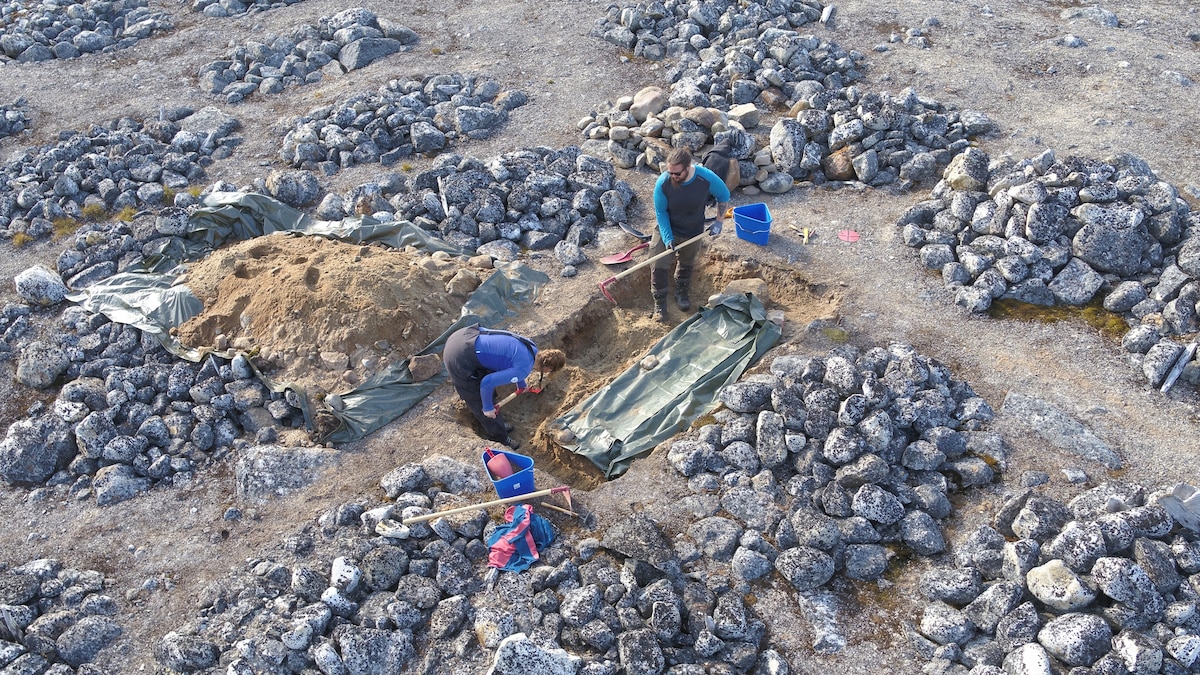
Likneset, or “Corpse Point” as it’s called in Norwegian, encompasses more than 200 known burials from this period on a coastal plain between Smeerenburg Fjord and the foot of Kennedy Glacier.
In 2019, Loktu excavated three burials from central Likneset and shipped them to the Svalbard Museum in Longyearbyen. There, she used a vacuum to clean sawdust from the coffins. She and her colleague Elin Therese Brødholt, a forensic anthropologist at Oslo University Hospital and author on the paper, analyzed the contents.
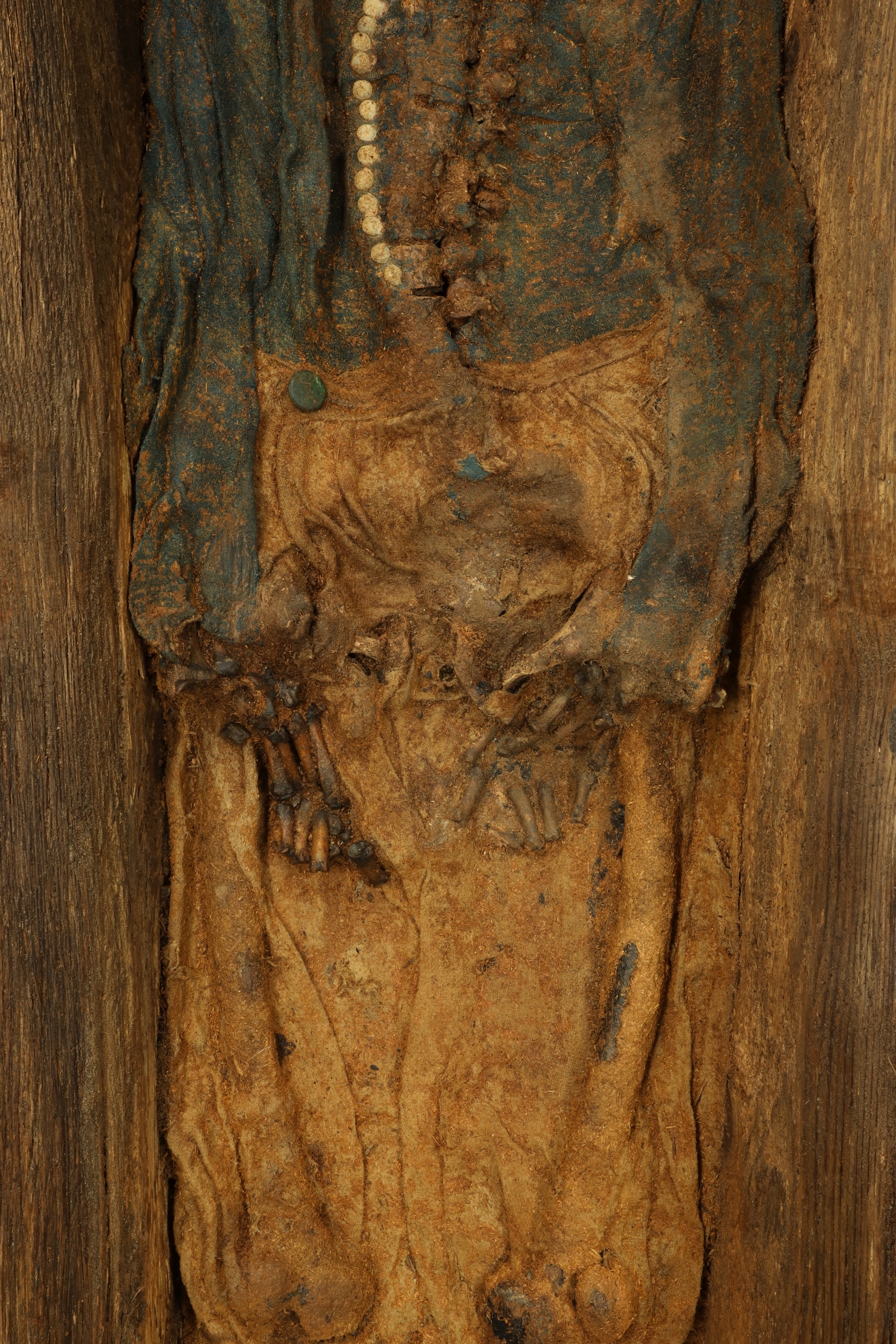
A plain-woven indigo-dyed woolen jacket and a pair of brown woolen knee breeches were found on a skeleton from one of the graves on Likneset.
Lise Loktu, Governor of Svalbard
They re-examined 16 sets of bones and other materials held in the museum that were recovered from the coastal edge of the cemetery in the 1980s and 2016. Loktu then compared the states of preservation among the different samples. That let them determine how the whalers lived and worked, as well as how climate change has impacted the artifacts and the scientific data within them.
All 19 skeletons were biologically male, and most were estimated to be 20 to 34 years old when they died. Many smoked, indicated by gaps between their upper and lower teeth in the shape of pipe stems. Bones from 18 skeletons bore the telltale darkening and pitting from scurvy, and nearly all showed signs of degenerative joint diseases and activity-related stress, suggesting the young, malnourished whalers often handled heavy objects that strained their entire bodies.
(Scientists find oldest direct evidence of whaling in a place they never suspected)
Stable isotope analysis, which measures elements in tissues to reveal where a person may have lived, on three skeletons from 2016 revealed that one whaler likely came from the present-day Netherlands. The other two showed isotopic signatures consistent with colder environments and a fish-heavy diet, pointing to western Norway.
Catalog of change
Archaeologists excavating Likneset’s burials close to the shoreline in the late 1980s found graves damaged by erosion to varying degrees. However, permafrost had preserved many recognizable garments, including wool caps, jackets, trousers, knitted stockings, linen shirts, scarves, and one pair of shoes.