
Think about the last time you fell asleep. Your body went still. Your breathing slowed. You didn’t have to do anything to stay put.
Now picture a version of sleep where your own body keeps trying to float you up and out of bed.

Every time you drift off, up you go. To rest at all, you’d have to keep nudging yourself back down, over and over, never quite waking.
That’s roughly the puzzle a sperm whale faces underwater. And a new study of whales off the coast of Norway has worked out how they pull it off.
A body built to float
Noémie Freymond of the Université de Neuchâtel in Switzerland, working with Alec Burslem and Patrick Miller of the University of St. Andrews in the U.K., set out to understand how these animals stay submerged while they rest.
The trouble starts with the head. A sperm whale’s head takes up nearly a third of its body, and it’s stuffed with oil, wax and air. All of that floats.
When a whale settles in for a nap, hanging quietly with its head tipped toward the surface around 80 feet (25 meters) down, physics is working against it. Left alone, it would rise like a cork.
Safe and still below the surface
There’s a good reason to stay under, though. Up top, the water is choppy and busy with passing ships.
A little below, it’s calm, and the surface is close enough to slip up for a breath when the body demands it.
“It is fascinating to discover the diverse adaptations that marine mammals have evolved to overcome the challenges of sleeping underwater,” Freymond told Earth.com in a direct interview.
She pointed to dolphins, which can shut down one half of the brain at a time so the other half keeps breathing and watching.
Nobody has ever measured a sperm whale’s brain in the wild, she added, so whether they do anything like that is still an open question.
Listening in on naps
Watching a wild sperm whale sleep is close to impossible. You’d have to follow one around the clock, in the open ocean, in the dark.
Near the Lofoten Islands off northern Norway, the team let the whales record themselves.
Using a long pole from a small boat, they attached sound-and-motion tags to 42 whales with suction cups.
Each tag listened for the hiss of escaping air while tracking how deep the whale went and whether its head pointed up or down.
When a tag popped loose, it floated to the surface to be collected. Then came the long job of playing it all back.
Of the 42 tagged sperm whales, 17 were caught having a sleep. A single rest could run from a few minutes to more than three hours, broken into naps that lasted anywhere from about six to 30 minutes.
Three ways to rest
The sperm whales didn’t all sleep in the same way. Some sank gently, tail-first, to hang about 26 feet (8 meters) down.
Others dove head-first to around 90 feet (27 meters) before rolling slowly into that head-up float.
A few drifted upward after returning from a deep dive, sometimes from more than 650 feet (200 meters) below.
That range caught the researchers off guard. “It was also surprising to find that some individuals rested in more than one way, using different types of resting dives,” Freymond told Earth.com.
Here’s the part that gave the game away. On almost every rest – 56 out of 61 – the tags picked up the sound of bubbles.
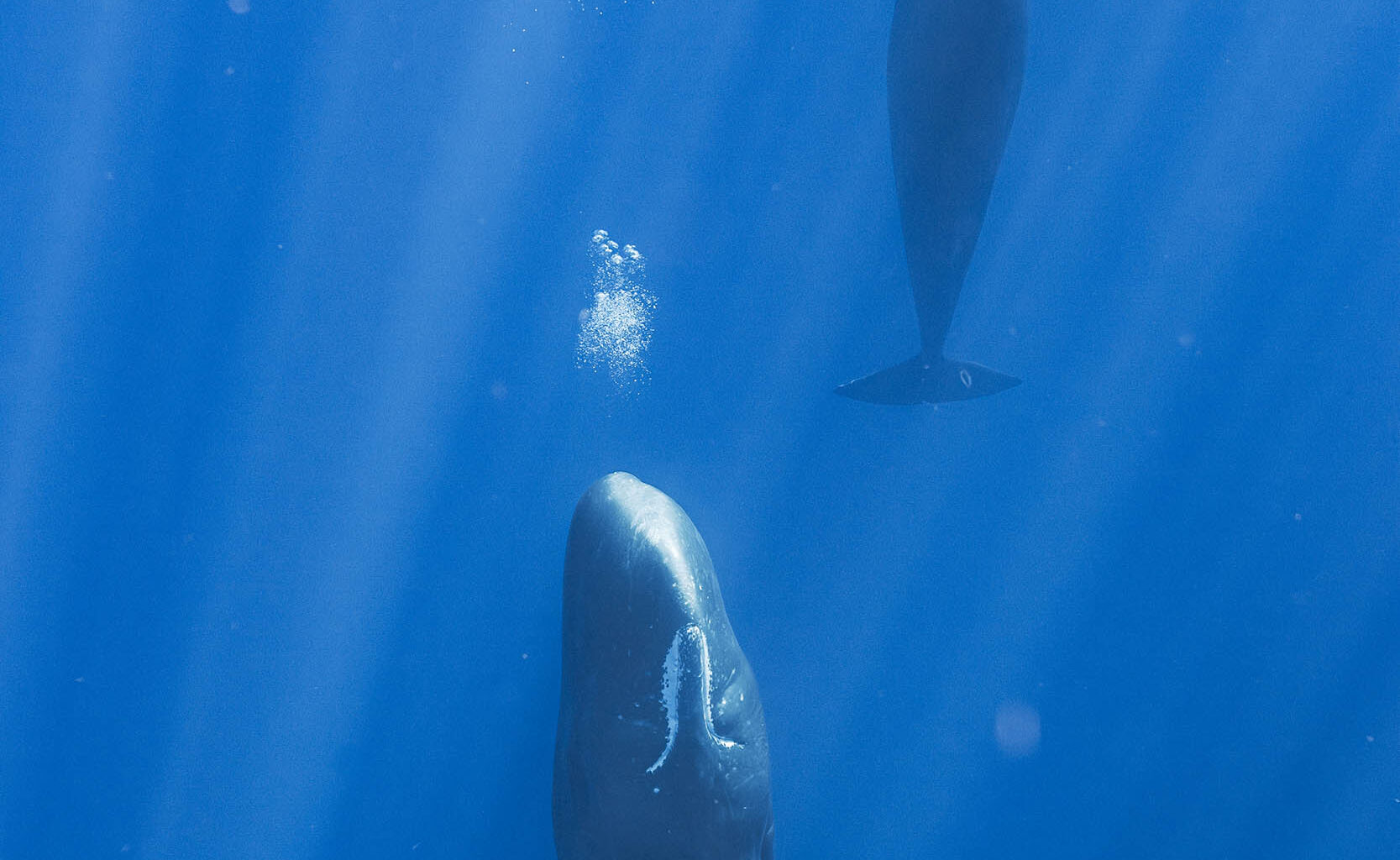
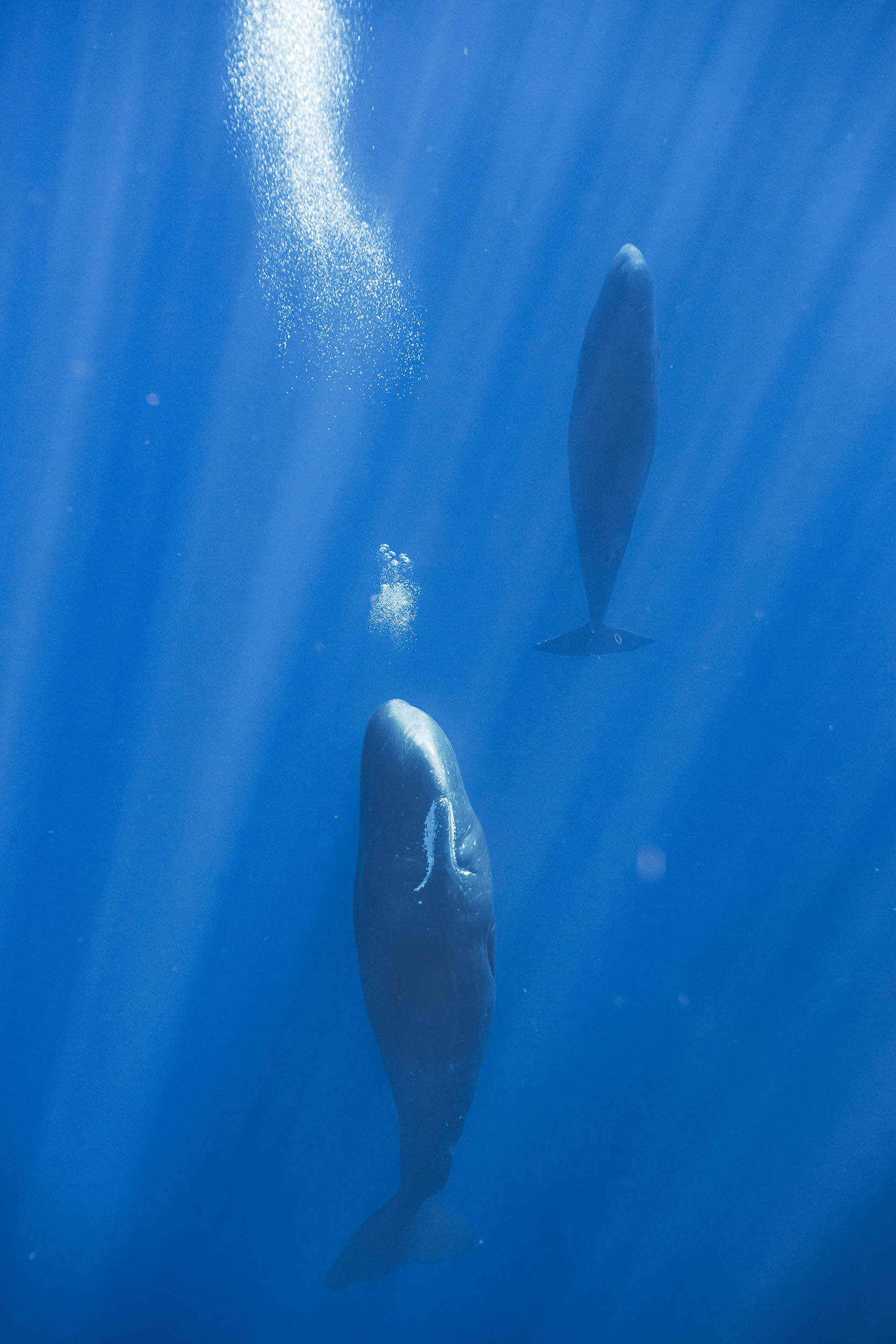 Sperm Whale at rest, blowing bubbles. Credit: University of St. Andrews / Stephane Granzotto. Click image to enlarge.Letting the air out
The bubbles were the answer. As a resting whale slowly rises, the air trapped in its lungs expands, the same way a balloon swells as it drifts up from the bottom of a pool.
More expanded air means more lift, which would send the whale straight to the choppy surface. By letting a little of that air escape, it trims its buoyancy and holds its spot.
The whales did this most reliably on the dives that started with a head-down plunge, which happened to be the most common way they rested.
Freymond said the team already knew sperm whales let out bubbles while resting, but the sheer consistency of it on those head-down dives still surprised her.
Model supports the bubble blasts
The shallow nappers released bubbles around 11 times per snooze, each burst lasting roughly eight seconds.
The deep drifters barely bothered – just three or four releases on the whole way up. They were already heavy enough, because the crushing pressure down deep had squeezed the air in their bodies down small.
Freymond and her colleagues built a computer model of the forces tugging on a drifting whale, then matched it against the real dive records.
The numbers only fit if the whales were steadily bleeding off air as they went.
Each stretch of the nap left them a little lighter on air than the one before, trimming their onboard supply by about 5 percent at a time.
Packing light for sleep
There was another clue that the whales plan ahead. When they set off on a foraging dive, they gulp down a big load of air. When they settle in to rest, they carry far less – only about a third as much.
Freymond told Earth.com that she sees this as a second buoyancy trick in its own right.
The sperm whales appear to take in less air before a sleep dive than before a hunting one, which suggests they adjust the load depending on what kind of dive is coming.
For a 33-ton whale, that resting supply works out to roughly 62 gallons (235 liters) of air. Enough to hover, not enough to shoot upward. It looks like the whales know a nap is coming and pack lighter for it.
Only two other animals have ever been caught using bubbles this way.
Grey whales seem to blow them to stretch out foraging dives, and bowhead whales appear to do something similar on their own drift dives. That’s the whole list. It’s a rare trick.
Sperm whales awake, or asleep?
Now for the honest caveats. Nobody has recorded a sperm whale’s brain out in the wild, so the team prefers to call this resting, not sleep.
We don’t actually know whether these giants are fully out, or whether they doze like dolphins, with one half of the brain awake to stand watch.
“At this stage, we cannot determine whether bubble release is a conscious act or an automatic process occurring during sleep,” Freymond told Earth.com.
If the sperm whales do sleep one hemisphere at a time, she noted, the waking half could be the part managing all this fine buoyancy work – though the venting might also fit with a brain that’s fully asleep.
Offloading carbon dioxide and nitrogen
Either way, the bubbles hint at some awareness. To time them, a whale has to sense that it’s creeping too close to the surface and then act on it. That’s not nothing, for an animal that might be out cold.
The researchers add one more note of caution. Some of that escaping gas might not be about buoyancy at all.
Resting near the surface could let the whales offload carbon dioxide and nitrogen that builds up after a run of deep dives. Both things could be true at once.
So, we end up close to where we started. You drift off, and your body stays put on its own.
A sperm whale drifts off and, breath by quiet breath, keeps correcting its depth in the dark. Whether it’s awake enough to know it’s doing that, no one can yet say.
The full study was published in the Journal of Experimental Biology.
—–
Like what you read? Subscribe to our newsletter for engaging articles, exclusive content, and the latest updates.
Check us out on EarthSnap, a free app brought to you by Eric Ralls and Earth.com.
—–