
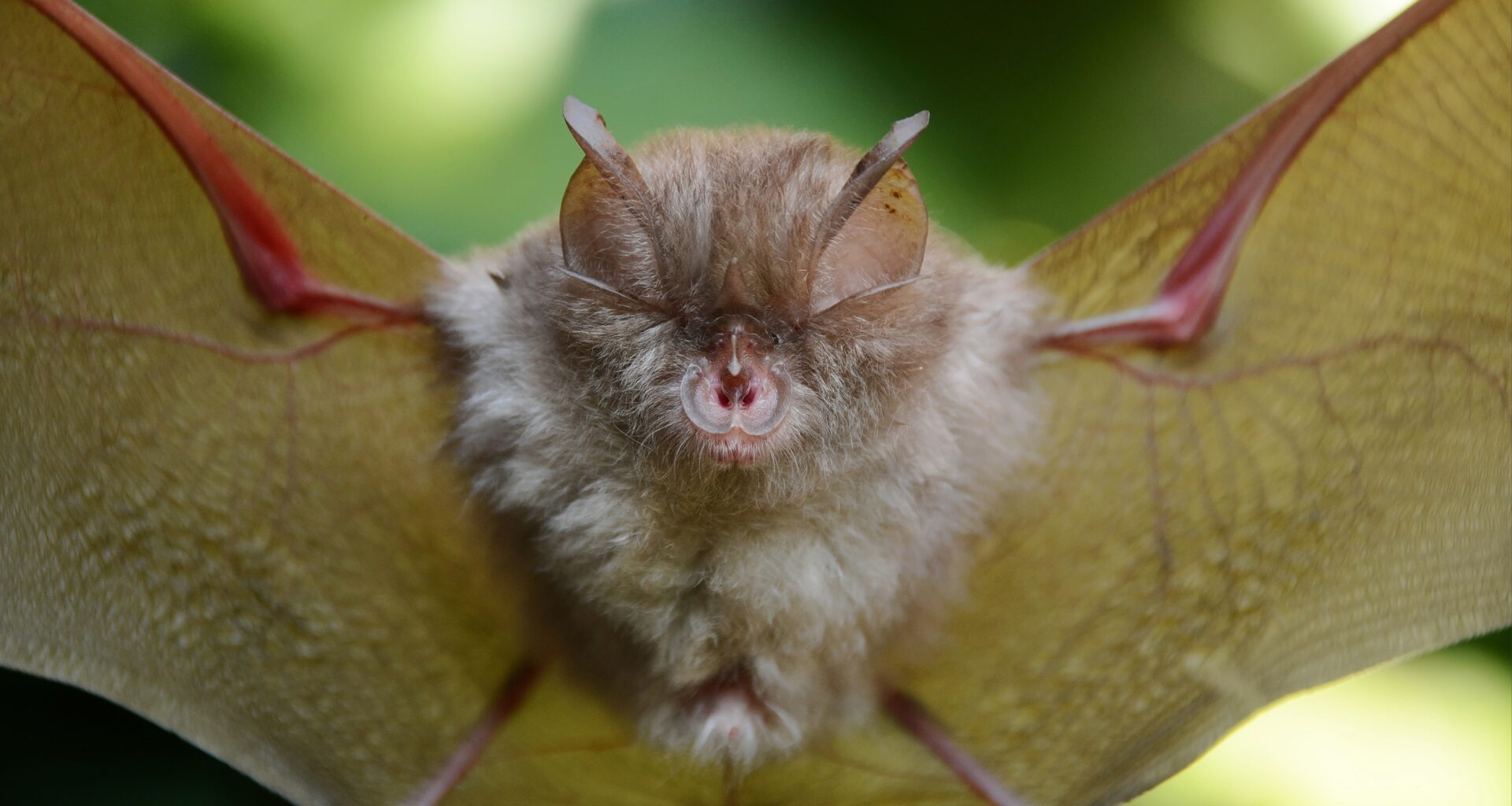
Bats spend every night making split-second decisions in complete darkness.
They avoid obstacles, chase insects, and stay close to other bats by listening to echoes from sounds they produce themselves.

It sounds simple, but it becomes much harder when dozens of bats fly together and each one sends out its own ultrasonic calls.
Scientists have now found that one species has an unexpected way of handling this problem. Instead of spreading out their call frequencies to avoid one another, these bats often move toward the same frequency.
That shared approach may help them detect prey more clearly, even when surrounded by the sounds of an entire colony.
Bats use echolocation differerently
Echolocation works by sending out high-frequency sound waves and listening for the echoes that bounce back.
Those echoes tell bats where objects are, how fast they are moving, and even help them spot flying insects. This remarkable ability also inspires engineers working on sonar systems and autonomous robots.
Most bats constantly change the frequency of each call. Greater Japanese horseshoe bats are different.
Every pulse combines changing frequencies with a steady constant-frequency section, allowing bats to detect tiny echo changes, known as glints, that reveal fluttering prey.
They also have a specialized hearing feature called the acoustic fovea, which is extremely sensitive to a very narrow range of sound centered on the second harmonic constant-frequency component, known as CF2.
As bats fly, movement changes the frequency of returning echoes through the Doppler effect, so they continuously adjust their calls to keep those echoes within this highly sensitive hearing range.
Surprising patterns inside bat colonies
The study was carried out by researchers Haruhito Matsumoto, Soshi Yoshida, and Shizuko Hiryu of Doshisha University.
The researchers wanted to know what happens when wild greater Japanese horseshoe bats join an established captive colony.
If different groups naturally use different CF2 frequencies, would they move farther apart to reduce interference, or would something else happen?
“Unlike some other echolocating bats that separate their call frequencies to avoid interference, these horseshoe bats appear to converge on a shared frequency,” said Yoshida.
“Building on our previous study showing that they use a ‘silent spectral window’ to detect Doppler-shifted echoes from fluttering prey, we propose that this convergence allows colony members to maintain and share that window.”
Finding a quieter listening zone
Earlier research introduced the idea of a silent spectral window.
This is a clutter-free band of frequencies that sits above a certain threshold, allowing bats to pick out echoes from fluttering prey while reducing background interference from other sounds.
By adjusting their calls so that most unwanted noise stays below this threshold, the bats can detect the important Doppler-shifted glints from insects more reliably.
Sharing a similar call frequency appears to help maintain this cleaner listening zone across the colony.
Years of bat calls
The researchers captured wild horseshoe bats during 15 different collection periods.
They measured each bat’s CF2 frequency, introduced the animals into a captive colony, and measured their frequencies again after one month.
From 2008 through 2024, the team collected data during 15 capture events involving both wild and captive bats. The results showed an uneven pattern.
Bats with lower frequencies, usually the newly captured wild individuals, shifted their calls upward much more than higher-frequency bats adjusted theirs.
When both groups already started with similar frequencies, that shift did not happen.
“This observation was only possible because past and present laboratory members carefully recorded the calls of individual bats over many years. It highlights the scientific value of long-term data accumulated through sustained effort,” said Yoshida.
Why only some bats changed
The upward shift supports the idea that lower-frequency bats were trying to avoid having the echoes from prey overlap with the higher-frequency calls already being used by other colony members.
By moving their calls upward, those bats could keep the returning prey echoes inside the shared silent spectral window instead of competing with background sounds.
The higher-frequency bats already had access to that clearer listening range, giving them much less reason to change their calls. That created the uneven pattern seen throughout the study.
Understanding life in colonies
Many studies have examined how bats use echolocation, but far fewer have explored what happens when members of the same species with different calling frequencies come together.
This research helps fill that gap by showing how individual bats adjust their behavior to improve sensing while living in groups.
The findings also add another piece to the growing understanding of how animals solve complex sensory challenges.
As scientists continue studying bat echolocation, discoveries like this may also guide future improvements in sonar systems and other technologies designed to detect objects accurately in noisy environments.
The full study was published in the Journal of Comparative Physiology A.
—–
Like what you read? Subscribe to our newsletter for engaging articles, exclusive content, and the latest updates.
Check us out on EarthSnap, a free app brought to you by Eric Ralls and Earth.com.
—–