
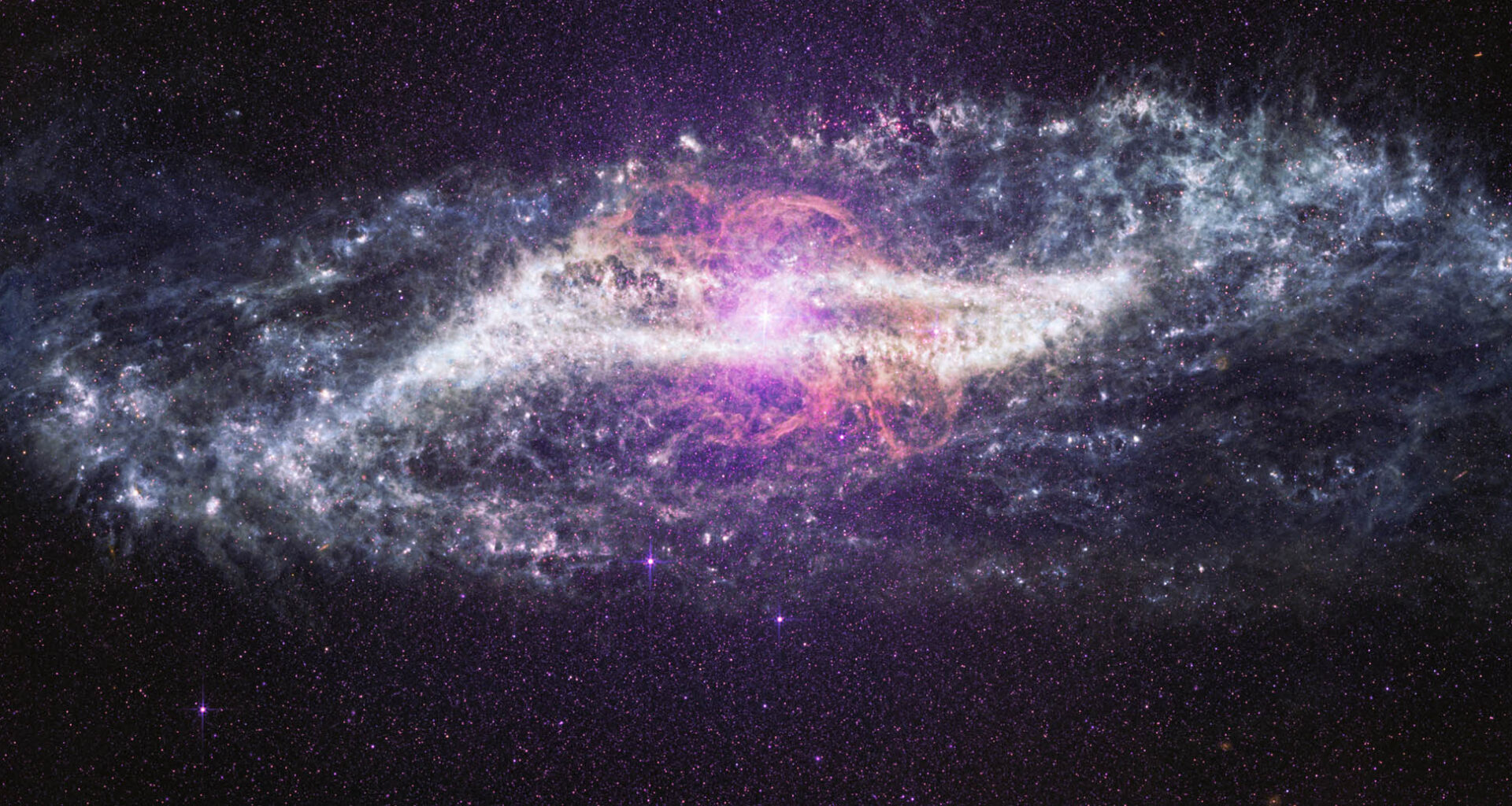
Centaurus A was never a quiet galaxy. Even from 11 million light-years away, astronomers have known for decades that something unusual was happening inside it.
A giant black hole sits at its center. Stars continue to form in pockets of gas and dust. Signs of an ancient collision remain visible across its structure.

Now, new images from NASA’s James Webb Space Telescope have pulled back another layer of the story. To celebrate Webb’s fourth year of science operations, NASA released fresh views of Centaurus A that reveal details hidden from every telescope that came before it.
The result is not a smoother or cleaner version of earlier pictures. It is an entirely different look at one of the sky’s most studied galaxies.
Centaurus A galaxy behind the dust
It is difficult for visible light to penetrate through the dusty material covering the galactic nucleus of Centaurus A.
The earlier images taken by NASA’s Hubble Space Telescope were able to capture only the regions outside these dusty zones.
The Spitzer Space Telescope has revealed the presence of this galaxy using infrared radiation, although it did not see the individual stars since they were covered in dust.
However, Webb’s near-infrared and mid-infrared capabilities have enabled it to pierce through the dust and spot numerous stars residing close to the galactic nucleus.
New telescopes, new details
What once looked like a rough texture in images turns out to be millions of separate stars packed tightly together.
“No single telescope tells the whole story,” said Shawn Domagal-Goldman, division director, Astrophysics, NASA Headquarters in Washington. He added that new observatories grow on the foundations laid by earlier missions.
“Webb represents the most powerful step forward yet, opening a window into wavelengths and details never before accessible. This allows astronomers to examine structures and processes that other telescopes could not see,” Domagal-Goldman stated.
Scars from an ancient collision
Centaurus A carries the marks of a violent event that happened roughly two billion years ago when it collided with another galaxy.
Unlike many galactic mergers that settle down over time, this one still shows its effects today.
The galaxy’s strange shape is one clue. Another is the continued birth of new stars, long after the collision ended. Gas thrown around during the merger continues to collapse into fresh generations of stars.
Few nearby galaxies are this active. Furthermore, because Centaurus A sits relatively close to Earth, it is an important place for studying how galaxies change over time.
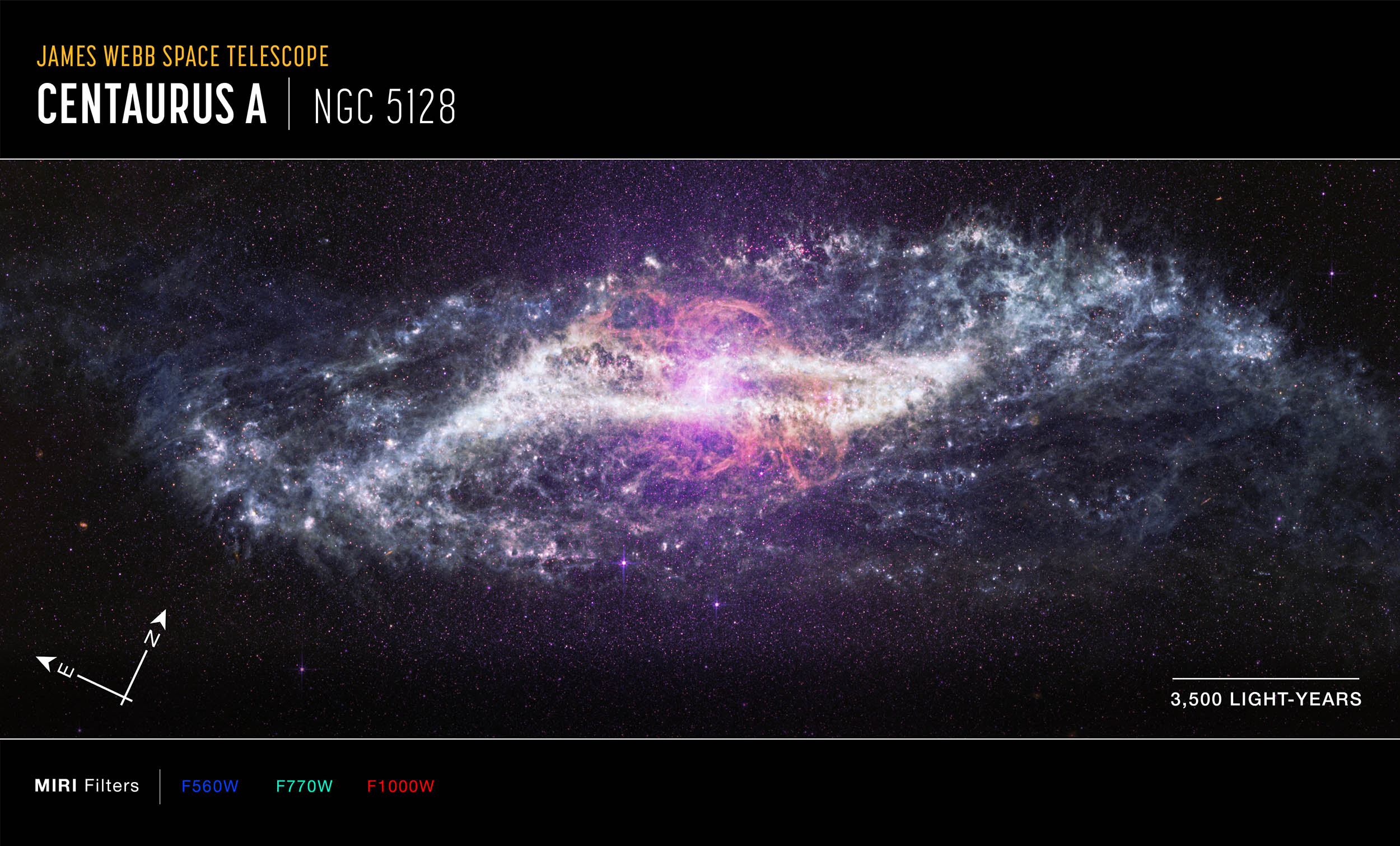 Annotated image of the active galaxy Centaurus A captured by the James Webb Space Telescope’s MIRI instrument. Credit: NASA. Click image to enlarge.The dusty heart of Centaurus A
Webb’s mid-infrared images reveal twisting clouds of dust spread throughout the galaxy. A warped band shaped like a parallelogram slices across the center, while thinner streams of material stretch outward into space.
One structure stands out more than the rest. An unusual, S-shaped feature appears clearly in images taken by Webb’s Mid-Infrared Instrument, known as MIRI.
Astronomers are still trying to understand what created it. Was it shaped by the black hole at the center? Did the long-ago collision leave it behind? Could nearby star formation be responsible? The answer remains unknown.
Many of the glowing red points scattered throughout the image are stars surrounded by dust or regions where new stars are being born.
Older stars release material back into space as they age, and that material later becomes the building blocks for future stars and planets.
History written in the stars
The stars revealed by Webb act like a historical record. Their ages and locations allow astronomers to reconstruct the galaxy’s past.
Some belong to the earliest generations, formed billions of years ago. Others appeared during bursts of star formation triggered by the collision. Still more formed from gas left swirling through the galaxy afterward.
By studying these different populations, researchers can build a timeline showing when major events took place and how the galaxy responded to them.
Centaurus A has become an example of galactic archaeology, where astronomers piece together history using the stars themselves as evidence.
Ionized gas races outwards from Centaurus A
At the center of Centaurus A lies a supermassive black hole that continues to pull in surrounding material. As matter falls inward, enormous amounts of energy are released back into the galaxy.
Webb’s instruments do more than take pictures. Using spectroscopy, scientists can break apart light and measure the movement of gas inside the galaxy.
Early observations show fast-moving, ionized gas racing outward from the center, likely pushed by the black hole’s activity. Webb also detected warmer molecular hydrogen inside a warped disk that rotates near the core.
The black hole at work
These observations are helping astronomers tackle one of the biggest questions in modern astronomy: how a black hole can shape an entire galaxy.
The answer appears to work in two directions. The black hole can squeeze gas tightly enough to trigger new stars to form. It can also blow gas away and prevent star formation from happening.
Four years after beginning science operations, Webb continues to exceed expectations. It has traced dust in extraordinary detail, separated millions of stars, and tracked gas moving near a supermassive black hole.
Webb’s capabilities have turned Centaurus A into one of the clearest records of galactic history ever observed.
Information was obtained from a publication on the NASA website.
—–
Like what you read? Subscribe to our newsletter for engaging articles, exclusive content, and the latest updates.
Check us out on EarthSnap, a free app brought to you by Eric Ralls and Earth.com.
—–