
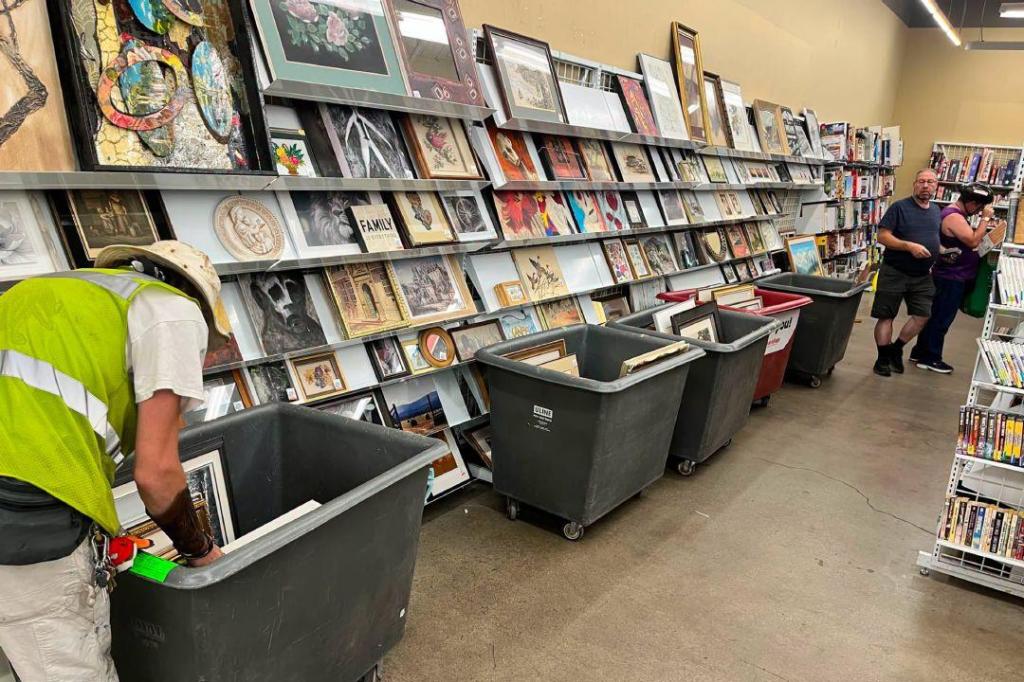
Fierce community backlash over the Penticton Art Gallery’s decision to donate items to Value Village led to a cyber attack and alleged beratement of a young staff member.
Around two weeks ago, the gallery sent several items, including artwork, to the for-profit business as it was sorting through hundreds of pieces at its Marina Way location.
Leslie Whatmough, president of the gallery’s board, says she regrets the way the situation was handled.
“We hurt people’s feelings and we undermined the trust in the process,” Whatmough told The Western News in a July 31 phone interview.
Whatmough said the gallery should have explored reaching out to non-profit organizations about its plans to donate items before moving ahead with Value Village.
She also outlined the community backlash that followed, sparked by former curator Paul Crawford posting on Facebook last weekend about the situation. Crawford, currently embroiled in a legal battle with the gallery after being laid off in August 2025, posted pictures of gallery items at Value Village in his post.
“Within 12 hours of that first Facebook post, we had a cyber attack,” Whatmough said. “And our website was taken down. For two days, our means of doing business were stopped.”
Whatmough said she directed community feedback to her email address after noticing people taking out their frustration on other gallery staff.
“An artist who was upset, fair enough, wanted to voice their feelings and took it out on our summer student,” she said. “They actually verbally abused them to the point of tears. It bothers me that in some ways people have gone out of their way to make this personal.”
The board president added that she has received a barrage of emails, negative and “hurtful,” with some suggesting she should be “ashamed.”
“I’m not ashamed. I regret,” she said. “I really appreciate the people who’ve reached out and said, ‘Wow, you’ve had a problem. We’re not impressed with how you dealt with it. But can we help solve it so going forward this doesn’t happen again.’”
Whatmough emphasized that not all the items donated to Value Village were pieces of art.
There were calendars and puzzles and a “wide array of things,” she said.
“We even had pictures that had Value Village stickers on them,” Whatmough added.
“We had just things that didn’t make sense. And so when we sorted through that big stack of things, we divided the things that we felt were of a calibre that the gallery could raise a reasonable amount of funds at a future fundraiser.”
Said items have been set aside and currently reside at the gallery, she noted.
Some residents have taken to social media over the last week after visiting Value Village, claiming that items in question were listed for as low as $11.
Asked why the gallery couldn’t return the artwork to donors, Whatmough said none of the donations the gallery received had any documentation.
Tax receipts were also nowhere to be found, an issue that Whatmough has noticed with items since starting with the gallery last fall.
“And the problem is that if a tax receipt was given to someone for an item, we cannot give it back,” Whatmough explained. “That’s tax fraud.”
Recent social media chatter has also revolved around the gallery’s decision not to hold a fundraiser with the items it donated to Value Village, as it navigates well-documented financial hardship.
In August, the gallery announced it had laid off Crawford due to cost-saving measures. Karen Walls, gallery gift shop coordinator, was also placed on leave with no recall date.
It marked the second straight year economic pressures have led to job cuts at the gallery.
Whatmough said selling the former gallery-owned artwork, as suggested by many on social media, would not generate sufficient revenue.
“They don’t raise enough money to solve big problems, so that’s a challenge,” Whatmough said of having sales, noting that staff layoffs in both 2024 and 2025 happened within two months of major art auction fundraisers at the gallery.
The board president explained that education programs are a key revenue driver for the gallery. There are also now admission fees, a change Whatmough says has been well received by the community.
“Not only do they cover the cost of the building, but that allows us to pay artists what they’re worth,” she noted.