
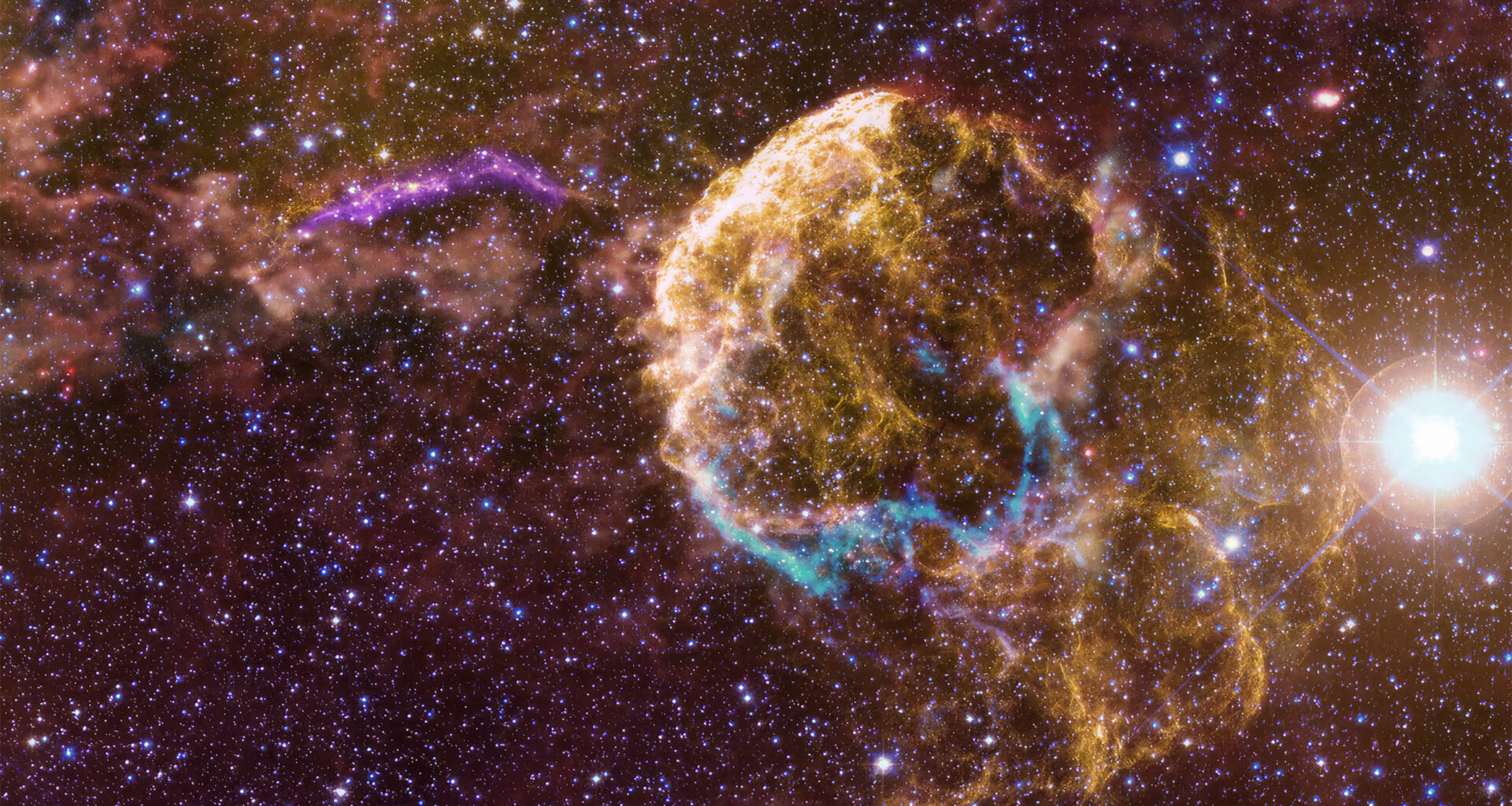
Two enormous stars once circled each other, forming a binary star system about 5,900 light-years from Earth. One of them ran out of fuel and blew apart, and the explosion threw its partner star across space.
Tens of thousands of years later, the partner exploded too.

A team led by Miltiadis Michailidis, a physics postdoctoral scholar at Stanford, now reports that the wreckage of both is sitting in the same patch of sky, and that astronomers have been studying one of them for decades without noticing the other.
He presented the work in June at an American Astronomical Society meeting in Pasadena, and the paper came out July 21 in Nature Communications.
Faint shell seen near Jellyfish Nebula
The famous supernova remnant is the Jellyfish Nebula, known to astronomers as IC 443. It is among the brightest supernova remnants the Milky Way has, and one of the few that glow in gamma rays, the most energetic light there is.
The German-led ROSAT satellite spotted the second shell in an X-ray survey in 1994, and astronomers left it on a candidate list for close to 30 years. Nobody could find the round radio shell they usually want before calling something a supernova remnant.
Michailidis and his colleagues pulled 16 years of observations from the Fermi Large Area Telescope, an instrument conceived and built at Stanford and SLAC National Accelerator Laboratory. The data run from August 2008 through October 2024.
Fermi pins down a source more precisely the more energetic the light it catches. At the sharpest energies, the telescope sees a broad gamma-ray glow east of the Jellyfish Nebula, sitting right on top of an X-ray shell that the eROSITA telescope mapped from orbit.
Earlier astronomers had catalogued that glow as four separate points. One extended object fits the data far better.
Protons north, electrons south
Gamma rays can be made two ways, and this remnant uses both, on opposite sides of itself.
Along the northern edge, the light carries the mix of energies that appears when protons slam into dense gas. Across the southern half, where there is no dense gas to hit, fast electrons make the gamma rays instead.
Michailidis and his coauthors know of no other supernova remnant where the two kinds of particles split this cleanly across one shell.
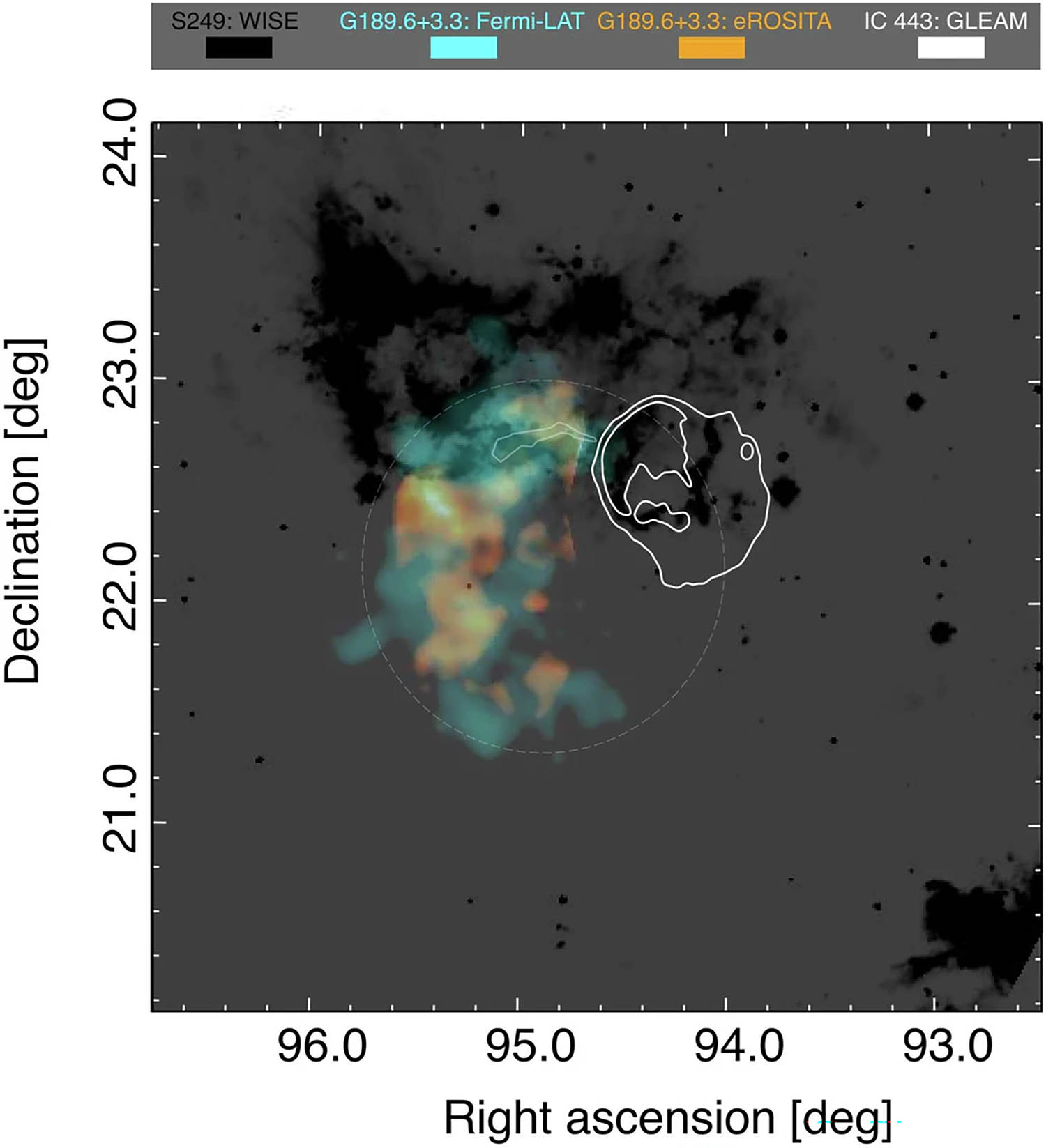 Composite map of the Jellyfish Nebula (IC 443) complex region. Spatial comparison of X-ray, gamma-ray, and infrared (IR) emission in the vicinity of G189.6+3.3. Credit: Nature Communications. Click image to enlarge.First measured in 1984
A curved thread of glowing gas runs between the two supernova remnants. Robert Fesen measured its light in 1984 and found something odd: it did not match an ordinary cloud of ionized hydrogen.
It matched gas heated by a shock, and he suggested it might belong to an older supernova remnant nobody had recognized.
He was right, and it took forty years to confirm. At the highest energies Fermi records, the brightest gamma rays in the whole region come from that filament. Swift’s ultraviolet camera picked it out too.
Stefano Gabici in Paris worked out the physics. The remnant’s shock was traveling about 310 miles per second (500 km/s) when it reached a dense cloud of hydrogen called Sharpless 249. Inside the cloud it slowed to about 31 miles per second (50 km/s).
Behind a shock that slow, gas cools and compresses. Cosmic-ray protons already in the cloud gain energy at the shock, compress with the gas, and then collide with it often enough to make gamma rays. The team estimates the shock has swept up at least 300 suns’ worth of material.
One distance, two explosion dates
Both remnants touch the same cloud, so both sit the same distance from Earth. Using X-ray absorption and 3D dust maps built from Gaia and 2MASS, the team put that distance at about 5,900 light-years.
From Earth the two explosion sites look 30 to 50 light-years apart.
The Jellyfish Nebula is about 8,000 to 9,000 years old. Its neighbor is somewhere between 20,000 and 110,000 years old. The two stars may have exploded as much as 100,000 years apart.
Reinhold Willcox at KU Leuven simulated a million binary star systems to find out whether one pair could do that. Only systems that traded material before the first explosion ended up with remnants that far apart within that delay. Stars born too far apart to touch never picked up enough speed to travel.
Both original stars also appear to have been heavy, at least 20 times the mass of the sun. Nearly every star that massive circles a companion.
“We’re looking at the final chapter of a relationship that began millions of years ago,” says Michailidis. “It is a binary star story with two massive stars that were bound together by gravity before they both exploded, and we can see the remnants.”
Two remnants, one unfinished case
Michailidis and his coauthors call the pair a candidate rather than a settled case. No single measurement can prove a binary origin in remnants this old, so the argument rests on separate lines of evidence that agree.
Direct proof that the shock hit the dense gas would come from a radio signal called an OH maser, which astronomers often detect around remnants pushing into clouds.
Michailidis and his colleagues searched the literature and the existing maser catalogs and found no report of one here.
The HAWC and LHAASO observatories have both picked up higher-energy gamma rays from this direction. Neither team can assign that light to one remnant, because the two overlap on the sky.
The team calculates the odds that two unrelated remnants would land this close at the same distance at about 0.1 percent. Under the most cautious assumptions they tried, the number stays below 1 percent.
Two dead stars are out there somewhere in that wreckage, a neutron star or a black hole from each explosion. As of today, nobody has found either one. Determining their speeds would show how hard each blast kicked them, and which star went first.
The full study was published in the journal Nature Communications.
—–
Like what you read? Subscribe to our newsletter for engaging articles, exclusive content, and the latest updates.
Check us out on EarthSnap, a free app brought to you by Eric Ralls and Earth.com.
—–