
Born Gyula Halász in Brassó, Hungary (today Brașov, Romania), in 1899, Brassaï – meaning “from Brassó” – studied fine arts in Budapest and Berlin before settling in Paris in 1924. A gifted writer – he apparently taught himself French by reading Proust – he initially made a living from journalism while keeping company with Montparnasse’s other bohemian émigrés. He hoped buying photographic equipment would facilitate his entry into photojournalism, then in a state of transformation owing to the advent of the portable 35mm camera and the flashbulb.
Instead, under the tutelage of fellow Hungarian André Kertész, Brassaï pioneered the art of nocturnal photography, wandering the streets of the metropolis by night with a Voigtländer Bergheil folding plate camera and wooden tripod. Over two years he created the 60 black-and-white, high contrast images of rain-slicked cobblestones, fog-enshrouded architecture and marginalised denizens of the city’s night-time economy that would comprise his first published collection, Paris de nuit (1933). “It is,” he would later say, “to capture the beauty of the streets and gardens, in the rain and fog, and to capture the Parisian night that I became a photographer.”
In contrast with the candid, spontaneous ways of working favoured by his contemporary Henri Cartier-Bresson, Brassaï strove to establish relationships with his subjects. The result is a fascinating tension. While sometimes deeply, even shockingly intimate, Brassaï’s photographs do not reveal the artist as a voyeur so much as a kind of co-participant, his subjects knowing signatories to what feels like a mutually empathetic contract with their chronicler.
He meticulously composed his images and was careful not to waste any of the 24 glass plates that were all he could carry on his walks. He measured distances by knotting a piece of string and timed exposures by how long it took to smoke one or more cigarettes. Unlike Cartier-Bresson, he approached photography as a hands-on, end-to-end process, remaining committed throughout his career to developing his photographs himself in his own darkroom.
Perhaps no modern city has been as reproduced or mediated as much as Paris, yet Brassaï’s photographs … resist the kind of kitschification that has befallen the works of many of his contemporaries.
Curated by Lesley Harding, Emmanuelle de l’Ecotais and Philippe Ribeyrolles – the artist’s nephew and executor – and showing at the Heide Museum of Modern Art, Brassaï: Secret Paris assembles about 150 of the artist’s gelatin silver photographs, all of them prints developed by Brassaï himself between the 1930s and 1970s. Collectively, they both record and aestheticise the vanished world of 1930s Paris – gas lamps and traffic signals, brothels and restaurants, slums and avenues – its deep, almost agential shadows permeated with moonlight and neon, and all of it inflected with melancholy and decadence. It is, apparently, the first retrospective of Brassaï’s work in Australia since the 1970s, as well as the most expansive survey undertaken in this country.
Individual rooms are themed around day- and night-time photography, Brassaï’s intersections with Picasso and the Parisian avant-garde, his experiments with surrealism and his trailblazing interests in the city’s demimonde and what we would today call street art – though labelled “graffiti”, these scratchings into the stone walls of the city bear an intriguing resemblance to ancient rock art. The design, by architectural firm Bright, is suitably modernist – unembellished and largely monochromatic. The photographs are hung at eye level, their natural timber frames set against night-black walls, except for the “Paris by Day” room, bedecked in diurnal white. Several works, including 1932’s Escalier de Montmartre (Au chien blanc), are blown up across suspended banners, exposing intriguing details – Brassaï has, we can see, given one of the dog’s ears the faintest of touch-ups.
There are some surprising flourishes. In a room dedicated to Brassaï’s connections with André Breton’s surrealist movement, visitors are invited to sit on stools and gaze into peepholes that reveal an iterative series of works, described by the artist as “Transmutations”, created by engraving images on exposed glass negatives. Alongside the vaguely surrealist butterfly wings, flower petals and female nudes of this series are intimate scenes from Picasso’s Paris and Boisgeloup studios, one depicting the cubist painter’s hand in close-up as it provocatively daubs over a newspaper headline about a Catholic priest. One peephole looks out onto Heide’s leafy grounds, a nod perhaps towards Brassaï’s affinity with the natural world.
A final room houses a projection of the artist’s sole film, the 21-minute Tant qu’il y aura des bêtes, which won an award at Cannes in 1956 and screened at the 1958 Melbourne Film Festival. Sadly, the film – shot at the Paris Zoo but described by the artist as “closer to animated design than a documentary” – wasn’t set up for viewing during the media preview I attended. Kinetic, fast-cut and occasionally dreamlike, it renders the movement of the zoo’s animals as a kind of ballet, and features much use of Mickey Mousing, whereby the score synchronises exactly with the onscreen action. It can be watched in full on Vimeo.
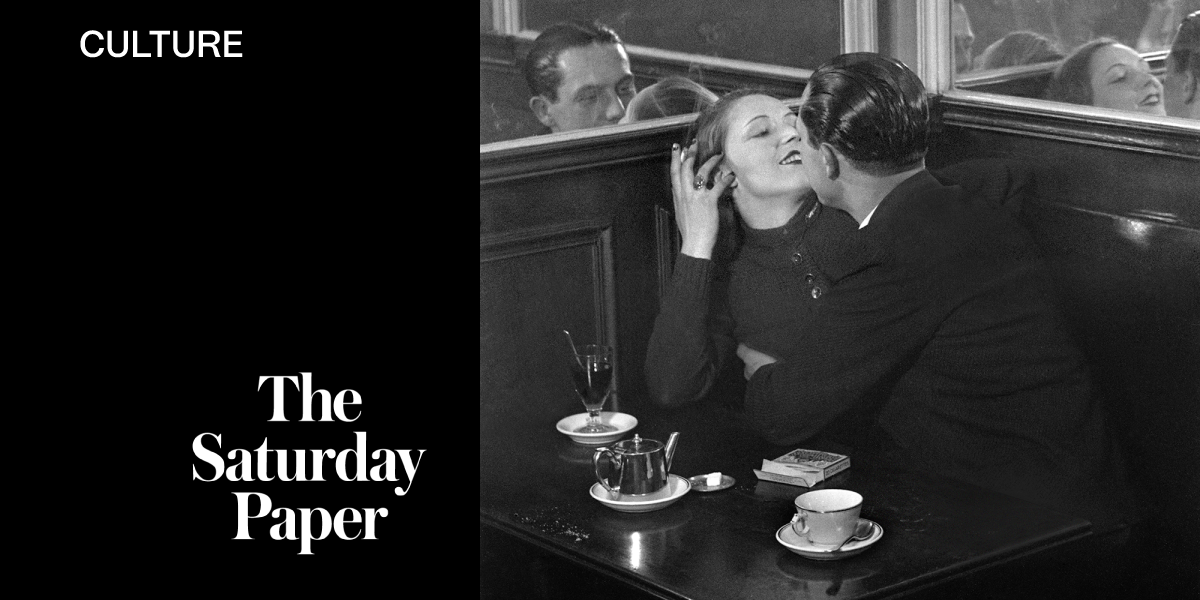
The artist’s most iconic images are present and correct, from Autoportrait, Brassai photographiant la nuit boulevard Blanqui (1931-32) to Couple d’amoureux dans un petit café (circa 1932). While the artist once described his oeuvre as “a study of customs through photography, a social study of underground Paris”, his gaze emerges from these photographs as a humanist rather than coldly anthropological one, rendering the lives of sex workers, petty criminals, street cleaners and socialites equally deserving of witness. All speak to the expressive possibilities of photography, as well as to the medium’s role in exposing divisions of class and social station.
Perhaps no modern city has been as reproduced or mediated as much as Paris, yet Brassaï’s photographs – even when of such fixtures of the cultural imaginary as the Eiffel Tower or Arc de Triomphe – resist the kind of kitschification that has befallen the works of many of his contemporaries. In Tour Eiffel (1929), the earliest photograph here, the famous lattice iron tower is framed by a distant fence, lending greater significance to the photographer/viewer’s subjectivity than the object itself, resplendent in its after-dark illuminations though it is.
Photographs, Susan Sontag contended, slice out moments and freeze them, testifying to “time’s relentless melt”. Perhaps, but Brassaï’s photographs reanimate a lost time with startling immediacy, in the process exerting a powerful, if paradoxical, nostalgic pull for an age almost beyond living memory. They continue to resonate because they are beautiful, their formal excellence undiminished by their relative technological primitiveness. If anything, in fact, it struck me that Brassaï’s images have only benefited from the passage of time, their supremely artful composition and production today evincing all the humanising imperfections of pre-digital photography.
As Henry Miller, a friend of the artist, put it: “Just as a thousand diverse types may write automatically and yet only one of them will bear the signature of André Breton, so a thousand men may photograph the Cemetery Montmartre, but one of them will stand out triumphantly as Brassai’s.”
Brassaï: Secret Paris is showing at Heide Museum of Modern Art until November 15.