
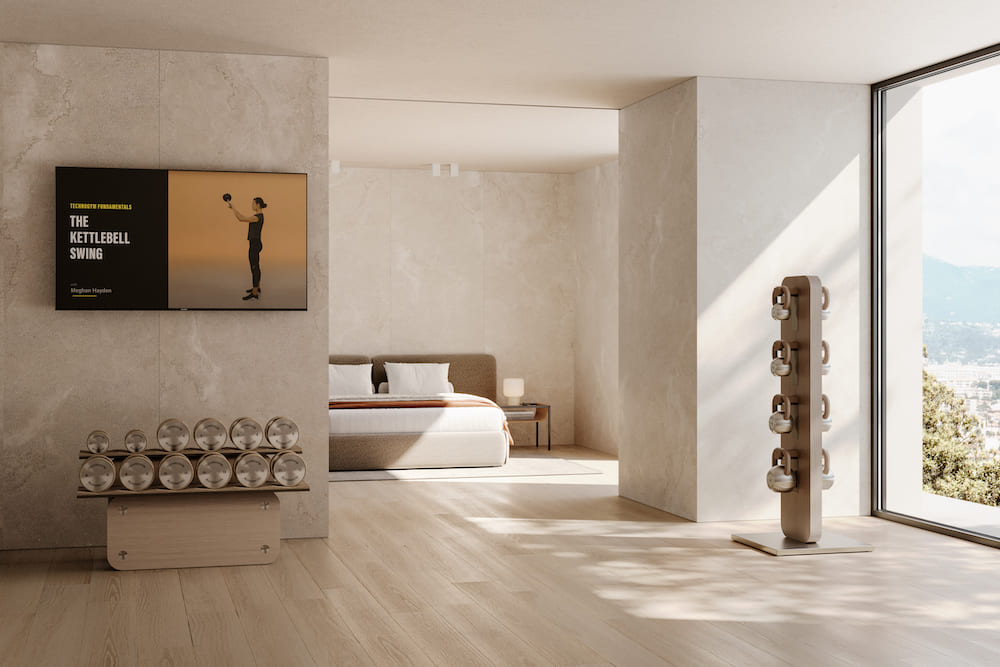
Over the past few years, interior design has been undergoing a subtle but very clear shift in direction. As someone who has often found minimalism cold, I am delighted that luxury spaces are now embracing something much softer and warmer: textured materials, new shades and tones, and an atmosphere that invites you to stay longer because you feel comfortable there. This new interpretation of luxury in private and hotel interiors is rooted in a return to the self, something we as individuals have also been working intensely on for some time. There is also a sense of home, and we know that is where we are happiest. In this new language of interiors, warmth is becoming a new form of elegance, and it is precisely within this context that it becomes clear how long fitness spaces have remained outside that narrative.
Looking back at the evolution of fitness design over the past few decades, it has followed broader design trends almost exactly: the 1980s were industrial and grey, the 1990s clean and white, and the 2010s intensely black and technical. Each phase had its own logic, but they all shared the same limitation: fitness remained a “separate language.” Technogym, the global leader in fitness, wellness, sport and health, founded in 1983, has not only followed this evolution but also helped shape it through founder Nerio Alessandri’s long-standing aesthetic consistency and the influential role of the Technogym Design Center, which has spent decades exploring how the body, technology and space can come together. In 2025, a subtle shift took place, as the focus moved beyond equipment design to creating an identity for the entire space. A new chapter in the era of the luxury wellness lifestyle bears the name of the new collection: Sand Stone by Technogym.
The fitness room as the last “cold” space in the home
In high-end architecture, the same scenario is repeated almost without exception. Homes and hotels in which wellness is part of the offering are carefully designed through layers of materials, light and tactility, yet the fitness space remains the exception. It is planned, but rarely designed down to the last detail with the same level of focus as the rest of the interior. This often results in spaces that end up as technical zones: black equipment, metallic contrasts and visually separate elements that fulfil their function but do not participate in the language of the surrounding interior. When considering the shift in design towards warmth, this very contradiction becomes increasingly personal and leads to one logical question: why should the most functional part of the home also be the coldest? The answer has arrived. It is warmer than ever, architecturally perfected and inspires the previously unimaginable idea of spending the day relaxing in a fitness room designed like this.
Sand Stone as a response to a stylistic shift
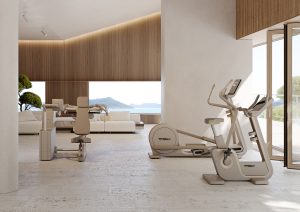
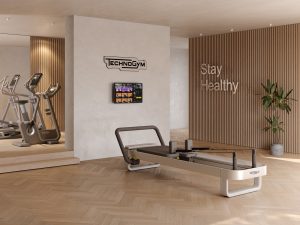
The Sand Stone collection by Technogym could easily inspire you to do just that, as it was created to bring fitness into the same emotional and material language as the rest of the home. What is crucial to this approach is a shift in perspective: fitness equipment is no longer an object added to a room, but an element that actively helps shape a comfortable, inviting atmosphere.
This new collection spans the full spectrum of training, from cardio and strength equipment to Pilates, functional training, free weights and measurement systems, all united by a single visual identity. This eliminates the usual fragmentation of fitness spaces, where each segment looks like a world of its own. Elements in soothing sandy shades take centre stage, making the space feel like a cohesive whole. This is precisely why the name Sand Stone was chosen with a degree of poetic freedom. On the one hand, it evokes sandstone, a sedimentary rock that symbolises layers and permanence. On the other, it plays with the two words “sand” and “stone,” with “sand” conveying the warm, granular texture of sand and “stone” the solid, stable presence of rock.
The collection’s material logic: design that is felt before it is seen
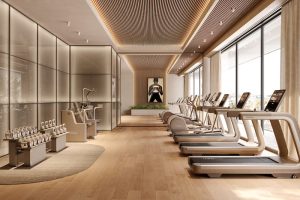
Sand Stone introduces a material language that is directly connected to contemporary interior trends, translated into the context of fitness. Speckled Stone features surfaces inspired by natural stone, with the addition of 2 to 3% mica to create subtle depth and reflect light. Combined with the use of recycled materials, it also highlights the increasingly important role of sustainability in premium design. Visually, the result is a material that looks architectural rather than “industrial,” like part of a wall or floor finish rather than a machine.
Clay introduces matte vegan leather in warm, neutral tones. It is one of the collection’s most important elements because it transforms the user’s physical interaction with the equipment. Instead of the cold touch of technology, it creates a sense of softness and intimacy, which is particularly important in private wellness spaces. Warm Titanium defines the structure through subtle metallic lines. Rather than creating a dominant industrial effect, metal becomes a quiet framework that provides structure without visual weight, referencing contemporary high-tech design in a more refined interpretation. Beech and ash wood add natural variation and warmth, particularly in the Personal Tools and Technogym Reform ranges, where body and material meet most directly.
A unified visual identity for wellness spaces
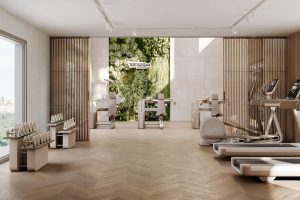
One of the key innovations of the Sand Stone collection is the possibility of creating a completely cohesive wellness space. In practice, this means architects and designers no longer need to combine different visual languages for different types of training. Cardio, strength and functional training no longer appear as separate zones, but as parts of the same interior. This introduces a new level of wellness space design: it is no longer simply a well-equipped exercise room, but an architecturally valuable space where training happens naturally while remaining visually connected to the rest of the interior.
Technology that stays in the background
Although the aesthetic focus is on warmth and materials, Technogym retains a powerful technological component. The digital ecosystem, AI-powered workout personalisation and device connectivity remain at the heart of the experience, but they are no longer visually dominant. Instead of “speaking first,” they support the user from the background, adapting the workout to a space that looks like part of the home rather than a separate functional zone. zone. Confidence in Technogym’s quality is further reinforced by its status as an official supplier to the Olympic and Paralympic Games. As a partner to no fewer than 10 editions of the Olympic Games, Technogym continuously equips the world’s leading athletes and major international sporting events.
These are all reasons why even a single glance at the new Sand Stone collection by Technogym demonstrates that we are witnessing a fundamental aesthetic transformation of fitness “corners.” They are becoming spaces where you do not simply want to “get through” another workout, but to stay longer, remain mindful and grounded in the moment, and extend your workout into every other aspect of wellbeing. The future of wellness truly looks exciting.