Mapped: Where Innovation Is Thriving Across America
See visuals like this from many other data creators on our Voronoi app. Download it for free on iOS or Android and discover incredible data-driven charts from a variety of trusted sources.
Key Takeaways
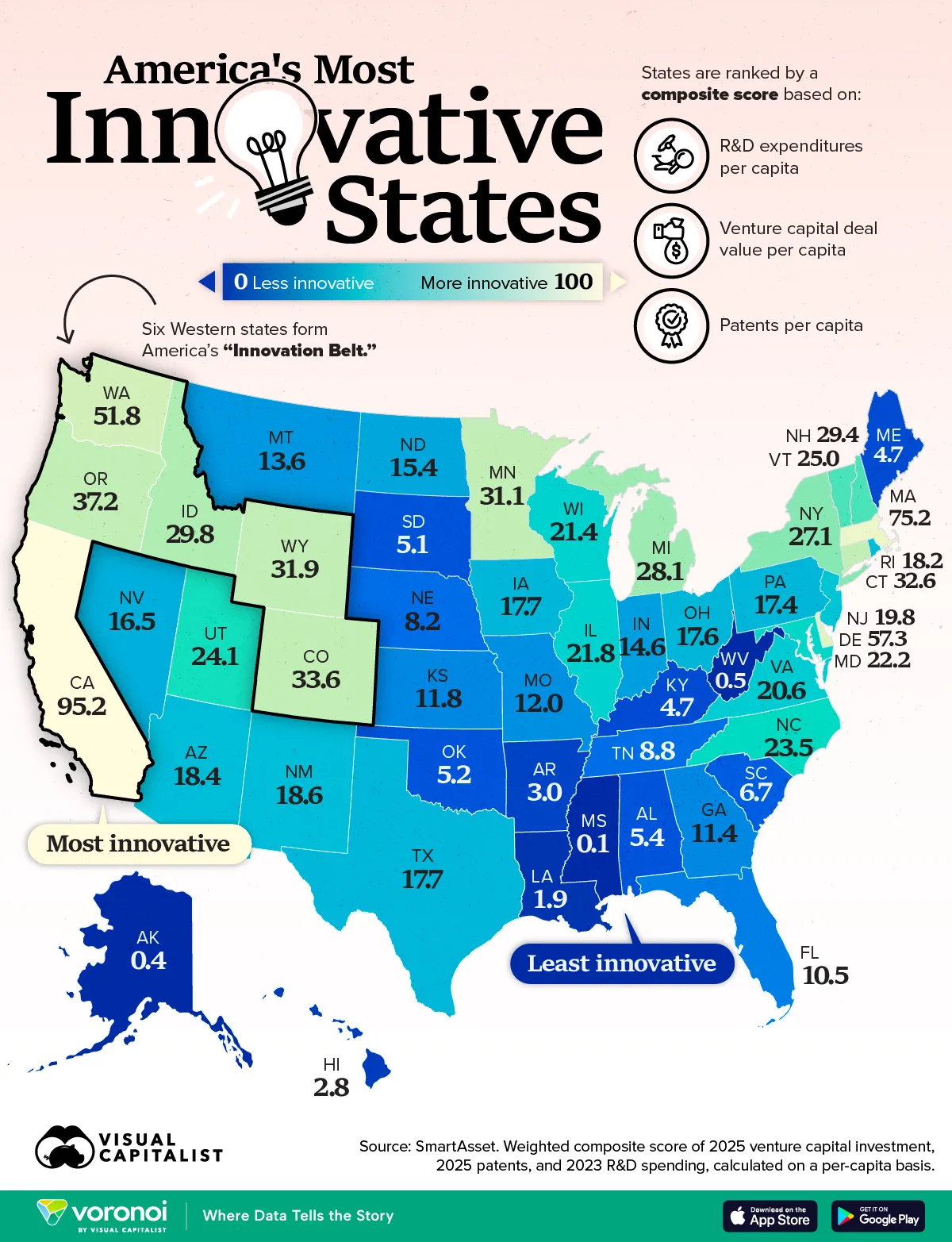
California ranks first by a wide margin, driven by its strength in patents, venture capital, and R&D spending.
Six Western states place in the top 10, forming an “Innovation Belt” from the Pacific Coast to the Mountain West.
The ranking combines patents, venture capital investment, and research spending to measure innovation activity across all 50 states.
Innovation shapes where new companies are built, breakthrough technologies emerge, and high-paying jobs are created. Across the U.S., however, that activity is concentrated in a relatively small group of states.
This map ranks all 50 states using a composite score based on patents per capita in 2025, venture capital deal value per capita in 2025, and research and development expenditures per capita in 2023.
The data for this visualization comes from SmartAsset.
California Leads by a Wide Margin
California tops the ranking with a composite score of 95.2, nearly 20 points ahead of second-place Massachusetts.
RankStateMost Innovative (0-100)
1California95.2
2Massachusetts75.2
3Delaware57.3
4Washington51.8
5Oregon37.2
6Colorado33.6
7Connecticut32.6
8Wyoming31.9
9Minnesota31.1
10Idaho29.8
11New Hampshire29.4
12Michigan28.1
13New York27.1
14Vermont25.0
15Utah24.1
16North Carolina23.5
17Maryland22.2
18Illinois21.8
19Wisconsin21.4
20Virginia20.6
21New Jersey19.8
22New Mexico18.6
23Arizona18.4
24Rhode Island18.2
25Iowa17.7
26Texas17.7
27Ohio17.6
28Pennsylvania17.4
29Nevada16.5
30North Dakota15.4
31Indiana14.6
32Montana13.6
33Missouri12.0
34Kansas11.8
35Georgia11.4
36Florida10.5
37Tennessee8.8
38Nebraska8.2
39South Carolina6.7
40Alabama5.4
41Oklahoma5.2
42South Dakota5.1
43Kentucky4.7
44Maine4.7
45Arkansas3.0
46Hawaii2.8
47Louisiana1.9
48West Virginia0.5
49Alaska0.4
50Mississippi0.1
The state produces 129 patents per 100,000 residents, attracts nearly $5,000 in venture capital investment per person, and spends more than $7,100 per capita on research and development.
California’s advantage extends beyond Silicon Valley and the San Francisco Bay Area. Southern California’s technology, aerospace, and biotech hubs also contribute to the state’s innovation ecosystem.
Together, these regions bring major technology companies, leading research universities, and venture-backed startups into close proximity, reinforcing investment and new business formation.
Most InnovativePatents per 100K residentsVC deal value (per capita)R&D expenditures (per capita)
California129$4,920$7,105
Massachusetts106$2,324$9,688
Delaware63$3,772$5,796
Washington80$938$7,443
Oregon75$320$2,675
Massachusetts ranks second, supported by exceptional R&D spending and a dense concentration of universities, biotech firms, and research institutions around Boston and Cambridge.
Delaware rounds out the top three, boosted by unusually high venture capital investment relative to its population.
The West Forms America’s Innovation Belt
Six Western states rank in the top 10: California, Washington, Oregon, Colorado, Wyoming, and Idaho.
Their strong performance reflects expanding startup ecosystems, skilled engineering workforces, and close ties between universities and private industry.
Some neighboring states have also attracted companies seeking lower operating costs while retaining access to talent and venture funding.
Washington’s fourth-place finish is supported by major employers such as Microsoft and Amazon, while Oregon stands out for its patent activity and technology manufacturing base.
Innovation Gaps Remain Across the Country
Mississippi, Alaska, West Virginia, Louisiana, and Hawaii record the lowest composite scores in the ranking.
Least InnovativePatents per 100K residentsVC deal value (per capita)R&D expenditures (per capita)
Hawaii8$78$748
Louisiana8$18$422
West Virginia5$2$413
Alaska4$12$581
Mississippi4$2$435
These states tend to lag across all three measures, producing fewer patents while attracting less venture capital and research investment per resident.
As industries such as artificial intelligence, biotechnology, and advanced manufacturing expand, states that strengthen their innovation ecosystems may be better positioned for future economic growth.
Learn More on the Voronoi App 
To learn more about this topic, check out this graphic on the jobs most exposed to AI.