
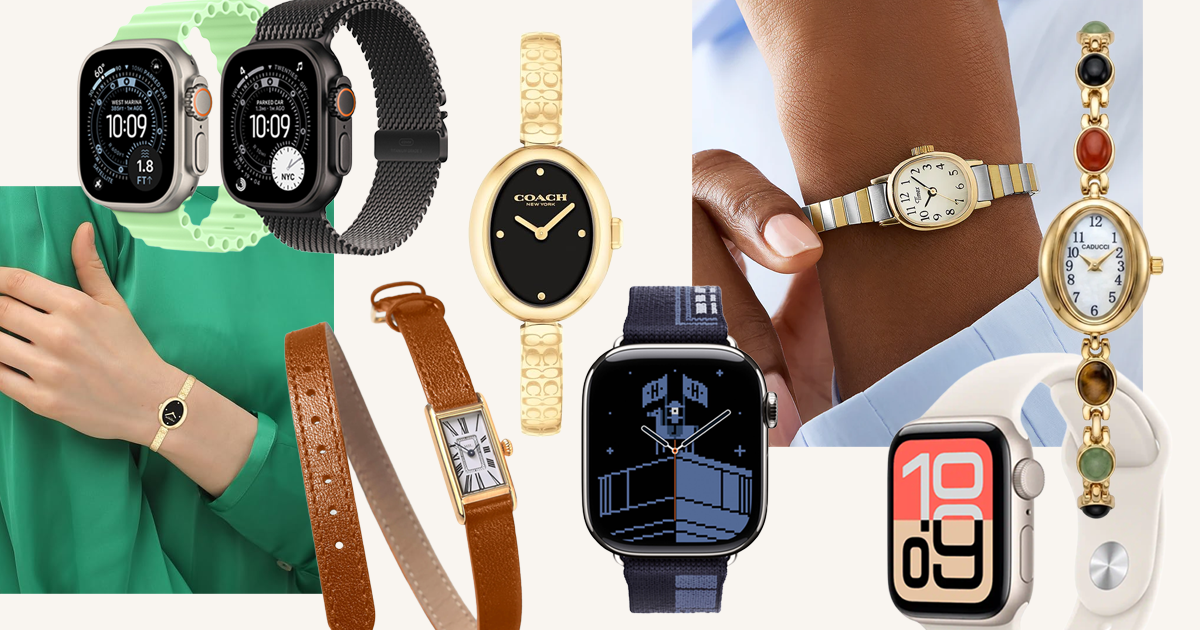
The watch industry classifies anything under 30 millimeters as mini, but today’s most coveted styles measure between 18 and 26 millimeters. Compare that to the supersized watches that dominated the 2000s and early 2010s, they practically disappear. They’re so tiny, they get lost in a stack of bangles or nestled beside a tennis bracelet.
Ironically, the trend has expanded beyond wristwatches, too. Ring watches are making a comeback, while pocket watches clipped to belt loops have found an unlikely audience among fashion people who enjoy dressing like eccentric art collectors.
The Analog of it All
Part of the appeal is what grandma watches don’t do. They don’t buzz, count your steps, or tell you how much sleep you had the night before. They don’t interrupt dinner to tell you you’ve hit your stand goal. Gen Z has grown up in a world where nearly every device (and increasingly every accessory) is tracking something. So much so, that choosing a watch that simply tells time is taboo.
If I’m being frank, after years of smart watches optimizing our lives, there’s something nice about having one that just tells time. I’m touting it as the fashion equivalent of putting your phone on Do Not Disturb.
It’s also part of a broader return to objects that exist purely because they’re beautiful. Just as younger shoppers are gravitating toward landlines, film cameras, wired headphones and vintage iPods, tiny analog watches reject the idea that every purchase needs to be high tech. And yes, I know watches aren’t technically jewelry. But sometimes, you don’t want a tiny computer on your wrist. You just want something pretty.
Unlike oversized luxury watches, mini versions often come with a lower price tag simply because they’re smaller. Vintage shops are also packed with petite watches from decades past, making it easy to find a unique piece without spending a fortune.