
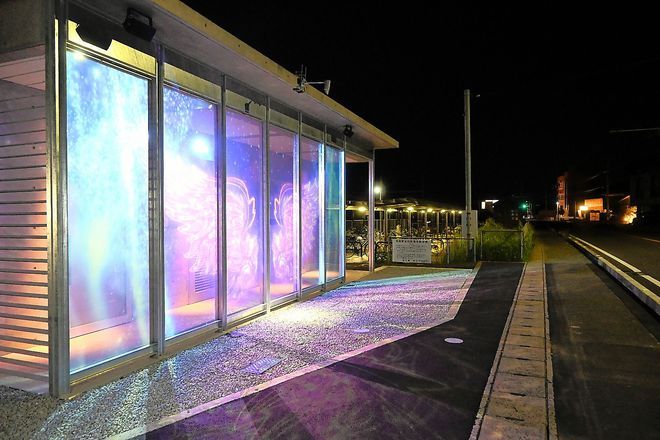
Projection mapping images are displayed on the glass wall of a newly built restroom at JR Kinashi Station in Takamatsu. (Kyoka Watanabe)
TAKAMATSU–On a recent weekday night, only a few people were seen around the restroom at JR Kinashi Station in this capital city of Kagawa Prefecture.
But as soon as it turned 8:20 p.m., moving images of a pair of wings shining in pink were projected on a glass wall of the entrance to the restroom, accompanied by piano music.
The wings eventually turned white, leaving feathers scattered at the end of the presentation.
The light show is held twice a night, from 7:15 to 8 p.m. and from 8:20 to 9 p.m.
On that weekday night in May, several students got off a train before and during the 40-minute projection mapping show. But only two of them stopped to see it.
A 56-year-old company employee who watched the moving display said she finds solace in the show.
“There were many people in March (when the restroom was completed), but I enjoy it all to myself these days,” she said.
Meanwhile, a corporate worker, 48, said, “Who asked for such a thing? Who is happy about it?”
Still, he said he welcomes the new restroom because the old one was too filthy to use.
TRANSFORMS AT NIGHT
During the day, the restroom looks nothing out of the ordinary except that it is new.
But at night, it turns into a light show venue with a dazzling projection mapping display accompanied by music.
The prefectural government built the artistic restroom in March at a total cost of about 99 million yen ($612,000), with a little more than 27 million yen allocated to the projection mapping and other aesthetic aspects.
While some users say it provides comfort, others are not so happy about the expense.
Some social media users said while it is good to have a clean restroom, the new facility and light show are too luxurious.
In the business year ending in March 2025, Kinashi Station was utilized by an average of 1,188 passengers a day.
In another part of the station, there is an old restroom built by the former Japanese National Railways in 1953.
Because it was a unisex restroom with non-flush toilets, local residents had persistently called for improvements.
‘ATTRACTING VISITORS’
The prefectural government started considering adding a new restroom in or around fiscal 2023, saying that something had to be done, according to an official from the culture promotion section.
Because Shikoku Railway Co. (JR Shikoku) and the city government had no intention of renovating the restroom, prefectural officials decided to build a new one and borrowed a plot of land adjacent to the platform at no charge from the railway operator.
The prefectural government included about 4.61 million yen for designing and about 67.32 million yen for construction and equipment in its budget for fiscal 2024 and 2025, in addition to about 27.14 million yen to purchase two projectors and produce the projection mapping content and other artistic elements.
On top of it, the show also uses electricity. The officials set aside about 2.32 million yen in its budget for the current fiscal year for expenses to pay utility bills.
The prefectural government also intends to use about 3.92 million yen in subsidies from the central government to cover a portion of the costs, the officials added.
A prefectural official explained why the local government decided to adorn the restroom with video projections.
After hosting a projection mapping show three times at the prefecture-run Anabuki Arena Kagawa since fiscal 2024 to fuel nighttime tourism, the officials believed those who visit Kinashi are interested in art because the town is famous for bonsai.
They wanted the restroom itself to attract visitors.
The effort is also aimed at nurturing young artists interested in creating projection mapping content.
Part of the video projected on the restroom wall was created by local vocational school students.
The prefectural government is planning to hold a contest for young artists and present award-winning works at the restroom.
Takuya Hirai, a Lower House lawmaker whose constituency represents Takamatsu, and others had called for improvements of the restroom at Kinashi Station in their street speeches during the past Lower House elections and other occasions in response to requests from local residents.
Hirai explained in writing through his office to The Asahi Shimbun that, “I wanted (the restroom) not only to simply go through refurbishment but also to be a renovation model representing the local characteristics and charms.”
A Takamatsu city assembly member who told Hirai of the actual condition of the old restroom was surprised by the high cost of the new one.
“Sometimes the best gain is to lose,” the assembly member said. “Even if we suffer a little loss, it’s fine when we can gain a return later.”
The politician said the city intends to make further efforts to attract visitors with the artistic restroom serving as a starter.