
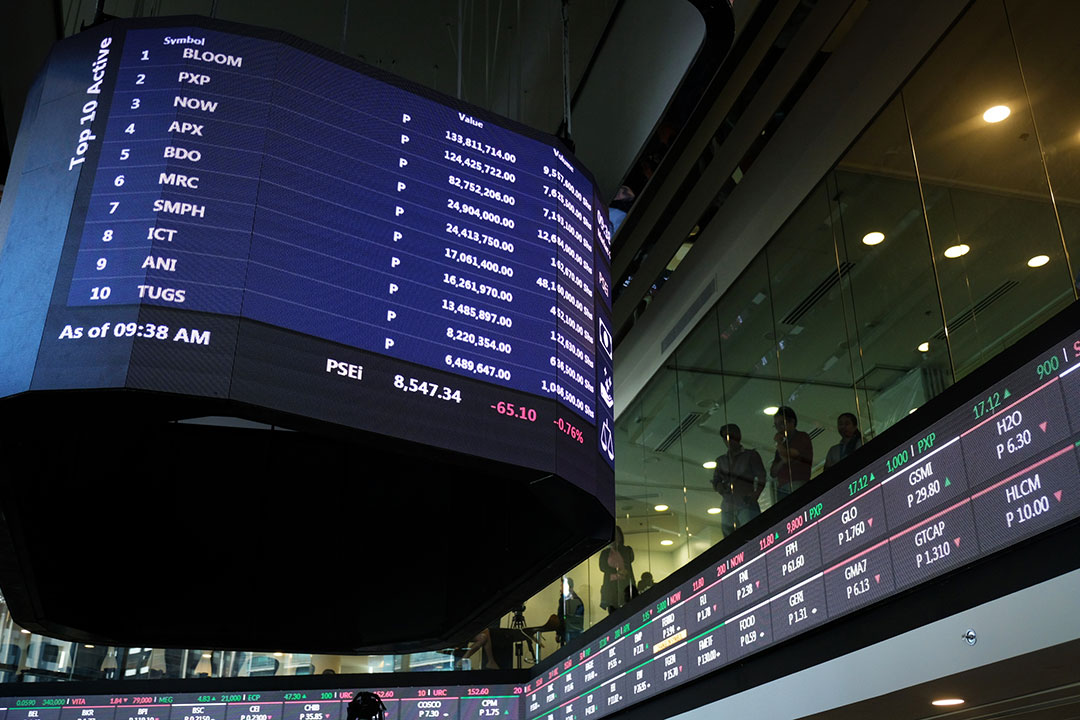
 BW FILE PHOTO
PHILIPPINE SHARES may trade cautiously this week as investors await the release of the latest inflation and gross domestic product (GDP) data to gauge the state of the economy and continue to monitor the situation in the Middle East.
On Friday, the Philippine Stock Exchange index (PSEi) fell by 1.09% or 69.31 points to close at 6,236.44, while the broader all shares index went down by 0.59% or 20.30 points to end at 3,395.05.
This was the benchmark index’s worst close in three weeks or since it ended at 6,223.87 on July 9.
Week on week, the PSEi decreased by 44.57 points from July 24’s finish of 6,281.01.
“Cautious sentiment and drag in major heavyweights weighed on local equities…,” F. Yap Securities, Inc. said in a market note.
“Bearishness persisted in the local market for a second straight week as the war in the Middle East caused another oil rally while the peso hit another record low,” Philstocks Financial, Inc. Research Manager Japhet Louis O. Tantiangco said in a Viber message.
For this week, the main trading drivers would be Philippine data on July inflation (out Aug. 5) and second-quarter GDP (Aug. 7), Mr. Tantiangco said.
“Headline inflation slowed down last June amid easing oil price pressures and strengthened food supply. However, core inflation continued to rise, reflecting a build-up in demand side pressures. For July, the market is expected to check both figures. A slowdown of both is expected to bring optimism in the bourse. A sustained increase in core inflation is expected to be a cause of concern. An increase in both is expected to bring pessimism,” he said.
“GDP growth slowed down to a multi-year low in the first quarter as the corruption issues continued to weigh on public infrastructure spending. The market is expected to watch out for the second quarter figures. A significant improvement from the first quarter may give the market a boost. A further slowdown is expected to bring the market lower, however.”
Separate BusinessWorld polls yielded median estimates of 6.4% for July headline inflation and 2.8% for second-quarter GDP growth.
“Higher-than-expected July inflation might support the case for possible rate hike from the local central bank,” F. Yap Securities added.
“A lower-than-expected [second-quarter] GDP could lead to tempered portfolio exposure in equities.”
Meanwhile, the war between the United States and Iran will continue to weigh on sentiment, Mr. Tantiangco said. “Any negative developments between the two, which would bring global oil prices higher, is expected to weigh on the local bourse.”
He said the PSEi’s decline in the latter part of the previous week despite retesting the 6,400 level is a negative signal, and placed the bellwether’s major support at 6,150 and major resistance at 6,400. — Alexandria Grace C. Magno