
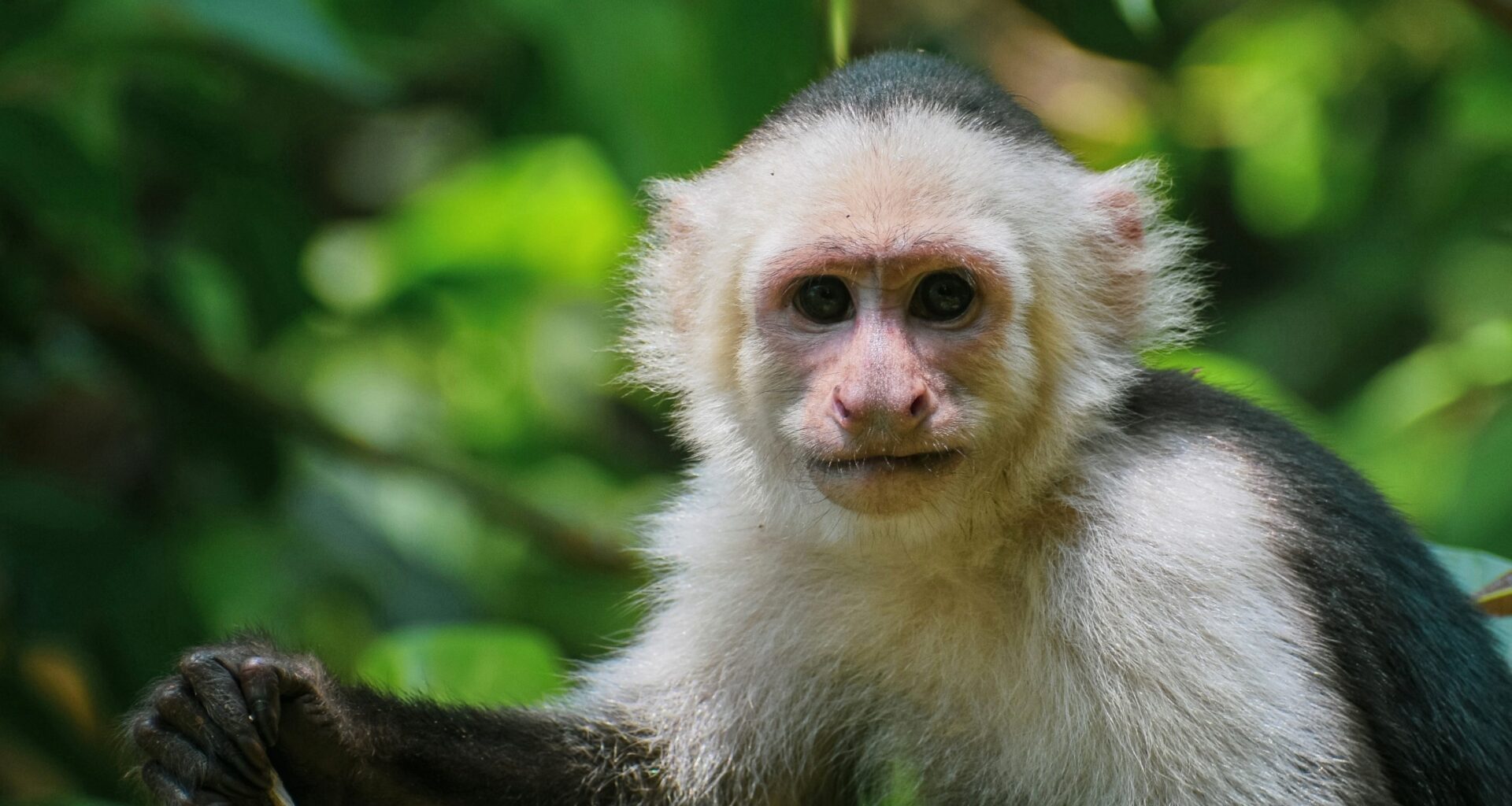
A wooden box bolted to a platform in a Costa Rican forest can spot a capuchin monkey’s face and choose a puzzle suited to that individual.
Get the answer right, and a slice of banana pops out. Nobody has to stand there and run the test.
Wild primates are usually studied one of two ways: in controlled laboratory settings or watched loose in the trees with almost no experimental control.
Researchers at Emory University and the Georgia Institute of Technology built a new system to close that gap.
Marcela Benítez, an assistant professor of anthropology at Emory, led the project, which the team calls CapuchinAI.
She has spent years studying monkey behavior both in captivity and in the wild, and she wanted a way to bring lab-grade precision into the forest itself.
“The primate brain didn’t evolve in a lab, it evolved in complex, competitive environments,” said Benítez.
“Yet primate cognition is rarely studied in the wild because the experimental control needed to measure cognition is difficult in unpredictable environments.”
Teaching AI to recognize monkeys
The team first needed a computer that could tell one capuchin from another. They adapted an open-source facial-recognition program called YOLO.
Then they trained it on thousands of close-up photos and videos of six adult male capuchins living at the Taboga Forest Reserve.
Undergraduates at both universities spent hours drawing boxes around each monkey’s face in old field footage and tagging every image with the correct name.
The team tested the finished model on pictures it had never seen, some blurred or lit differently than the training photos.
It detected a capuchin’s face in the frame 98 percent of the time, and when it did, it identified the correct monkey 97 percent of the time.
A lab in a wooden box
Federico Sánchez Vargas, an Emory PhD student in anthropology and the paper’s first author, took on the job of getting that software into the forest.
His own degrees are in evolutionary biology and psychology, not computer science. Still, he taught himself enough Python to strip the recognition model down so it would flag any capuchin face, not only the six it already knew.
“The model was great at identifying six monkeys, but there are 100 capuchins at the Costa Rica field site,” noted Sánchez Vargas.
“And we didn’t have high-quality video of all of these individuals, which is needed to train the model.”
He and Benítez then built the housing themselves, in her garage, with pine planks, deck sealant, rubber insulating strips and plastic piping from Home Depot.
“We built it in my garage,” Benítez said.
The finished box stands about 20 inches tall and weighs roughly 35 pounds (15.9 kilograms).
A small Raspberry Pi computer inside runs a webcam, a touchscreen and a 3D-printed food dispenser for at least eight hours on ordinary travel battery packs.
The monkey that figured it out
The team waited three days in the field before any capuchin approached the box at all. Then a large male named Trompudo, Spanish for “big snout,” couldn’t resist the smell of dried banana packed inside.
“He climbs on the box and starts slapping the back of it,” Sánchez Vargas says. “Finally, he slaps the touchscreen and a banana slice pops out.”
Trompudo ate it, touched the screen again, and got another slice.
“It was almost like you could see him realizing, ‘Ah, that’s what you have to do, touch the screen!’” Sánchez Vargas said. “It was amazing to watch an individual learn something so quickly.”
“Other capuchins followed his lead faster than the team expected. “Even I was surprised by their enthusiasm.”
Not every monkey caught on
Over six sessions with two habituated groups, 16 capuchins interacted with the box while 14 more watched from a distance without touching it.
Of those 16, ten learned to trigger a reward by touching the screen. Eight built a full habit of walking up, touching, and expecting banana, and five still remembered that habit a week after the box was removed.
The monkeys didn’t all learn the same way. Some caught on almost immediately. Some hung back and watched their groupmates first.
Others investigated the box with their lips instead of their hands, learning to press their mouths to the screen for a reward.
The touchscreen only pays out when its camera confirms a capuchin face is present. When coatis, tree-climbing relatives of raccoons known for breaking into houses, tried to get inside, they got nothing and lost interest.
Learning more about monkey cognition
The team is now training an upgraded model to recognize all 16 pilot monkeys individually.
Around it, they are building four categories of cognitive tests: learning speed, impulse control, flexibility when rules change, and short- and long-term memory.
A known monkey will get whichever task fits its progress. An unfamiliar monkey still gets the basic touch-for-banana lesson while a camera records its face to learn it.
Nobody yet knows whether a monkey that learns fast on one task also learns fast on the others, or whether how it grew up made the difference.
The next generation of field research
“We can explore outstanding questions about how the environment, individual experiences and behaviors connect to cognitive abilities,” Benítez said.
“Why are some individuals better at some tasks than others? How do different individuals adapt to different situations? How do different cognitive strategies relate to fitness?”
Sánchez Vargas ties the work back to Frans de Waal, the Emory primatologist who spent decades studying individual animal personalities before his death in 2024.
“Frans de Waal said that you cannot study cognition if you don’t understand the animals,” he said.
“Our AI methodology doesn’t replace the need for human researchers in the field. It’s essential to have rich, observational datasets gathered by people working on the ground.”
The full study was published in the journal American Journal of Primatology.
—–
Like what you read? Subscribe to our newsletter for engaging articles, exclusive content, and the latest updates.
Check us out on EarthSnap, a free app brought to you by Eric Ralls and Earth.com.
—–