
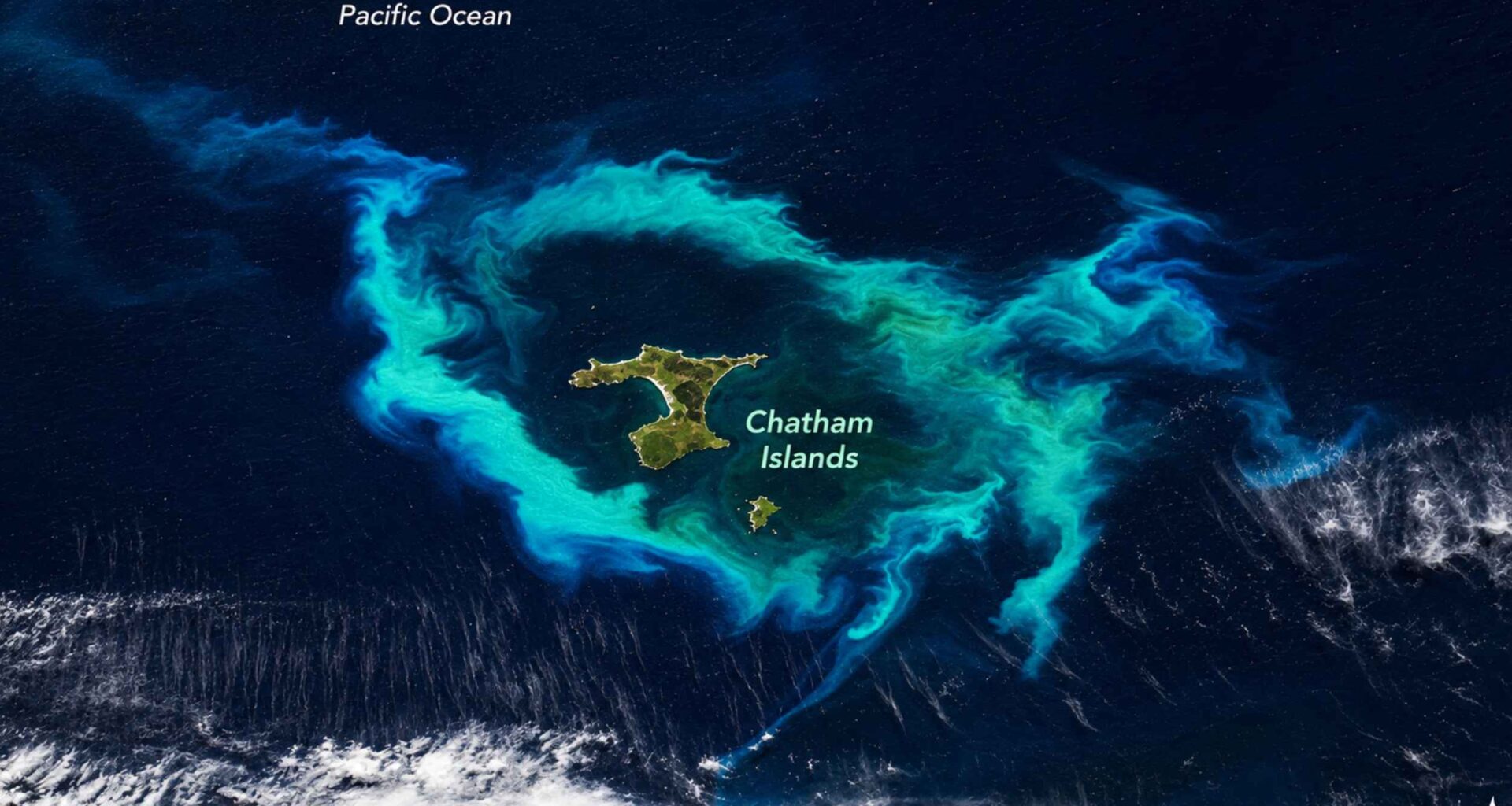
A satellite image captured on January 10, 2026, shows bright green and chalky blue water curling into a broad ring around New Zealand’s Chatham Islands.
The remote archipelago lies about 500 miles east of the South Island, and the color came from a summer bloom of phytoplankton.

The scene is beautiful, but the real story is below the waves.
Currents and eddies stretched the bloom into wisps and spirals, while a huge underwater rise helped bring together the light and nutrients needed for microscopic life to multiply.
Why the green ring formed
Phytoplankton are tiny organisms that use sunlight to grow, much like plants on land.
When enough light and nutrients reach the same patch of ocean, their numbers can increase until the water changes color and the bloom becomes visible from orbit.
How can hidden terrain paint the sea above it?
The Chatham Rise is a broad underwater plateau roughly 500 miles long and 185 miles wide, with deep water on both sides.
Its shape helps hold the boundary where cold, nutrient-rich Antarctic water meets warmer, nutrient-poor subtropical water.
January falls in the Southern Hemisphere summer, when long days provide more sunlight.
Once the bloom formed, surface currents pulled it into loops, filaments, and swirls around the islands.
The phytoplankton became a moving map of the ocean.
How the satellite spotted it
The image came from the Visible Infrared Imaging Radiometer Suite, known as VIIRS, aboard the NOAA-20 satellite.
The sensor measures ocean color, and greener water can signal more chlorophyll, the pigment phytoplankton use to capture light.
Satellite color can show where a bloom is and how it moves across a huge area.
But the January report did not identify a species, which matters because color alone is not the same as collecting organisms from the water and examining them directly.
Earlier regional blooms offer a clue, not a final answer.
Official images from 2008 and 2009 said milky turquoise patches could contain coccolithophores, microscopic algae wrapped in reflective, chalk-like plates.
For the 2026 halo, however, the confirmed description remains a phytoplankton bloom.
Why tiny plankton matter
Phytoplankton sit at the bottom of much of the marine food web.
They feed zooplankton, tiny drifting organisms that are eaten by fish and other animals, so a major bloom can send a pulse of energy through the ecosystem.
The waters around the Chathams support pāua, a local abalone, along with rock lobster and blue cod.
New Zealand Department of Conservation records also list five seal species and 25 whale and dolphin species around the islands.
A 2011 food-web model by marine scientist Matthew Pinkerton at New Zealand’s National Institute of Water and Atmospheric Research divided the Chatham Rise ecosystem into 28 major groups.
The model connected phytoplankton with zooplankton, deep-water fish, seabirds, seals, and whales, showing how many parts of the region depend on the same flow of energy.
A bloom with a history
This was not the first vivid bloom seen around the Chatham Islands.
Satellites recorded a ring in November 2008, broad swirls across the rise in December 2009, and another large green-blue display in December 2010.
Those earlier events make the 2026 image look less like a one-time surprise and more like a recurring seasonal feature.
Still, one photograph cannot predict the next fishing season or prove a long-term climate shift. A snapshot is not a trend.
A natural laboratory from orbit
Repeated satellite observations can reveal when blooms appear, how far they spread, and how currents reshape them.
Direct sampling is still needed to confirm the species in the water and measure the local conditions behind each event.
Lauren Dauphin prepared the image from VIIRS data, and Lindsey Doermann wrote the official report.
What looks like a green halo is really a surface signature of sunlight, nutrients, moving water, and seafloor geography working together.
The official observation has been published by NASA Earth Observatory.
—–
Like what you read? Subscribe to our newsletter for engaging articles, exclusive content, and the latest updates.
Check us out on EarthSnap, a free app brought to you by Eric Ralls and Earth.com.
—–