
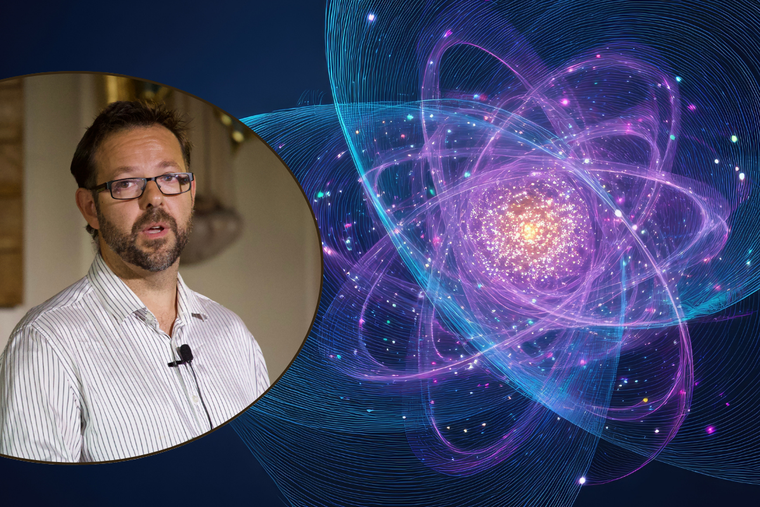
LONDON — Quantum physics, or quantum mechanics, is rapidly emerging not just as a means to develop new technologies but also as a scientific method that can help mankind better understand the truth about creation pointing to the mystery of its Creator.
In this July 31 interview with the Register on the sidelines of “A Day With Mary” conference in London, Catholic professor Vincenzo Tamma discusses what quantum mechanics is, how it relates to divine action, and how it can be a useful tool in the dialogue between science and theology.
“Quantum mechanics helps the faithful think about how God made the world because it describes the deepest level of how nature works,” explains professor Tamma, founding director of the Quantum Science and Technology Hub at the University of Portsmouth in the U.K. “It gives the most fundamental epistemological, ontological insights into nature, the way God willed it and has ordered it.”
To help maximize its potential in this field, he is calling for the recovery of an interdisciplinary idea of the university, as proposed by St. John Henry Newman, in order to deepen the intersection of Catholic theology, philosophy and quantum science and educate the wider public.
Professor Tamma, what in a nutshell is quantum physics?
Quantum physics is the rulebook for how reality works from the smallest scale. It is, if you like, the science of the fundamental building blocks of the universe — such as atoms, electrons and photons. Quantum physics says these things do not behave like ordinary objects; instead, they can be observed in probabilistic ways, where you can only predict the chances of any measurement outcome, not the exact result.
In simple terms, it gives us an understanding of nature at the most fundamental level. It explains why tiny particles can seem to be in more than one place at once, why light can act like both a wave and a particle, and why particles can be linked together in different ways over distance. Furthermore, quantum physics is not just a theory about the universe’s basics — it also powers new technologies like quantum computers, ultra-precise sensors and secure communication. All this technology is now based on the fundamental physics of quantum mechanics, so it helps us not only to understand the universe in its fundamental nature but can be used to develop new technologies.
How can it help us understand the truth of creation?
Quantum mechanics helps the faithful think about how God made the world because it describes the deepest level of how nature works. It gives the most fundamental epistemological, ontological insights into nature, the way God willed it and has ordered it. In that sense, the laws of physics — and especially the quantum laws — are part of the “book of nature,” and God is the one who gives those laws. As St. Augustine said, the book of nature and the Book of Revelation are two complementary ways of learning about God. They are not the same book, and they should not be merged into one, but they help us understand God together.
Does quantum physics support the meaning of mystery as we understand it as Catholics?
Yes, I believe so. Quantum physics and the empirical sciences in general cannot prove God because God is beyond the natural world and beyond the scientific method, even the laws of quantum physics. But the fact that the laws of nature, and especially the quantum laws, are intelligible at all is itself a sign of something deeper and greater. In other words, the laws of physics cannot explain themselves. The mystery is that the universe has intelligible laws that can be understood by a rational observer. So, in essence, quantum mechanics allows us to point towards higher-order realities and to point about the mystery of nature, its intelligibility. That points beyond the laws to a higher order of reality.
That is why many physicists have spoken with awe and wonder about the universe. Einstein famously said that the world’s comprehensibility is a mystery and even called it a miracle. He realized that intelligibility of nature was pointing towards a transcendent. So the answer is: Yes, quantum physics can support a Catholic sense of mystery because it shows that creation is intelligible, yet still ultimately points beyond itself to God.
How might quantum physics relate to divine action? How can it help us understand divine action perhaps in a way that previous science couldn’t?
Quantum physics can help us understand divine action because it gives us insight into how God acts within the material world and within the laws of nature, but it cannot explain God’s action adequately in itself because that goes beyond the created world. St. Augustine said that nature reflects the very nature of God. It is an imprint (vestigium), in a sense, of who God is and also how God acts. St. Thomas Aquinas speaks about God as the primary cause, while the laws of nature and created things are secondary causes. So the world acts, but it acts because God gives it being and power.
This also raises questions about causality, about the relation between the observer and nature, and about how quantum reality may reflect something relational in God, the communion of persons within God. In that sense, quantum physics can help us think about divine action in a deeper and more analogical way.
Do you think, in a sense, quantum mechanics allows for more harmony between God’s will for creation and science, for example?
I would be careful about using one scientific theory of nature to claim a better harmony because we may later discover an even better theory. In the same way, classical physics worked up to a point, and then quantum mechanics was needed because classical physics could not explain everything. The same caution applies today because quantum mechanics and general relativity still do not fully fit together. So we should not treat quantum mechanics as the final word, even though the more we understand nature, including the quantum level, the more we can also understand how God creates. So there is a harmony between science and faith — or, better, between science and theology and between faith and reason. Science can help remove superstition from faith, and it can also inform theology. Theology is still the “queen” of the sciences, but it should be informed by empirical science.
How do you see this field developing in the future in terms of helping people understand the faith and how the Lord works in the world and the universe?
I think there is a real need, in both society and the Church, for scholars to bring together different kinds of knowledge — especially quantum science, philosophy and theology. In Catholic theology in particular, there has been too little top-level interdisciplinary research of this kind. That is why I think we need to recover an interdisciplinary idea of the university, like the one St. John Henry Newman defended, where the different disciplines work together rather than becoming isolated. Even in physics, things are becoming so specialized that we can lose the links between fields and, with them, new insights. This kind of collaboration can help deepen our understanding of the intersection between Catholic theology, philosophy and quantum science, and it can also help inform education and the wider public. It is why we held an international gathering of physicists, philosophers and theologians in July at Chapman University in Orange, California. It is driven by a sincere search for truth, which requires honesty, humility and the willingness to say that we need one another. So the future, as I see it, is building a real community of scholars who can do rigorous research together, remain people of faith, and help one another understand reality, God and creation more deeply.
Do you see quantum physics as an aid to evangelization, especially in the West, which has been affected by scientism and an excessive belief in the work of science?
Yes I see a twofold problem that needs to be solved: On the one hand there is scientism that effectively considers science a religion, that views only what can be measured as real and is a very limited view of reality, and on the other there is what we call fideism [the view that religious truth is known only by faith and not by reason], a kind of superstition that does not really think carefully about faith. So we need both science and faith to work together, instead of setting them against each other.
Science can help us read creation and Holy Scripture more deeply, but it does not put God in a box. God is free, he acts through secondary causes, and he continues to act in creation. Quantum physics can help here because it shows that interaction matters: How we measure a system affects what we can observe, and quantum phenomena like interference and wave-particle duality show a world that is richer than a purely materialist view allows.
So, yes, quantum physics can support a true interdisciplinary dialogue between science and theology by opening people to mystery, challenging scientism and showing that nature is real, intelligible and ordered for human good — all of which can point beyond itself to God.
For anyone interested in learning more about quantum physics and the faith, what books would you recommend?
A good book to start with is [Dominican Father] Michael Dodds’, which connects modern physics and quantum mechanics with the question of how God acts. But there is a lot of misleading writing on this topic. In particular, some people wrongly say quantum mechanics is pure chaos and therefore cannot fit with God, when in fact it is a probabilistic but intelligible theory. Then there is “quantum quackery,” where people use quantum language to support spiritual ideas that have little to do with real physics. Scholars have a responsibility to clear up the confusion, tell the truth and help both the Church and society avoid misleading ideas about quantum physics and theology.