
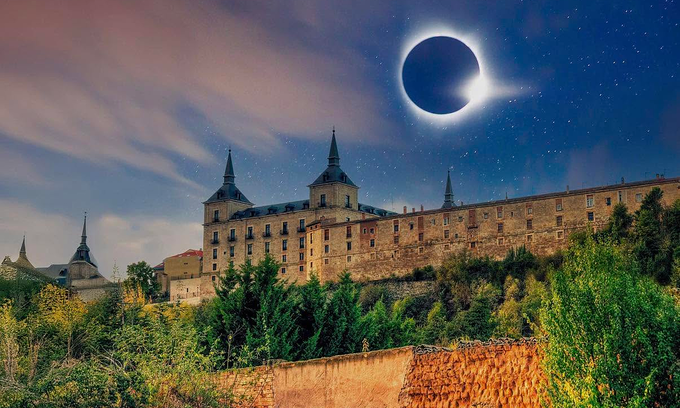
On Aug. 12, the moon’s shadow will sweep across Greenland, Iceland, northern Spain and the Balearic Islands, creating Europe’s first total solar eclipse since 1999, according to Space.com.
Along the narrow path of totality, the moon will completely cover the sun, revealing its outer atmosphere, or corona, while observers across much of Europe and parts of northeastern North America will see a partial eclipse.
Jabaloyas, a village in Teruel province, eastern Spain, will experience 1 minute and 27 seconds of totality, while observers at nearby El Javalón mountain will see 1 minute and 26 seconds.
The village, home to 66 registered residents and about 18 year-round inhabitants, has become one of Spain’s top eclipse destinations thanks to its high elevation and Starlight-certified dark skies.
However, authorities in Jabaloyas have ordered the closure of the 3.5-mile mountain road to El Javalón mountain for 24 hours on Aug. 12, allowing access only on foot to prevent traffic congestion and protect the surrounding environment.
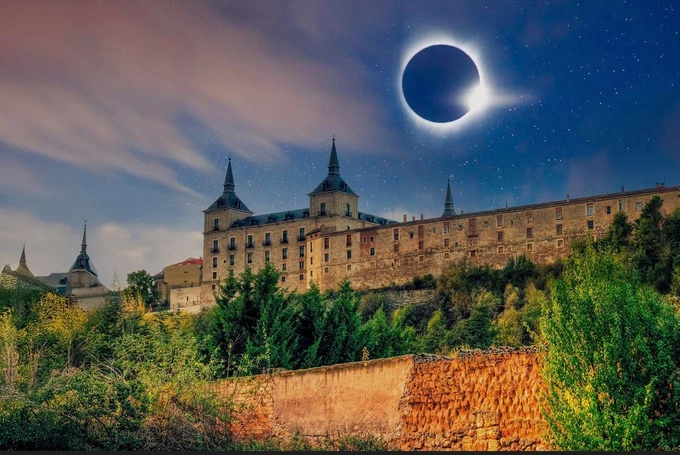
Illustration of the stone fortification Alcázar of Toledo in Spain during a total eclipse. Photo from Facebook
Mayor Óscar Castillo said the village lacks the infrastructure to safely manage the expected crowds.
“That road wasn’t built for thousands of vehicles in a single day, and a ‘limited’ access plan would require a traffic and emergency operation that a municipality like ours doesn’t have,” he said, adding that blocked roads could prevent emergency vehicles from reaching people in need, Forbes reported.
Castillo said he had asked Spain’s Guardia Civil to deploy officers on eclipse day, but no confirmation had been received.
“If reinforcements don’t arrive, I’ll close the road myself with stones or trailers.”
The route also passes through the UNESCO-recognized Valle del Cabriel Biosphere Reserve, where authorities are concerned about wildfire risks and environmental damage after recent wildfires forced hundreds of thousands of people to evacuate across Spain and France.
Spain welcomed 96.8 million foreign tourists last year, a 3.2% increase from 2024, making it the second most visited country globally, behind France with 105 million visitors.
Despite the vehicle ban, visitors will still be able to hike to the summit, and other viewing locations across the Sierra de Albarracín region will remain open. The eclipse also coincides with the village’s annual patron saint festival, when about 500 former residents return home.
“We’d rather have people who stay, who spend a few days living alongside us, than an avalanche of thousands of people for the minute and a half the eclipse lasts,” Castillo said.
Anyone planning to watch the eclipse should use certified solar eclipse glasses that meet the ISO 12312-2 international safety standard, according to Space.com. Viewers should also avoid using glasses that are scratched, damaged or otherwise worn, as they may not provide adequate eye protection.