

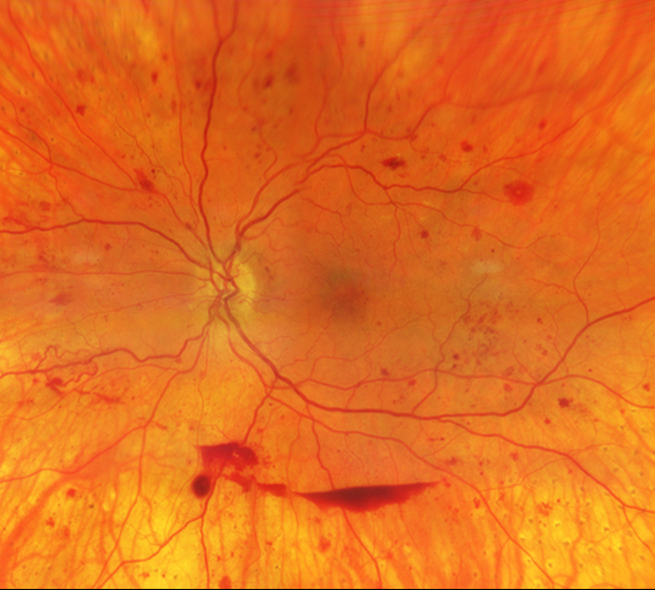
In patients with gout, elevated uric acid may contribute to retinal damage by increasing inflammation, oxidative stress and vascular dysfunction. Photo: Carolyn Majcher, OD. Click image to enlarge.
New research published in Graefe’s Archive for Clinical and Experimental Ophthalmology has found that urate-lowering therapy may reduce the risk of retinal complications, such as vitreous hemorrhage and diabetic macular edema, in patients with severe diabetic retinopathy and gout.
The retrospective cohort study used a virtual patient database, identifying patients with type 2 diabetes and comparing those with and without a diagnosis of gout. The analysis excluded patients with pre-existing diabetic retinopathy, other retinal diseases that could affect outcomes (i.e., AMD and retinal vein occlusions) and those with less than one year of follow-up. The final cohort came out to 21,707 patients in each group. The authors also performed a secondary analysis of 3,425 matched patients with severe nonproliferative and proliferative diabetic retinopathy to better understand the effects of urate-lowering therapy.
Over five years, patients with gout were more likely to develop nonproliferative and proliferative diabetic retinopathy, vitreous hemorrhage, diabetic macular edema and neovascular glaucoma than matched controls. They were also more likely to require intravitreal injections, panretinal photocoagulation and pars plana vitrectomy. However, gout was not associated with a higher risk of tractional retinal detachment or subtenon injections.
Among patients with advanced diabetic retinopathy and gout, those receiving urate-lowering therapy had a relative risk of 0.59 for vitreous hemorrhage, 0.81 for diabetic macular edema, 0.78 for intravitreal injections and 0.44 for pars plana vitrectomy compared to patients who did not receive any therapy. The therapy was not associated with significant differences in tractional retinal detachment, neovascular glaucoma or panretinal photocoagulation.
The researchers suggested that elevated uric acid may contribute to retinal damage because it increases inflammation, oxidative stress and vascular dysfunction. “These findings,” wrote the researchers in their paper, “highlight the importance of close monitoring of this patient population,” adding that prospective studies are needed to determine whether earlier gout treatment can help reduce diabetic retinopathy complications.
Click here for the journal source.
This article was developed by the editorial staff in conjunction with experts in the field. In the process, AI may have been among the editorial tools used to meet the goals of human editors, who approved all content.