
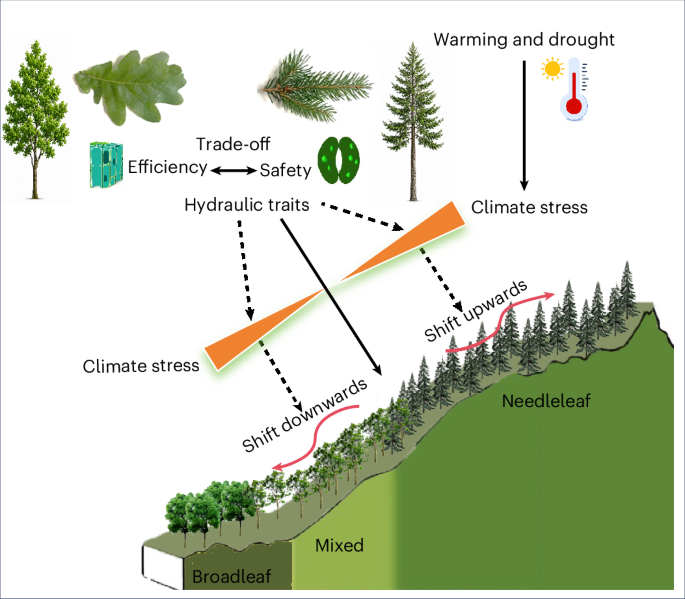
Sayre, R. et al. A new high-resolution map of world mountains and an online tool for visualizing and comparing characterizations of global mountain distributions. Mt. Res. Dev. 38, 240–249 (2018).
Urban, M. C. Climate change extinctions. Science 386, 1123–1128 (2024).
Rahbek, C. et al. Humboldt’s enigma: what causes global patterns of mountain biodiversity?. Science 365, 1108–1113 (2019).
Lawlor, J. A. et al. Mechanisms, detection and impacts of species redistributions under climate change. Nat. Rev. Earth Env. 5, 351–368 (2024).
Antão, L. H. et al. Climate change reshuffles northern species within their niches. Nat. Clim. Change 12, 587–592 (2022).
Lu, X., Liang, E., Wang, Y., Babst, F. & Camarero, J. J. Mountain treelines climb slowly despite rapid climate warming. Glob. Ecol. Biogeogr. 30, 305–315 (2021).
Lenoir, J. et al. Species better track climate warming in the oceans than on land. Nat. Ecol. Evol. 4, 1044–1059 (2020).
Chan, W. P. et al. Climate velocities and species tracking in global mountain regions. Nature 629, 114–120 (2024).
Rumpf, S. B. et al. Range dynamics of mountain plants decrease with elevation. Proc. Natl Acad. Sci. USA 115, 1848–1853 (2018).
Freeman, B. G., Lee-Yaw, J. A., Sunday, J. M. & Hargreaves, A. L. Expanding, shifting and shrinking: the impact of global warming on species’ elevational distributions. Glob. Ecol. Biogeogr. 27, 1268–1276 (2018).
Thurman, L. L. et al. Persist in place or shift in space? Evaluating the adaptive capacity of species to climate change. Front. Ecol. Env. 18, 520–528 (2020).
Stahl, U., Reu, B. & Wirth, C. Predicting species’ range limits from functional traits for the tree flora of North America. Proc. Natl Acad. Sci. USA 111, 13739–13744 (2014).
Anderegg, W. R. L. et al. Hydraulic diversity of forests regulates ecosystem resilience during drought. Nature 561, 538–541 (2018).
Bauman, D. et al. Tropical tree growth sensitivity to climate is driven by species intrinsic growth rate and leaf traits. Glob. Change Biol. 28, 1414–1432 (2022).
Sanchez-Martinez, P. et al. Increased hydraulic risk in assemblages of woody plant species predicts spatial patterns of drought-induced mortality. Nat. Ecol. Evol. 7, 1620–1632 (2023).
Cuapio-Hernández, L. et al. Is there a response pattern between radial growth of trees and elevation gradient?. Tree-Ring Res. 79, 12–26 (2023).
Sigdel, S. R. et al. Moisture-mediated responsiveness of treeline shifts to global warming in the Himalayas. Glob. Change Biol. 24, 5549–5559 (2018).
Leuschner, C. & Meinzer, F. C. Drought resistance and drought adaptation of Douglas-fir (Pseudotsuga menziesii)—a review. Perspect. Plant Ecol. Evol. Syst. 65, 125829 (2024).
Klesse, S. et al. No future growth enhancement expected at the northern edge for European beech due to continued water limitation. Glob. Change Biol. 30, e17546 (2024).
Millar, C. I. & Stephenson, N. L. Temperate forest health in an era of emerging megadisturbance. Science 349, 823–826 (2015).
Ma, J. et al. Most high mountainous areas around the world present elevation-dependent aridification after the 1970s. Earth’s Future 12, e2023EF003936 (2024).
Anderegg, W. R. L., Anderegg, L. D. L., Kerr, K. L. & Trugman, A. T. Widespread drought-induced tree mortality at dry range edges indicates that climate stress exceeds species’ compensating mechanisms. Glob. Change Biol. 25, 3793–3802 (2019).
Chen, I. C., Hill, J. K., Ohlemuller, R., Roy, D. B. & Thomas, C. D. Rapid range shifts of species associated with high levels of climate warming. Science 333, 1024–1026 (2011).
Marchin, R. M. et al. Extreme heat increases stomatal conductance and drought-induced mortality risk in vulnerable plant species. Glob. Change Biol. 28, 1133–1146 (2021).
Zu, K. et al. Changes in species’ elevational range limits and range sizes uncovered by herbarium specimens. New Phytol. 251, 868–880 (2025).
Osmolovsky, I., Xirocostas, Z. A., Chiarenza, G. M. & Moles, A. T. Counterintuitive range shifts may be explained by climate induced changes in biotic interactions. Glob. Change Biol. 31, e70332 (2025).
Zhang, X. et al. A higher tissue fraction of parenchyma in secondary xylem supports growth recovery of angiosperm trees after drought. Funct. Ecol. 38, 2709–2719 (2024).
Guo, F., Lenoir, J. & Bonebrake, T. C. Land-use change interacts with climate to determine elevational species redistribution. Nat. Commun. 9, 1315 (2018).
Elsen, P. R., Monahan, W. B. & Merenlender, A. M. Topography and human pressure in mountain ranges alter expected species responses to climate change. Nat. Commun. 11, 1974 (2020).
Chytrý, K. et al. Limited impact of microtopography on alpine plant distribution. Ecography 2024, e06744 (2023).
Sanczuk, P. et al. Unexpected westward range shifts in European forest plants link to nitrogen deposition. Science 386, 193–198 (2024).
Bell, D. M., Bradford, J. B. & Lauenroth, W. K. Mountain landscapes offer few opportunities for high-elevation tree species migration. Glob. Change Biol. 20, 1441–1451 (2014).
Lyu, S. & Alexander, J. M. Competition contributes to both warm and cool range edges. Nat. Commun. 13, 2502 (2022).
Augusto, L. et al. Widespread slow growth of acquisitive tree species. Nature 640, 395–401 (2025).
Snethlage, M. A. et al. A hierarchical inventory of the world’s mountains for global comparative mountain science. Sci. Data 9, 149 (2022).
Bunn, A. G. et al. Dendrochronology program library in R. R package dplR version 1.7.1 (2020).
R Core Team R: A Language and Environment for Statistical Computing (R Foundation for Statistical Computing, 2020); https://www.R-project.org/
Friedman, J. H. A Variable Span Smoother (Stanford Univ., 1984).
Zhang, X. zhxianliang/Hydraulic-Trait-Governs-Opposing-Range-Shifts-of-Montane-Trees-Under-Warming: Hydraulic Traits Governs Opposing Range Shifts of Montane Trees Under Warming. Zenodo https://doi.org/10.5281/zenodo.20723572 (2026).
Kattge, J. et al. TRY plant trait database—enhanced coverage and open access. Glob. Change Biol. 26, 119–188 (2020).
Harris, I., Osborn, T. J., Jones, P. & Lister, D. Version 4 of the CRU TS monthly high-resolution gridded multivariate climate dataset. Sci. Data 7, 109 (2020).
Zhang, X., Rademacher, T., Liu, H., Wang, L. & Manzanedo, R. D. Fading regulation of diurnal temperature ranges on drought-induced growth loss for drought-tolerant tree species. Nat. Commun. 14, 6916 (2023).