
Astronomers hunt black holes at the center of a galaxy, not its edge, because that is where the heavy ones have always been found.
A flare anywhere else usually means an exploding star, and sky surveys have passed those over for years.

One of those flares came from a black hole about a million times the mass of the Sun.
It was tearing apart a star roughly 30,000 light-years from the center of its galaxy. Yet nothing else is visible at that location – no smaller galaxy and no cluster of stars.
Every search pointed at galaxy centers
Theorists have expected to find black holes out there for years. When two galaxies collide, not every black hole settles into the new center. Some could be left far out toward the edges.
Catching one is the hard part. A black hole with no gas falling into it gives off no light. Most are dormant like that, including the one at the Milky Way’s center, so a telescope has nothing to record.
A star that strays close enough to one gets pulled apart, and the shredded gas glows for months. That flare has a name: a tidal disruption event. Almost every one on record came from a galaxy’s center.
“What’s new is that, until now, we’ve started with the assumption that supermassive black holes reside in the centers of massive galaxies,” said Suvi Gezari, a co-author at the University of Maryland (UMD).
A flare that got hotter, not fainter
The Zwicky Transient Facility uses two telescopes in San Diego County to photograph the entire northern sky every two days.
The cameras record hundreds of thousands of changing objects a night, more than any team could check.
Robert David Stein, lead author on the publication, had already built a program that sorts flares by how their light changes from night to night.
He and his colleagues rebuilt it to judge flares anywhere in an image, not only at galaxy centers. The new version went live in August 2025.
The program picked this one out on November 4, 2025. Its light was hotter than about 18,000°F (9,900°C), and it was a poor match for an exploding star. It was also heating up by roughly 160°F (89°C) a day, while a supernova cools.
Stein’s team then measured broad bands of hydrogen and helium in the flare’s light, at the same distance as the galaxy. Those features settled the case for a shredded star.
Stein works at the Joint Space-Science Institute, which the University of Maryland runs with NASA’s Goddard Space Flight Center. His team reported the discovery on July 27.
A million suns in a giant’s outskirts
The galaxy itself is big. Its stars add up to the mass of roughly 150 billion Suns, and the black hole at its center weighs the equivalent of around 660 million Suns.
The one that tore this star apart is several hundred times lighter. Stein’s team put its mass near that of a million Suns, working from how bright the flare got at its peak.
The direct way to weigh one is to watch how stars move around it, and nobody has done that here. Anything from about 360,000 to 4 million Suns fits.
Astronomers measured that 30,000 light-years as it appears from Earth, so the real distance could be greater still. The whole case rests on that single flare.
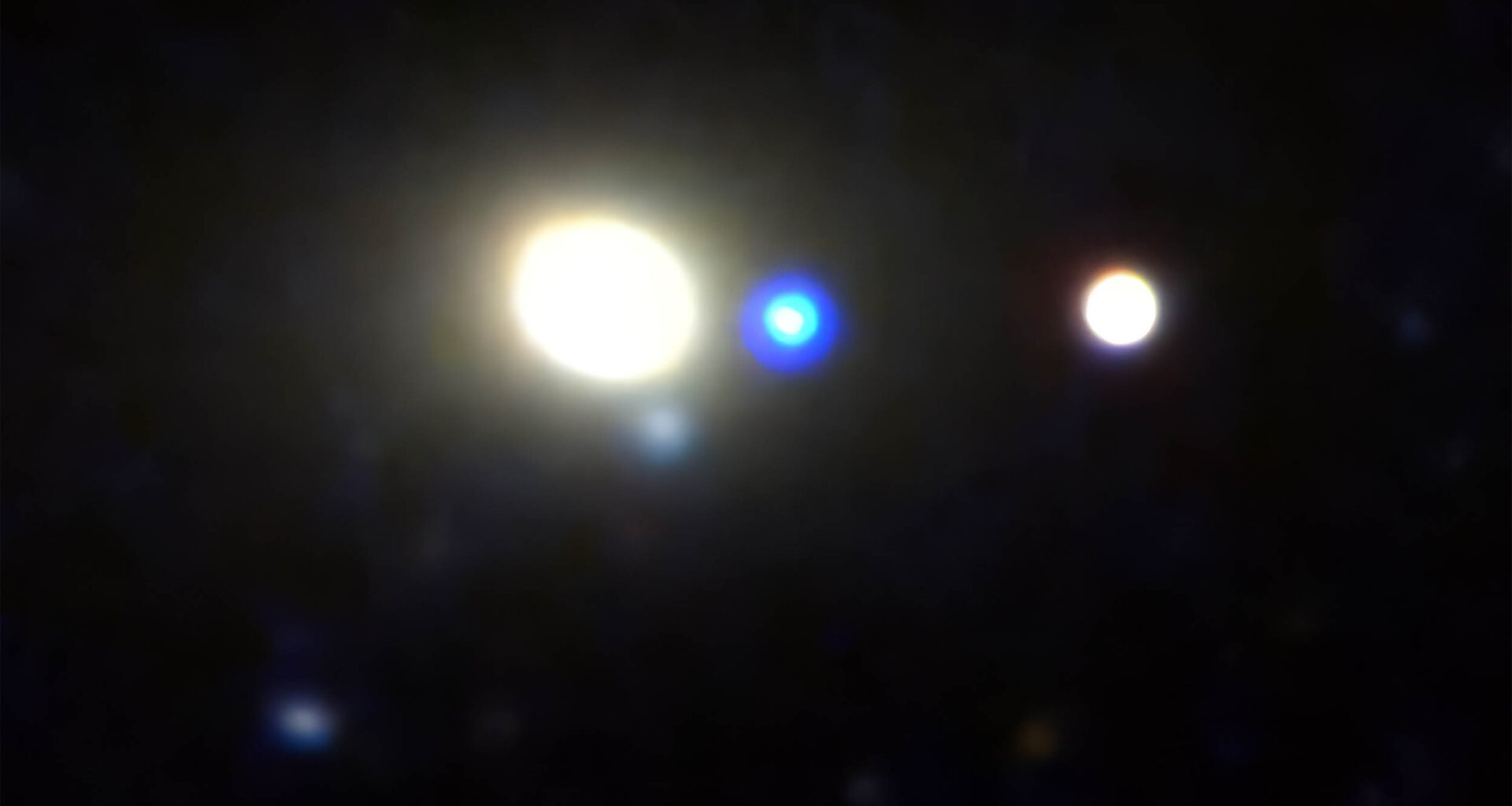
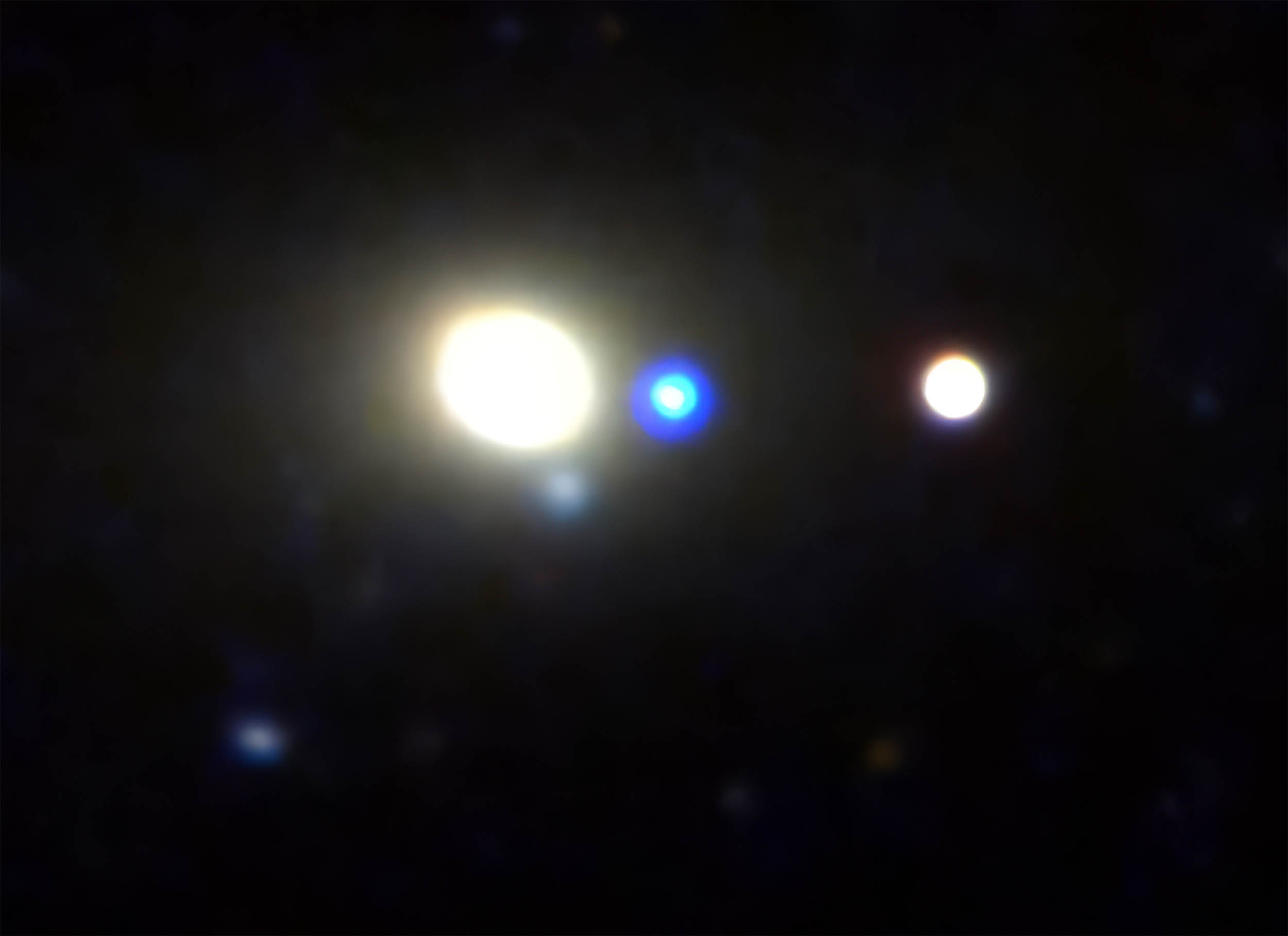 A supermassive black hole revealed itself with a flash of light, shown at the center of this image in blue, as it wandered the edge of a galaxy. Credit: Robert David Stein. Click image to enlarge.Nothing visible where the flare was
In deep images of that patch, nothing appears where the star died, down to the faintest object the cameras catch.
Stein’s team ruled out any bright dwarf galaxy around the black hole. Four faint smudges appear south of the big galaxy, and the flare went off at none of them.
“To have such a big black hole outside of a galaxy is surprising to me,” said Sylvain Veilleux, an astronomy professor at Maryland. “There should be a Milky Way-like object around it – and that’s definitely not the case.”
Astronomers had traced one earlier flare to an off-center black hole in 2024, about 2,600 light-years from its galaxy’s core.
X-ray surveys have added a handful of other candidates. One of them is in a merging pair of galaxies, tens of thousands of light-years from either center.
Thrown out, or the core left behind
Stein’s team put forward two histories, and both begin with a collision. In one, a bigger galaxy pulled a smaller one apart and slowly stripped its stars, leaving the dense core with its black hole inside.
That smaller galaxy would still be coming apart now, and whatever is left of it would be too faint for the cameras to catch.
In the other, two black holes were already circling each other at a galaxy’s center. A third arrived from another merger, the three pulled on one another, and the lightest was thrown clear.
Astronomers cannot tell the two scenarios apart from this flare alone. Stein and his colleagues expect later observations to favor one history over the other, as the flare fades.
Dozens more from the Rubin survey
For every hundred flares at a galaxy’s center, fewer than ten happen this far out. That is an upper limit, and one flare cannot narrow it.
Pinning down the 2024 flare took sharper images from other telescopes, and that kind of observing time is scarce. A separation this wide is obvious in ordinary survey pictures.
No one has yet spotted one out past the Milky Way’s own disk.
Chile’s Vera C. Rubin Observatory began a ten-year survey of the southern sky in June.
Stein expects the survey to turn up many dozens of these off-center flares a year – each one with a gap wide enough to measure.
The full study was published in the journal The Astrophysical Journal Letters.
—–
Like what you read? Subscribe to our newsletter for engaging articles, exclusive content, and the latest updates.
Check us out on EarthSnap, a free app brought to you by Eric Ralls and Earth.com.
—–