
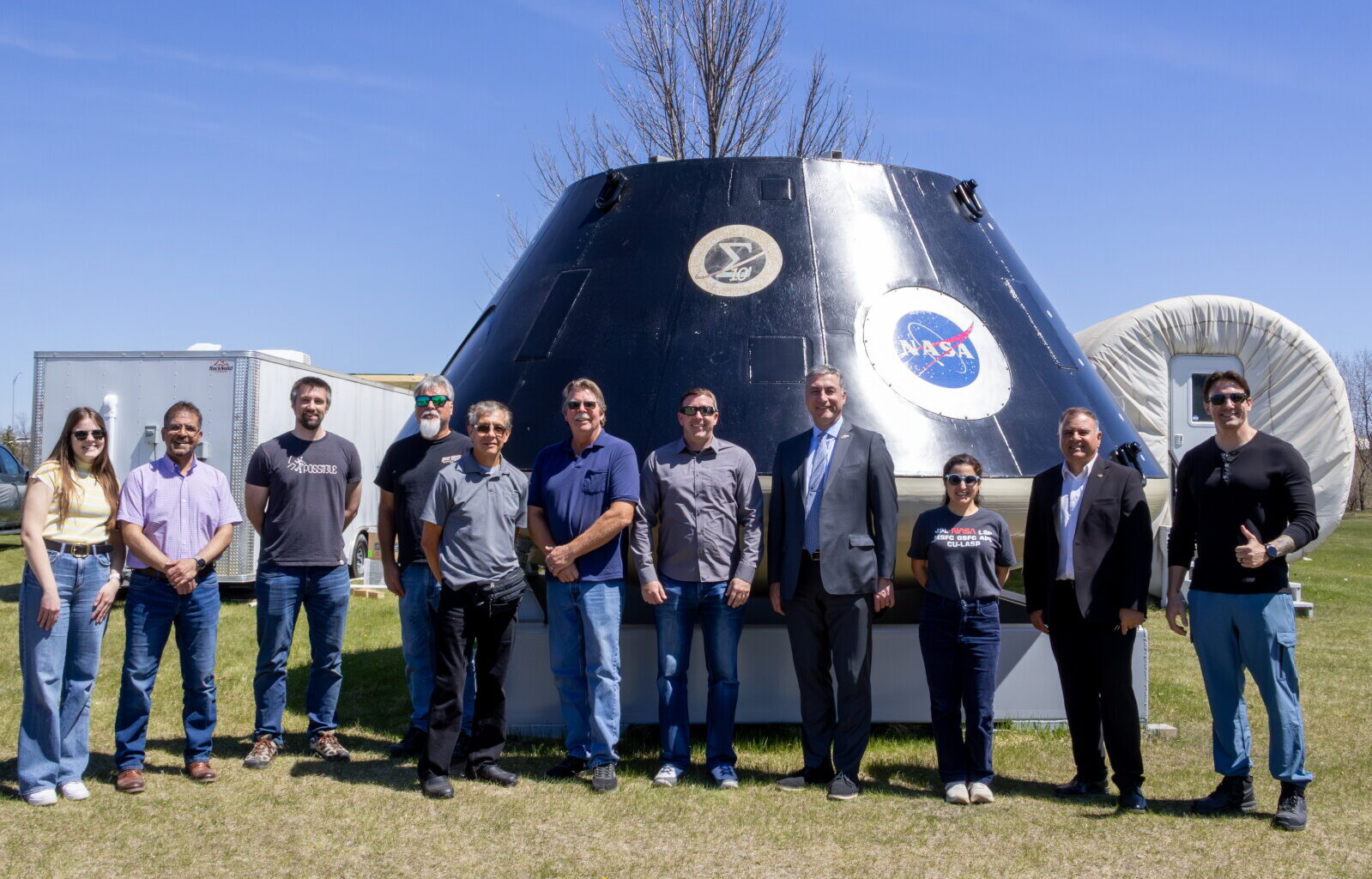
GRAND FORKS — A project at the University of North Dakota, in collaboration with NASA, aims to test a method of wastewater purification that could help astronauts orbiting the moon or living on a future lunar base reuse their water and reduce the costs and risks that come with trying to transport water from Earth to its natural satellite.
Pablo de León, professor and chair of UND’s Department of Space Studies, said it’s a critical part of a lunar base that many people might overlook.
“On the moon you have resources, you have water,” he said. “One of the questions is how you reclaim all that water and how to reuse it. … It’s a remarkable system, because imagine the amount of water that you have to transport all the time to space if it was a waste system that you just tossed away.”
UND was chosen by NASA to test a mobile wastewater treatment system built at NASA’s Kennedy Space Center in Florida. The Divergent Deployable Wastewater Treatment Facility was brought to UND in May and connected to the Integrated Lunar/Martian Analog Habitat. For the next three years, UND will test the system with ILMAH’s analog crews.
De León said Space Studies, the Department of Chemical Engineering and the Kennedy Space Center have been working together on the project, with Ali Alshami, associate professor of chemical engineering, being the principal investigator.
The system is different from the one on the International Space Station, which purifies 97% of the water that goes through it. De León said the ISS system is air dependent and relies on changing membranes and bringing filters in to keep it operational, which means transporting items like the filters from Earth to the ISS. While the ISS is in Earth’s orbit, the moon is farther away, making it more expensive to transport anything to a possible lunar base.
The test system looks into other ways of purifying wastewater, as well as turning solid waste into a safe fertilizer that can be used later for plant production systems on a future lunar base.
“Not all the food that the astronauts will consume on the moon will come from Earth,” De León said. “Some will have to be produced on the moon.”
If it’s successful, the system could become the prototype for the system astronauts use for liquid and solid waste on an American lunar base.
ILMAH’s four-person graduate student crews will test the system during their missions. Four analog missions are conducted per year, ranging from two weeks to up 30 days.
De León said ILMAH is one facility of only a few in the world where people can do space simulation, with ILMAH specifically focused on moon and Mars conditions.
“NASA selected UND because of this facility that we put together here,” he said. “It’s like my child, because I designed it myself, so I’m happy to see that this is being considered by NASA.”
Delaney Otto covers higher education for the Grand Forks Herald.

Otto is the University of North Dakota reporter for the Grand Forks Herald.