
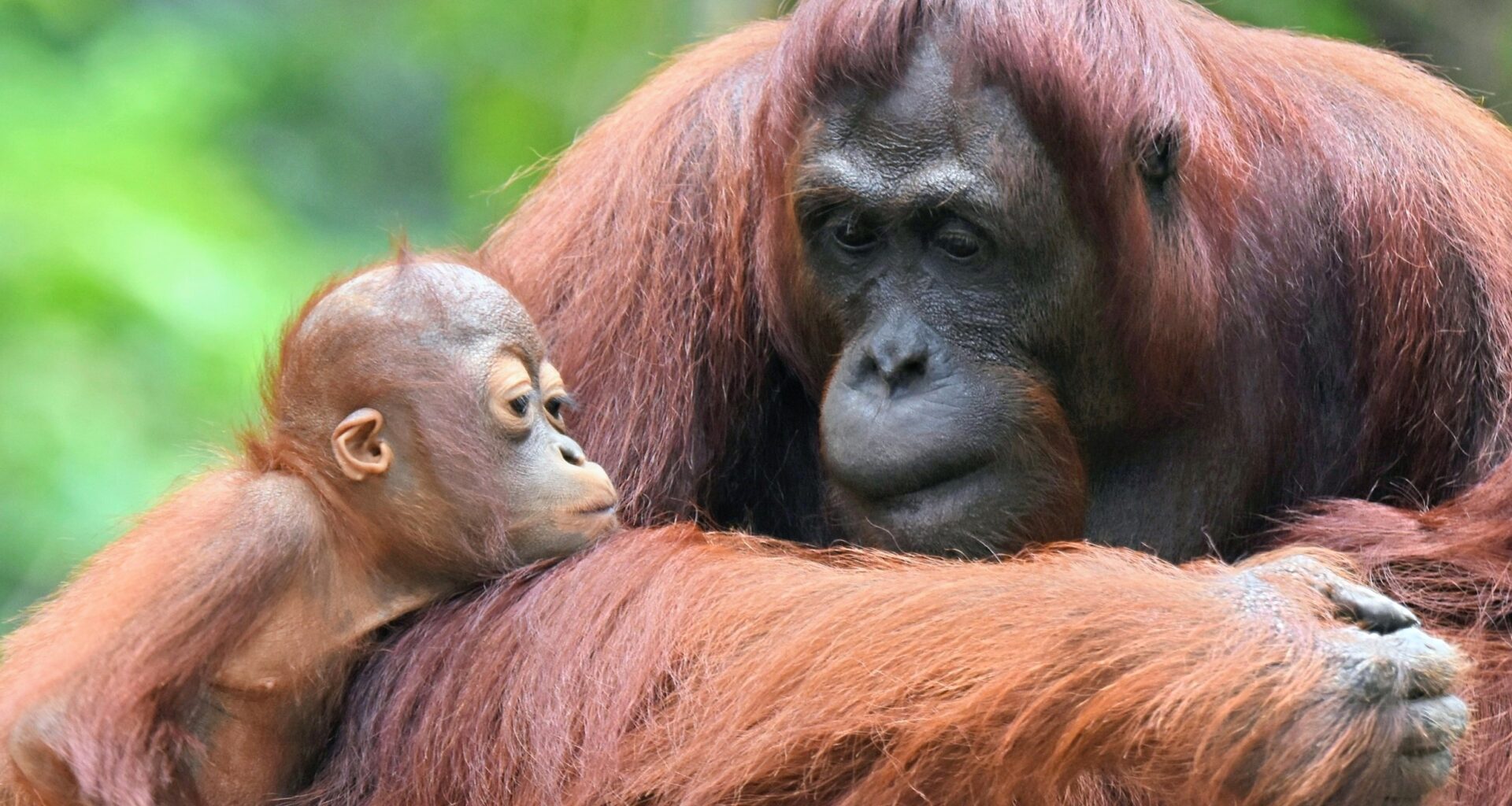
Orangutans are known for living more solitary lives than other great apes.
Adult female orangutans usually travel through the forest alone with their young instead of living in large groups. That makes one part of growing up harder.

Young orangutans rarely meet others their own age, even though playing together helps them learn how to move, behave with others, and handle their emotions.
A new long-term analysis of wild Bornean orangutans suggests that mothers may help solve this problem.
The mothers changed their travel routes so their young could play with another orangutan. These trips took extra time and energy.
Play helps young orangutans grow
For young animals, play is more than simple fun. Playing with another youngster may help them practice skills they may use later in life.
This is easy for animals that grow up in groups because play partners are nearby.
Orangutans live differently, and female Bornean orangutans spend much of their time alone with one dependent youngster.
That means another infant may be far away. A mother may travel toward another female so their young can play together.
The team wanted to know whether orangutan mothers actually make those kinds of changes. They also wanted to see whether the extra social time came with a cost.
Fifteen years of observations
The team used data collected at Tuanan Research Station in Central Kalimantan, Indonesia.
Observers followed wild Bornean orangutan mothers and their young through the forest and recorded where they went and what they did.
The records covered 15 years and more than 32,000 hours of observation. The analysis included 31 young orangutans born to 14 mothers.
Observers recorded location, feeding, social contact, and play. They also tracked whether mothers were spending time near other orangutans.
This gave the team a detailed picture of daily life over many years. It also allowed them to compare ordinary days with days when young orangutans met and played.
Similar ages mattered
Young orangutans that were closer in age played together more often. This makes sense because young orangutans of the same age are often similar in size and development.
The pattern remained even after the team considered other factors, including how closely related the mothers were and how much fruit was available.
The mothers also used shared parts of the forest more often when their young were similar in age.
Female orangutans have their own home ranges, but those areas can overlap with the ranges of neighboring females.
The mothers did not appear to move into completely new areas or enlarge their usual ranges. Instead, they spent more time in places that already overlapped with the range of a useful social partner.
Playtime costs mothers time and energy
Social visits were not free for the mothers. On days when they spent time near another orangutan, they traveled farther and spent less time feeding.
The difference became stronger when the young actually played. On those days, mothers traveled even farther and fed less than they did on days when they were near another orangutan but no play happened.
That suggests the extra effort was linked to creating or maintaining a chance for the young to play. The mothers were not simply paying the normal cost of being around another adult.
This matters because orangutans live with limited energy. Mothers care for each youngster for years, so changes in daily travel and feeding may be important over time.
Mothers begin traveling before playtime
The strongest clue came from what happened before and after play. Mothers did not only move differently on the day their young met a playmate.
They also tended to travel farther the day before a play event. Their movement was directed toward the central part of the other mother’s range.
After the young had played, the mothers shifted their travel back toward the central part of their own range. This pattern suggests that the meeting was not always a random encounter.
The authors say the movements are consistent with mothers actively seeking social opportunities for their young across more than one day.
Still, the work cannot prove what an orangutan was thinking or whether a mother consciously planned a play session in advance.
Mothers help create social opportunities
The findings show that a mostly solitary animal can still have an important social life.
Orangutan mothers may spend long periods without other adults, but they still appear to keep track of nearby females and their young.
The results also point to a form of maternal care that is easy to miss. Mothers do not only feed, carry, protect, and teach their young. They may also help create chances for them to meet another youngster.
That effort can come at a cost. More travel means more energy used, while less feeding means less time spent taking in food.
The team also found that play happened more often when fruit was more available. That does not prove that extra food caused more play, but it suggests that social time may be easier when feeding conditions are better.
Long-term benefits are still unknown
The analysis was based on observations, not an experiment. The team watched what the animals did but did not control where they moved or when they met.
Because of that, the results show a strong pattern but cannot prove that mothers were deliberately arranging play in the same way a human parent might.
Future work will need to find out whether playing with others helps young orangutans as they grow older.
The research was led by team from the Max Planck Institute of Animal Behavior, the University of Zurich, and Universitas Nasional.
The study is available as a preprint on bioRxiv.
—–
Like what you read? Subscribe to our newsletter for engaging articles, exclusive content, and the latest updates.
Check us out on EarthSnap, a free app brought to you by Eric Ralls and Earth.com.
—–